
When business owners ask about the cost of social media management, there’s no single, clean answer. It's a spectrum. For a local Franklin, TN, coffee shop just needing a vibrant presence on Instagram, you might be looking at around $500 a month. But for a larger real estate firm with multiple offices across Middle Tennessee that needs a full-blown strategy, video tours, and constant lead-gen ad campaigns, that number can easily jump to $5,000 or more.
What You Are Really Paying For

It's tempting to think you're just paying for someone to post updates, but that's only a tiny piece of the puzzle. A better way to think about it is like building a custom home. You could grab a standard, pre-made blueprint—it's predictable and gets the job done. Or, you could hire an architect to create a custom design that perfectly suits your lot, your family, and your vision. The price tag naturally reflects that level of expertise and customization.
Social media management is the exact same. You're investing in building your brand's digital home. The final cost depends on how complex the "build" is. Are you just putting up the basic framework (posting content), or are you also handling the interior design (creating stunning graphics and videos), landscaping (engaging warmly with your community), and setting up a security system (analytics and reporting)?
A Snapshot of Monthly Investment Levels
To give you a clearer picture, let's break down what businesses of different sizes typically invest each month for a positive return.
| Business Profile | Typical Monthly Cost | Common Services Included |
|---|---|---|
| Small Business / Solopreneur | $500 – $2,500 | Content creation for 1-2 platforms, scheduling, basic reporting. |
| Mid-Sized Company / Clinic | $2,500 – $7,500 | Management of 3-4 platforms, strategy, ad management, community engagement. |
| Large Organization / Enterprise | $5,000 – $15,000+ | Full multi-platform strategy, video content, deep analytics, crisis management. |
These numbers aren't pulled out of thin air. Industry surveys show a similar spread, with about 52% of businesses reporting they pay somewhere between $100 and $5,000 per month for these services.
Ultimately, the goal isn't just to be "on" social media; it's to build a genuine presence that attracts and keeps customers. A big part of understanding the cost is moving past common misconceptions, like the myth of just posting daily. Once you see it as a strategic investment rather than a simple expense, you're on the right track to getting a real return.
Ready to see what a custom blueprint for your brand might look like? Let's talk. A quick call is all it takes to map out your needs and put together a quote that actually fits your goals.
Decoding Social Media Management Pricing Models
When you start looking into the cost of social media management, you'll quickly discover that agencies and freelancers don't all price their services the same way. Getting a handle on these different models is the first step to finding a partner that fits your goals and your budget.
Think of it like hiring someone for home repairs. You wouldn't keep a plumber on a monthly salary just to fix one leaky faucet, and you probably wouldn't pay a landscaper by the hour for a season's worth of yard work. The payment structure should match the job, and the same principle applies here.
You're going to run into three main pricing structures out in the wild. Each one has its own place, with distinct pros and cons depending on what your business actually needs.
The Hourly Rate Model
Paying an hourly rate is a lot like calling that plumber for a quick fix. You pay for the exact time spent on your tasks, whether that’s setting up a new profile, designing a handful of graphics, or training your internal team.
This model is perfect for short-term, specific jobs. It's a fantastic choice if you have a one-off task or need some specialized help for a limited time without getting locked into a long-term agreement. The only catch is that costs can get unpredictable if the scope of the work starts to grow, which could leave you with a surprisingly high bill.
For instance, a local clinic here in Tennessee might bring on a consultant at an hourly rate to get their Google Business Profile and Facebook page tuned up right before flu season. It's a specific task with a clear beginning and end.
The Monthly Retainer Model
The monthly retainer is the most common model you'll see for ongoing social media management, and there's a good reason for that. This is like putting a landscaping service on contract. You pay a set fee every month for a clearly defined scope of services, making sure your digital "front yard" is always looking sharp.
This approach gives you predictability and stability. You know exactly what you'll be spending, and your social media partner gets to know your brand inside and out over time, which leads to smarter, more effective work. It’s the way to go for businesses that are serious about consistent growth, community engagement, and long-term brand building.
That same clinic, after seeing some good results, could easily switch to a monthly retainer. This would ensure they're consistently sharing patient education, answering community questions online, and running small local ads to stay top-of-mind.
The Project-Based Fee Model
Finally, there’s project-based pricing. This is for a single, big-ticket item with a clear finish line. Think of this as your "patio build"—a one-time project with a defined scope, a set timeline, and a single flat fee to get it all done.
This model works great for specific campaigns, like a new product launch, promoting a major event, or a total social media account makeover. You get a clear, upfront cost for a specific result. The biggest thing to watch out for is "scope creep," where extra requests start piling up and lead to additional charges. So, make sure the project scope is buttoned up from day one.
If our Tennessee clinic decided to launch a brand-new telemedicine service, they might go for a project-based fee. This would cover the entire launch campaign—from creating intro videos and announcement graphics to running a targeted ad blitz for the first 90 days.
Research shows that pricing can vary significantly based on location and scope. For instance, New York-based agencies might charge $40-$190 per hour, while monthly retainers for small to mid-sized businesses often range from $1,000-$3,500 for managing multiple platforms. Learn more about the factors that influence social media management pricing to see how these numbers apply to your situation.
Choosing the right model really comes down to your immediate needs and your long-term vision. The better you understand these options, the better equipped you'll be to find a partner who aligns with your business goals and delivers real value for every dollar you invest.
Comparing Social Media Management Pricing Models
To make things even clearer, let's break down these three models side-by-side. Seeing the pros and cons in one place can help you quickly identify which structure makes the most sense for where your business is right now.
| Pricing Model | Best For | Pros | Cons |
|---|---|---|---|
| Hourly Rate | One-off tasks, short-term projects, or specialized consulting. | – High flexibility – Pay only for work done – No long-term commitment |
– Unpredictable costs – Can be expensive for ongoing work – Harder to budget for |
| Monthly Retainer | Consistent, ongoing social media management and long-term growth. | – Predictable monthly cost – Deeper brand partnership – Encourages strategic planning |
– Less flexible for one-off needs – Requires a longer commitment – May pay for unused hours in slow months |
| Project-Based Fee | A single, large-scale initiative with a clear objective and end date. | – Fixed, upfront cost – Clear scope and deliverables – Focused on a specific outcome |
– Inflexible if goals change – Risk of "scope creep" – Requires detailed initial planning |
Ultimately, there's no single "best" model—only the best model for you. Whether you need a quick tune-up (hourly), consistent care (retainer), or a major renovation (project), understanding these options is your first step toward a successful social media partnership.
Key Factors That Influence Your Final Price
So, why does one local business pay $1,000 a month for social media management while another, just down the street, invests $7,000? It’s not random. The final price tag is a direct reflection of the work, resources, and expertise needed to hit your specific goals.
Think of it like building a new car. The base model gets you from A to B, but the price climbs as you add the good stuff. A bigger engine (paid ad management), a custom paint job (video production), and a top-of-the-line navigation system (deep analytics) all add to the final cost. Each addition serves a purpose, tailoring your investment to get you exactly where you want to go.
Scope and Complexity of Services
The single biggest driver of your cost is the sheer scope of the work. A simple plan to post three times a week on Facebook is a world away from a multi-platform campaign that includes daily engagement, video content, and running targeted ads.
Here’s a breakdown of the service components that really move the needle on price:
- Number of Platforms: Managing a single Instagram account takes far less time than creating and adapting content for Instagram, Facebook, LinkedIn, and TikTok. Each network has its own audience, rules of engagement, and content formats.
- Content Creation Needs: The type of content you need is huge. A plan built on simple graphics and shared articles will cost less than one that requires professional photography, custom video shoots, or slick animations.
- Community Management: Is the agency just posting and ghosting, or are they actively talking to your audience? Responding to comments, answering DMs, and monitoring brand mentions in real-time takes dedicated hours and adds serious value—and cost.
For example, a nonprofit like the Tennessee Wildlife Federation might need social media to push its annual fundraiser and share conservation news. Their needs are critical but are often focused on specific campaigns and community updates.
A project like this, aimed at a clear outcome like event sign-ups, demands a sharp, targeted approach that's different from the day-in, day-out grind of brand management.
Contrast that with a multi-location medical practice. They’re playing a different game entirely. They need constant, HIPAA-compliant patient interaction, reputation management across multiple review sites, and geo-targeted ads to pull new patients into specific clinics. That level of complexity, risk, and strategic heavy lifting naturally commands a higher investment.
Strategy and Advertising Management
Beyond the daily to-do list, strategic oversight and paid advertising are the two factors that really separate a basic service from a true growth engine.
Strategic Planning
A real strategy is the blueprint for your success. This isn't just about posting. It's about initial research, digging into what your competitors are doing, building out your ideal customer profiles, and creating a content calendar that actually supports your business objectives. High-level strategy requires experience and is a key difference between a simple posting service and a genuine growth partner. For a deeper look, our friends at Semrush have great insights on how expert storytelling shapes a winning strategy.
Paid Ad Management
Running paid social media campaigns is its own specialized skill. The management fee for ads covers a lot of ground:
- Campaign Setup: Designing the ad creative and writing copy that gets people to click.
- Audience Targeting: Finding and reaching the exact people most likely to become customers.
- Optimization and Testing: Constantly watching ad performance and tweaking things based on data to squeeze more value out of every dollar.
- Reporting: Giving you clear, easy-to-understand reports on metrics that matter, like cost-per-click, conversions, and your return on ad spend.
It's important to remember that the ad management fee is separate from your actual ad spend—the money you pay directly to Facebook or Instagram. The more complex your campaigns and the larger your ad budget, the higher the management fee will be to reflect the increased responsibility and workload.
Understanding these drivers pulls back the curtain on the pricing you see in proposals. It equips you to have a smarter conversation about what you really need, making sure you invest in the services that will make the biggest dent in your bottom line.
Planning Your Budget Beyond the Management Fee
An agency's management fee is a great place to start, but it's really just one piece of the puzzle. If you want to get a true picture of your total investment in social media, you need to look past that initial number and plan for the other costs that actually fuel your results.
Think of it like planning a road trip. Your management fee is like the rental car cost—it's the main expense, sure. But you won't get very far without also budgeting for gas (your ad spend), toll roads (software tools), and maybe a few good meals along the way (professional content). Budgeting for everything upfront saves you from sticker shock later and makes sure you have what you need to actually reach your destination.
These aren't just "nice-to-haves." They're often the very things that turn a quiet social media page into a machine that actively brings in new leads.
The Power of Paid Advertising Spend
Let's be honest: getting seen organically on social media is tougher than ever. The most reliable way to get your message in front of the right people is with paid advertising. Your ad spend is the budget you give directly to platforms like Facebook, Instagram, or LinkedIn to boost your posts.
This is a totally separate line item from the management fee, which pays for the expertise to create, target, and tweak those ads. For a small business, it's pretty common to see a monthly budget of $500-$1,000 for management paired with another $500-$1,000 for the actual ad spend. Having a clear ad budget lets your agency pinpoint specific demographics, drive people straight to your website, and bring in leads you can actually measure.
This flowchart breaks down where the money typically goes in a social media campaign.
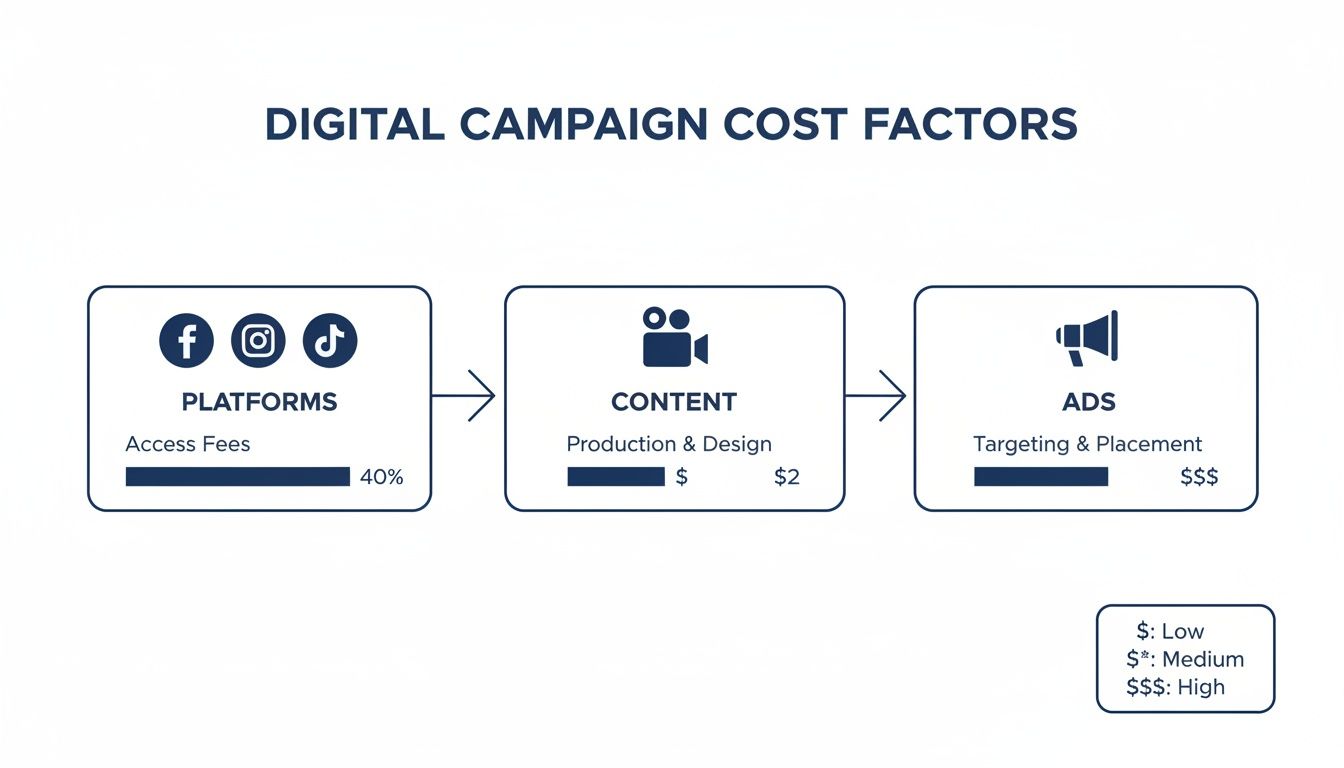
As you can see, while managing the platforms is the foundation, advertising is often the biggest variable—and the one that directly speeds up your growth.
Factoring in Content Creation and Tools
High-quality, professional content is what makes your brand look polished and trustworthy. While a management fee might cover basic posts, specialized assets usually need their own dedicated budget.
- Professional Photography & Videography: Stock photos are fine in a pinch, but nothing builds trust like authentic images of your team, your products, or your location. A one-time product photoshoot could run $300-$1,000, giving you a library of custom images to use for months.
- Specialized Software: Your agency will have its own set of tools, but sometimes a campaign needs something extra. This could be anything from an advanced analytics platform to an app for running a contest.
- Influencer Collaborations: Teaming up with local influencers can be a fantastic way to reach a new and engaged audience. When you're budgeting, it's smart to figure out how much to pay influencers so you can offer fair compensation for authentic promotion.
A Real-World Budget Example
Let's make this concrete. Imagine a small e-commerce business that sells handmade jewelry.
Their Total Monthly Social Media Investment:
- Management Fee: $1,500 (covers strategy, posting on two platforms, community engagement, and reporting)
- Ad Spend: $1,000 (dedicated to running targeted ads on Facebook and Instagram to drive sales)
- Content Production: $300 (a one-time photoshoot cost, averaged out over a few months)
Total Monthly Cost: $2,800
This breakdown shows how that initial $1,500 fee is just the starting point. The extra investment is what powers the whole strategy, making sure their beautiful jewelry actually gets seen by people who might buy it. This complete approach—expert management plus a solid ad and content budget—is what leads to real returns. It also connects your social media work to bigger marketing goals, helping to boost email clicks easily by sending targeted traffic to your sign-up forms.
When you plan for these extra costs from the beginning, you can have a much more strategic conversation with potential agencies. The question changes from "How much does this cost?" to "What can we achieve with this investment?"
How to Choose the Right Social Media Partner
Once proposals start landing in your inbox, the real work begins. It’s tempting to just skip to the bottom line, but the true value of a social media partner lies far beyond a monthly fee. Choosing the right one is less about picking the cheapest option and more about finding the team who will actually move the needle for your business.

The best proposals are clear, detailed, and speak directly to your business goals. They should feel less like a generic menu of services and more like a strategic plan built just for you. A great partner won't just list what they'll do; they'll show you how they plan to get you results.
Look Past the Price Tag
Let's say you're a local clinic owner and you get two different proposals.
-
Proposal A: $1,200/month. This one is pretty brief. It promises "social media management," "content creation," and "monthly reporting." The deliverables are vague, and there’s no mention of specific goals or how you'll know if it's even working.
-
Proposal B: $2,000/month. This one is a different beast entirely. It maps out a clear strategy for attracting new patients and defines specific key performance indicators (KPIs) like appointment inquiries generated from social media. It even includes case studies from similar clinics they've helped. They specify the number of posts, the type of content (patient testimonials, educational videos), and show you a sample reporting dashboard.
Proposal A is cheaper, sure, but it’s a total gamble. You don’t really know what you’re paying for. Proposal B costs more, but it gives you a clear roadmap to success. You’re not just buying posts; you’re investing in a strategy. That’s a crucial distinction when you’re evaluating the cost of social media management.
Scrutinize the Deliverables and Reporting
A trustworthy partner is an open book. Their proposal should clearly define every single aspect of the service, leaving no room for guesswork later on.
Key Questions to Ask:
- What exactly does "content creation" mean? Are we talking about custom graphics and professional video, or are you just going to be sharing articles from other sites?
- How often will you engage with our community? What’s the expected response time for comments and direct messages?
- What does your reporting actually look like? Can I see a sample? We need to see metrics that matter to our bottom line, not just vanity numbers like likes and followers.
A solid proposal will show you exactly what they mean. They won't just tell you they track results; they'll show you how they track them. This kind of specific, results-oriented thinking proves they understand how to connect their work to real business outcomes.
Verify Their Experience and Alignment
Finally, make sure the agency is a good fit for your specific world. Do they have experience in your industry? A partner who already understands the nuances of your business—whether it’s a nonprofit, a medical clinic with HIPAA concerns, or a local shop—can build a much more effective strategy right out of the gate.
The right partner doesn’t just execute tasks; they understand your vision and build a plan to get you there. They are transparent about their process, focused on measurable results, and have a proven track record of helping businesses like yours succeed.
When you make the right choice, you’re not just hiring a vendor. You’re gaining a strategic partner who is genuinely invested in your growth. This kind of partnership goes beyond social media, often connecting with all of your other digital efforts. To see how these pieces fit together, you can explore a full range of digital marketing services that can amplify your entire online presence.
Making the Right Investment with Confidence
Alright, we've covered a lot of ground. By now, you should have a much clearer picture of what goes into social media management costs. It’s not some arbitrary number pulled out of a hat; it’s a direct reflection of the time, skill, and strategic effort required to get you the results you’re after. The goal isn't to find the absolute cheapest deal. It’s about putting your money to work in a way that builds a powerful, unmissable presence for your brand.
Think about a local medical clinic investing $2,500 a month into their social media. They're not just paying for a few health tips to be posted. They're investing in a partner who gets the nuances of HIPAA compliance, who can build deep trust with potential patients through educational videos, and who knows how to run targeted ads that actually fill up the appointment book. That's where the real return is.
Your Bottom-Line Takeaways on Cost
As you start looking at proposals and making decisions, keep these fundamental truths in mind. They'll help you cut through the noise and make a smart choice that lines up with your real-world business goals.
- Price is Tied to Value: A higher price tag usually means a deeper strategy, better content, and more hands-on work managing your community and ads. You get what you pay for.
- Budget Beyond the Management Fee: A winning strategy needs fuel. That means having a dedicated budget for paid advertising and professional content like photos or videos in addition to the agency's retainer. This is non-negotiable for serious growth.
- The Right Partner is Obsessed with ROI: The best agencies don't get distracted by vanity metrics like likes and shares. They are laser-focused on delivering a measurable return on your investment, whether that means new leads, more sales, or a flood of patient inquiries.
At the end of the day, the cost of social media management is a direct investment in your brand's visibility, credibility, and connection with your community. When it's done right, it's not an expense—it's a growth engine.
Ready to Build Your Strategy?
You’re now armed with the knowledge to look at any proposal and understand exactly what you're paying for. The next step? Turning that knowledge into a concrete plan designed specifically for your business, your budget, and your unique finish line.
We're all about building partnerships that deliver clear, tangible results. Whether you're a small business trying to make your first real splash online or a clinic aiming to be the go-to expert in your town, we can build a strategy that gets you there.
Curious what that looks like for you? Let's talk. Reach out to us today for a personalized consultation. We’ll show you exactly how a smart social media investment can help you hit your business goals, no guesswork involved.
Answering Your Questions About Social Media Management Costs
When you start looking into social media management, the pricing can feel all over the map. That's normal. Let's clear up some of the most common questions business owners like you have when they're trying to figure out the budget.
How Much Should a Small Business Expect to Pay?
For a small business, a realistic budget is somewhere between $500 and $2,500 per month. It’s a wide range because the service really does scale to match what you want to achieve.
A budget near $500 is a great starting point. It typically covers the essentials like creating and scheduling content on one or two of your most important platforms, which is perfect for building a consistent presence. As you move into the $1,500-$2,500 range, you're investing in a more robust service—think managing 2-3 platforms, actively engaging with your community, monthly performance reports, and even managing a small ad budget. It all comes down to aligning the investment with your specific goals.
Is Paid Ad Spend Included in the Management Fee?
This is a big one: no, it's generally not. Your management fee pays for the expertise—the strategy, creative work, campaign management, and optimization needed to make your ads successful.
The ad spend itself is the money you pay directly to platforms like Facebook or LinkedIn to get your ads in front of people. Think of it like hiring a contractor to build a deck; you pay them for their labor and skill, but the cost of the lumber is a separate line item. A good agency will help you figure out a smart ad budget and then manage it for you to get the best possible results.
What Kind of ROI Can I Expect?
Return on investment (ROI) isn't always just about dollars and cents, especially at first. In the beginning, your ROI will show up as growth in brand awareness, more visitors to your website, and better engagement on your posts.
Over time, those early wins start turning into tangible business results like new leads, direct messages from potential customers, and actual sales.
For a local clinic, a clear ROI might be a full appointment book resulting from new patient inquiries sourced from Facebook. For a nonprofit, it could be a surge in event registrations or a successful fundraising campaign driven by Instagram. A great partner will help you define and track the specific KPIs that demonstrate a positive return for your business.
Can I Negotiate the Price of a Package?
While the core pricing is usually set based on the time and resources involved, there's almost always room to adjust the scope of work. This is where the real negotiation happens. Instead of just asking for a discount, have a conversation about the deliverables.
For example, if a proposal comes in a bit high, you could ask about modifying the plan. Maybe that means reducing the number of posts per week, concentrating on fewer platforms, or simplifying the type of content being created. A true partner will be happy to work with you to build a package that hits your most critical needs while fitting within your budget.
Feeling more confident about the investment? The next step is to see how a tailored strategy can fit your specific goals. At Studio Blue Creative, we build transparent, results-focused plans designed for businesses in our Tennessee community. Let's have a conversation and turn these numbers into a real-world plan for your success.
Ready to start? Contact us today for a no-obligation consultation.
Article created using Outrank