
In today's connected world, mobile app development for healthcare is about creating a powerful digital bridge between patients and providers. It’s the art and science of building specialized software for smartphones and tablets that makes healthcare more accessible, efficient, and personal. Imagine taking essential services like remote patient monitoring, booking appointments, or managing medications and putting them directly into the hands of the people who need them most. For your practice, this isn't just a trend; it's an opportunity to deliver a higher standard of care.
How Mobile Apps Are Transforming Patient Care
Imagine being able to support your patients long after they've left your office. That’s the reality mobile apps are bringing to healthcare. For a modern practice, a custom app isn't just a new tool; it’s a direct, consistent line to your patients. It helps you overcome the old limitations of in-person visits and solve real-world health challenges together, creating a partnership in their well-being.
Enhancing Patient Engagement and Outcomes
One of the greatest benefits of healthcare apps is their ability to keep patients actively involved in their own care. Instead of a few check-ins per year, patients can now engage with your practice every single day through a device they already use constantly.
This continuous connection creates real, measurable results:
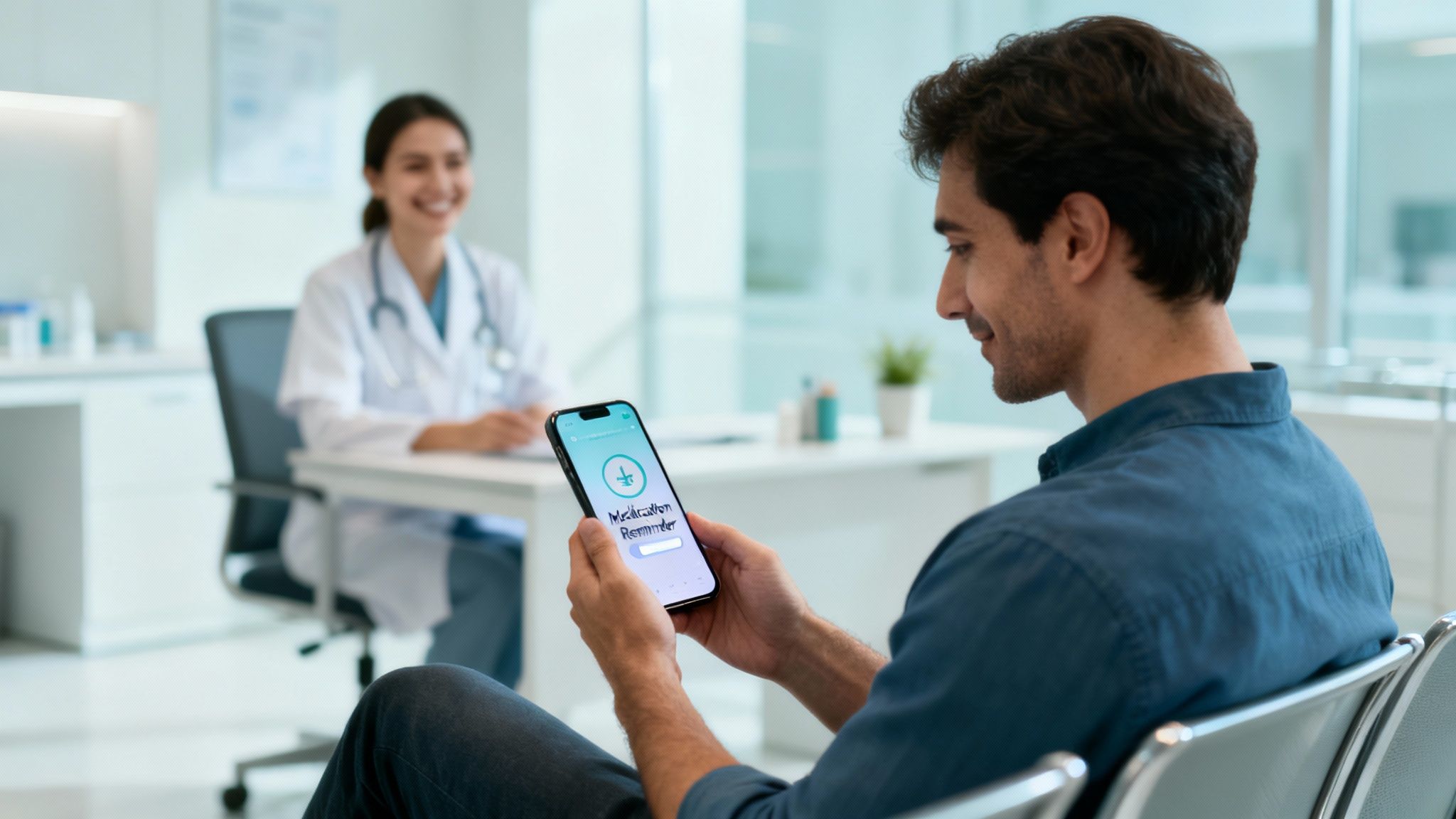
- Medication Adherence: An app like Medisafe can send simple, timely reminders for prescriptions. This small nudge makes a huge difference in helping patients stick to their treatment plans, improving outcomes for conditions from hypertension to HIV.
- Accessible Education: You can push curated health articles, how-to videos, and care instructions directly to your patients. For instance, a post-surgery app could share videos on proper wound care, empowering them with the knowledge to manage their recovery confidently.
- Proactive Monitoring: Patients with chronic illnesses like diabetes or hypertension can easily log their vital signs. The app tracks these trends, flagging potential issues for both the patient and your clinical team before they escalate into a serious health event.
Streamlining Administrative Tasks
It’s not just about the patient experience, either. These apps are workhorses behind the scenes, automating the tedious administrative tasks that can bog down your staff. A well-built healthcare app can handle appointment scheduling, send automated reminders, and manage intake forms, freeing up your team to focus on what they do best: providing exceptional care.
A custom app acts as a digital front door to your practice. It meets modern patient expectations for convenience while simultaneously reducing administrative burdens and improving clinical efficiency.
The market statistics tell the same story. The global mHealth apps market is on track to explode from roughly USD 37.5 billion to an incredible USD 86.37 billion by 2030. This boom is fueled by the simple facts that nearly everyone has a smartphone and needs better tools to manage long-term health. You can dig into the data on the mHealth market's impressive expansion to see the trend for yourself.
A custom healthcare app offers a powerful combination of benefits for both your practice and the people you serve. Here’s a quick breakdown of the value it delivers.
Key Benefits of Custom Healthcare Mobile Apps
| Benefit Area | Impact for Your Practice | Patient Advantage |
|---|---|---|
| Operational Efficiency | Automates scheduling and administrative tasks, reducing staff workload and operational costs. | Easy, self-service appointment booking and access to information 24/7. |
| Patient Engagement | Fosters a continuous connection, leading to better adherence and more proactive care management. | Feels more connected and supported in their health journey between visits. |
| Clinical Outcomes | Enables remote monitoring and data collection, providing a clearer picture of patient health over time. | Better management of chronic conditions with timely feedback and support. |
| Competitive Advantage | Differentiates your practice as modern and patient-centric, attracting and retaining more patients. | Access to a convenient, modern healthcare experience that fits their lifestyle. |
Ultimately, investing in a mobile app is about creating a more connected, responsive, and effective healthcare ecosystem for everyone involved. It’s a solution that can elevate your practice and improve lives.
Navigating the Compliance Maze of HIPAA and Data Security
In healthcare, patient trust is everything. And when it comes to mobile apps, that trust is built on a rock-solid foundation of security and compliance. Taking on a healthcare app project means you're accepting the profound responsibility of protecting sensitive patient data. This isn't just a best practice; it's governed by strict regulations like the Health Insurance Portability and Accountability Act (HIPAA).
Think of Protected Health Information (PHI)—names, diagnoses, test results, you name it—as the contents of a digital vault. HIPAA is the blueprint for that vault, laying out the precise security measures needed to keep that information safe. These rules are not optional. They're federal law, and falling short can lead to staggering penalties, sometimes hitting $1.5 million per year for willful neglect.
But this goes way beyond avoiding fines. A data breach can shatter your reputation overnight. That's why partnering with a development team that treats compliance as an afterthought is a risk you simply can’t afford. You need a team that builds security into every line of code, right from the very beginning.
The Pillars of HIPAA Compliance
To truly protect patient data, your app must be built on the core principles of HIPAA. These are broken down into specific safeguards that every healthcare app must have in place.
- Administrative Safeguards: These are the "people and process" rules. They include conducting regular risk assessments, training your staff on privacy policies, and appointing a dedicated security officer.
- Physical Safeguards: This is all about securing the actual hardware and software. For a mobile app, this means locking down the servers where data is stored, whether they're in your office or hosted in the cloud.
- Technical Safeguards: Here's where the technology shines. These are the built-in controls that protect PHI, like strong user authentication, access controls (so people only see what they're supposed to), and detailed audit logs.
A truly secure healthcare app doesn't just check boxes on a compliance list. It creates a secure ecosystem where data is protected at rest (on a server), in transit (as it moves across networks), and on the end-user's device.
This layered approach is critical; it ensures there are no weak links in your security chain. For instance, data encryption is completely non-negotiable. Using powerful standards like AES-256 for stored data and TLS for data being transmitted essentially scrambles the information, making it unreadable to anyone without the right keys.
Beyond HIPAA: Data Protection in a Global Context
While HIPAA is the law of the land in the United States, data privacy is a global conversation. If your app might be used by people in the European Union, it also needs to follow the General Data Protection Regulation (GDPR). While the specifics differ, many of the core data protection principles overlap. You can get a feel for these international standards in our guide on GDPR compliance for WordPress.
To really get a handle on the technical side, it's worth understanding the detailed HIPAA compliant software requirements that form the backbone of any secure app. Your development partner must be fluent in these rules.
Ultimately, building a compliant healthcare app requires more than just skilled programmers; it demands a partner who is a diligent steward of patient privacy. This commitment to security is what allows you to innovate with confidence, knowing your patients' trust is well-placed and their information is safe. It's the foundational work that separates a successful, widely-adopted app from one that’s a liability.
Designing for Both Patients and Clinicians
A truly effective healthcare app must speak two languages fluently. It must cater to the patient, who is often looking for clarity and convenience, while also serving the clinician, who needs efficiency and absolute precision. This doesn't mean building two different apps. It means creating one unified platform where the user experience (UX) is intentionally designed for each person's specific role. Nailing this balance is the secret to making a tool that actually gets used and valued by everyone involved.
For a patient, the app is their connection to their health journey. The experience has to be simple, reassuring, and completely intuitive. We've all dealt with confusing automated phone systems—they’re frustrating. A patient-facing app must be the exact opposite, smoothing out the process and empowering them to manage their care with confidence.
The Patient Experience: Simplicity Is Key
When designing for patients, the entire focus has to be on effortless interaction. They might be dealing with stress or an illness, and the last thing they need is a complicated interface. Every feature should answer a simple question or help them complete a task in just a few taps.
Here are a few core principles for patient-centric design:
- Clear Visuals and Language: You shouldn't need a medical degree to understand your lab results. For example, the Mayo Clinic app uses simple graphs, color-coding, and plain language to make complex information digestible.
- Effortless Navigation: Booking an appointment or refilling a prescription should feel as easy as ordering a coffee. A clean layout with obvious buttons is non-negotiable.
- Accessible Design: The app must be usable for everyone, including older adults or people with visual impairments. That means large fonts, high-contrast colors, and full compatibility with screen readers.
The goal of the patient interface is to reduce anxiety, not create it. Every screen, button, and notification should be designed with empathy, making healthcare feel more accessible and less intimidating.
The Clinician Experience: Efficiency Is Everything
While patients need simplicity, clinicians are driven by the need for speed and accuracy. Their workday is a high-stakes balancing act of multitasking and processing huge amounts of information. For them, a mobile app has to save time and reduce administrative headaches, not add another item to their to-do list. An inefficient app will be abandoned almost immediately.
This means designing a workflow that fits right into their established routines.
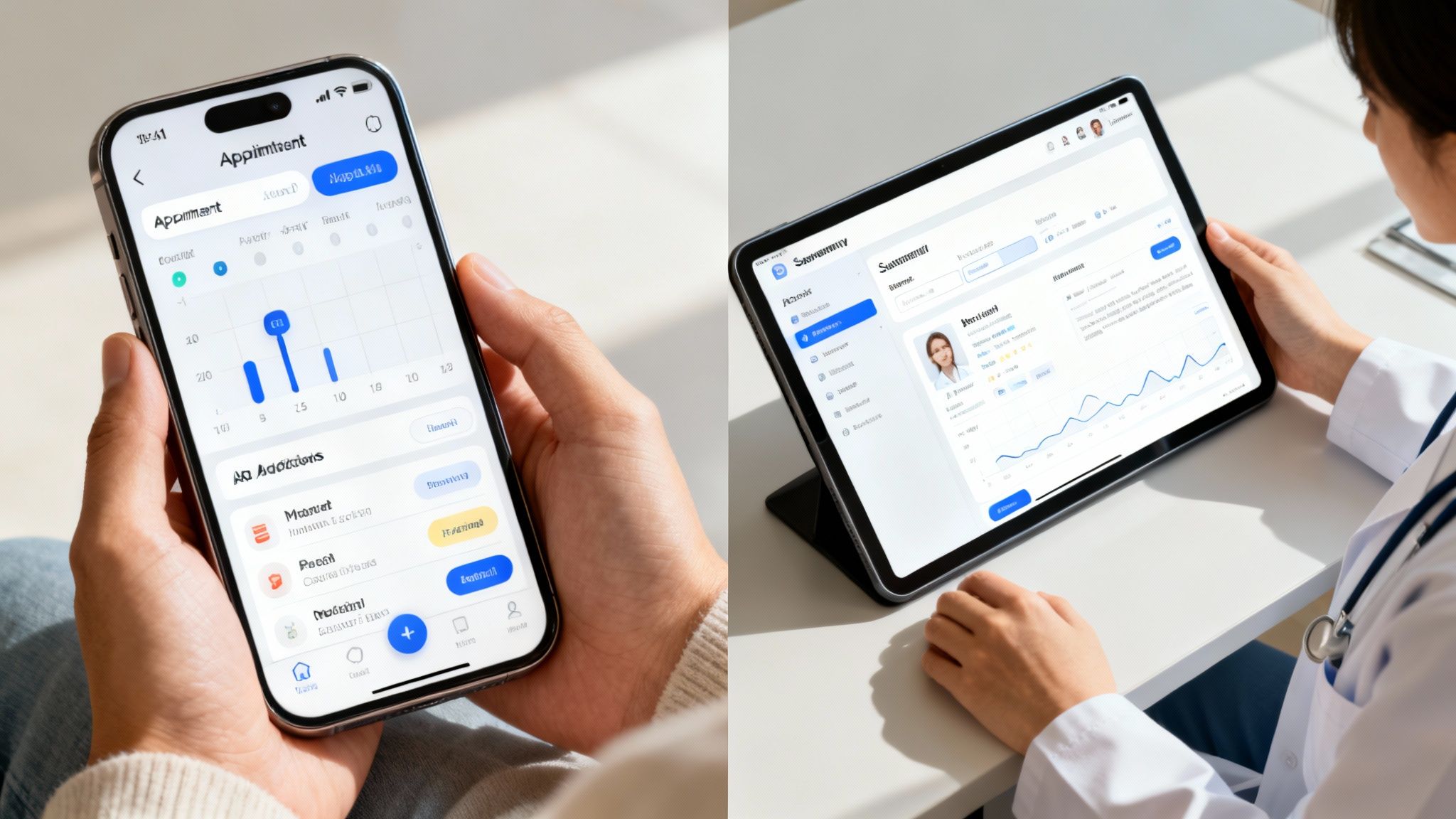
- At-a-Glance Dashboards: A clinician needs to see the most critical patient information instantly. A well-designed dashboard can summarize vital signs, upcoming appointments, and urgent messages on a single screen.
- Secure and Quick Communication: A secure messaging feature lets doctors and nurses coordinate care without having to use insecure channels like personal text messages.
- Streamlined Data Entry: Features like voice-to-text dictation or customizable templates can turn a tedious data entry task into a quick, efficient action.
The demand for health-related mobile apps is massive. While fitness and lifestyle apps often get the spotlight, the need for specialized medical tools is growing. As of a recent Q3 report, there were already 65,300 mHealth apps available on the Google Play Store alone, a number that continues to climb. You can discover more insights about the mHealth apps market to understand the scale of consumer demand. This crowded field makes it even more critical for dedicated medical apps to stand out with exceptional design.
Let's break down the different priorities for each user group.
Comparing Patient vs Clinician App Feature Priorities
| Feature Focus | Priority for Patients | Priority for Clinicians |
|---|---|---|
| User Interface (UI) | Simple, calming, and visually clear with large, easy-to-tap buttons. Minimalist approach. | Data-dense, efficient, and customizable. Dashboards showing critical info at a glance. |
| Core Functionality | Appointment scheduling, prescription refills, viewing lab results, secure messaging with care team. | Accessing patient charts (EHR/EMR), e-prescribing, charge capture, secure inter-team communication. |
| Data Presentation | Information is simplified and explained in plain language (e.g., graphs for vitals, definitions for terms). | Raw data, clinical notes, and historical trends are presented for quick, accurate decision-making. |
| Onboarding | A gentle, guided tour of the app’s key features. Quick and easy account setup is a must. | Minimal training required. The workflow should feel intuitive and mirror existing clinical processes. |
| Notifications | Reminders for appointments, medications, and messages from their doctor. Must be helpful, not intrusive. | Alerts for critical lab results, urgent patient messages, or consultation requests. Highly customizable. |
This side-by-side view makes it clear: while both groups use the same platform, their needs are fundamentally different. The patient needs empowerment through simplicity, while the clinician needs efficiency to deliver better care.
Ultimately, successful mobile app development in healthcare is about understanding that a single platform serves two distinct worlds. By designing with empathy for the patient's need for clarity and an appreciation for the clinician's need for efficiency, we can build digital tools that genuinely improve healthcare for everyone.
Choosing Your Tech Stack and Integrating with EHR Systems
The technology humming away behind the scenes of your healthcare app is every bit as important as the sleek, intuitive interface your patients and clinicians interact with. These foundational decisions about your tech stack will directly shape your budget, your timeline, and how well the app performs years down the road. Getting this right is about building an app that’s powerful, scalable, and ready to plug into the broader healthcare ecosystem.
One of the first big conversations we'll have is about native vs. cross-platform development. Let's use a simple analogy. Building a native app is like commissioning a custom-built car, engineered from the ground up to excel on a specific racetrack—say, iOS (Apple) or Android (Google). The performance is unmatched, and it takes full advantage of every feature of that specific environment.
Cross-platform development, on the other hand, is like building a high-performance all-terrain vehicle. You engineer it once, and it's designed to perform exceptionally well across multiple environments with only minor tweaks. For many healthcare apps, this approach is the smarter, more efficient route.
Native vs. Cross-Platform: A Practical Look
So, what does this mean for your project?
-
Native Apps: This path requires building two completely separate applications. One is for iOS, typically using Apple's Swift language, and the other is for Android, using a language like Kotlin. The upside is peak performance and immediate access to the device’s hardware (like advanced camera functions or biometrics). The downside? You're maintaining two codebases, which naturally takes more time and money.
-
Cross-Platform Apps: Frameworks like React Native or Flutter let our developers write the code once and deploy it on both iPhones and Android devices. Today's cross-platform tools are so sophisticated that they deliver a look, feel, and performance that’s nearly indistinguishable from a native app. This unified approach can cut costs by 25-30% and seriously accelerate your launch timeline—a massive win for practices wanting to get the most from their investment.
The right choice isn't about which technology is "best" in a vacuum. It’s about what’s best for your app. We'll help you align the technology with your specific clinical goals, budget, and the features you need to deliver.
The Real Powerhouse: EHR Integration
While the platform is a key decision, the most critical technical component is how your app connects with Electronic Health Record (EHR) systems. An app that can’t talk to major systems like Epic, Cerner, or Allscripts is essentially a digital island. It might look great, but its practical value is severely limited.
Seamless EHR integration is what elevates an app from a standalone novelty to an indispensable part of your clinical workflow. It’s the bridge that allows for the secure, real-time flow of crucial patient data—think lab results, medication lists, appointment schedules, and clinical notes.
How We Make the Connection: APIs and FHIR
So how does a mobile app actually "talk" to a hospital's massive EHR system? The magic happens through something called an Application Programming Interface (API).
Think of an API as a highly skilled, secure translator. Your app speaks one language, and the EHR system speaks another. The API acts as the go-between, translating requests and data back and forth so that both systems can understand each other perfectly, without ever exposing their underlying code.
To make this translation even more reliable and universal, a powerful standard called FHIR (Fast Healthcare Interoperability Resources) has become the gold standard. Pronounced "fire," FHIR is essentially a common language for exchanging health information.
Here’s why building with FHIR is a non-negotiable for modern healthcare apps:
- Standardization: It creates a consistent, predictable way for systems to share data, which slashes the time and complexity of integration.
- Developer-Friendly: It’s built on modern web standards that developers already know inside and out, making the development process faster and less error-prone.
- Flexibility: It’s designed to handle everything from patient demographics and insurance info to complex clinical observations, making it incredibly versatile.
By architecting your app around the FHIR standard, we’re not just building for today—we’re future-proofing it. Your app will be ready to connect with the vast majority of EHRs, making it a truly valuable and integrated tool in the patient care journey.
Getting these foundational tech decisions right is paramount. Partnering with a team that has lived and breathed both cross-platform development and secure EHR integrations is the most reliable way to build a healthcare app that works, scales, and delivers real value. Ready to figure out the right tech strategy for your vision? We would be happy to talk you through it.
From Concept to Launch: Your Development Roadmap
Bringing a healthcare app from a spark of an idea to a vital tool in the hands of patients and clinicians is a deliberate journey. This isn't a mysterious process; it's a structured roadmap we follow to make sure the final product is secure, effective, and achieves all of your goals. Knowing what this path looks like helps you stay in the driver's seat and feel confident in your investment.
To get your app built right, you need to understand the entire mobile app development lifecycle. Each phase logically builds on the one before it, which is how we create a rock-solid foundation for a reliable and compliant app.
Discovery and Strategy
This is the blueprint phase, and it’s the most important one. Before we write a single line of code, we work with you to nail down the core problem your app is meant to solve.
- Defining the "Win": We sit down with you to clearly define what success looks like. Is it about reducing no-shows, helping patients stick to their medication schedule, or boosting engagement?
- Understanding Your Users: We get into the heads of your target users. We need to know the specific pain points of a clinician rushing between appointments or a patient managing a chronic illness at home.
- Prioritizing for Impact: We map out a focused feature set for a Minimum Viable Product (MVP). The goal is to launch with the features that deliver real value right away, creating a strong foundation for future enhancements.
Design and Prototyping
With a clear strategy in hand, we start shaping what the app will actually look, feel, and act like. We create interactive wireframes and high-fidelity prototypes that let you click through the app's entire workflow long before the real development starts. This step is absolutely crucial for getting early feedback and making sure the final design is second nature for both patients and medical staff.
A well-defined roadmap turns a complex project into a series of manageable steps. It provides transparency and predictability, ensuring the development process stays on track, on budget, and fully aligned with your clinical objectives from start to finish.
Secure Development and Rigorous Testing
Once the design gets the green light, our development team starts building. In healthcare, security isn't just a feature—it's baked into the very foundation of the code. We build in robust encryption, secure authentication, and strict access controls to lock down sensitive patient data at every turn.
At the same time, our quality assurance team is trying to break it. Their testing is exhaustive and covers all the bases:
- Functionality Testing: Does every single button and feature work exactly as designed?
- Security Audits: We actively hunt for vulnerabilities to ensure the app is HIPAA compliant and secure.
- Usability Testing: We put the app in front of real users to make sure it’s genuinely easy to navigate.
The mHealth app market is booming, especially for managing chronic diseases like diabetes. Healthcare providers are jumping on board at a 27.8% CAGR, launching their own apps to keep patients engaged and meet the growing demand for personalized care.
This flowchart gives you a simple look at how your app will talk to existing EHR systems securely.
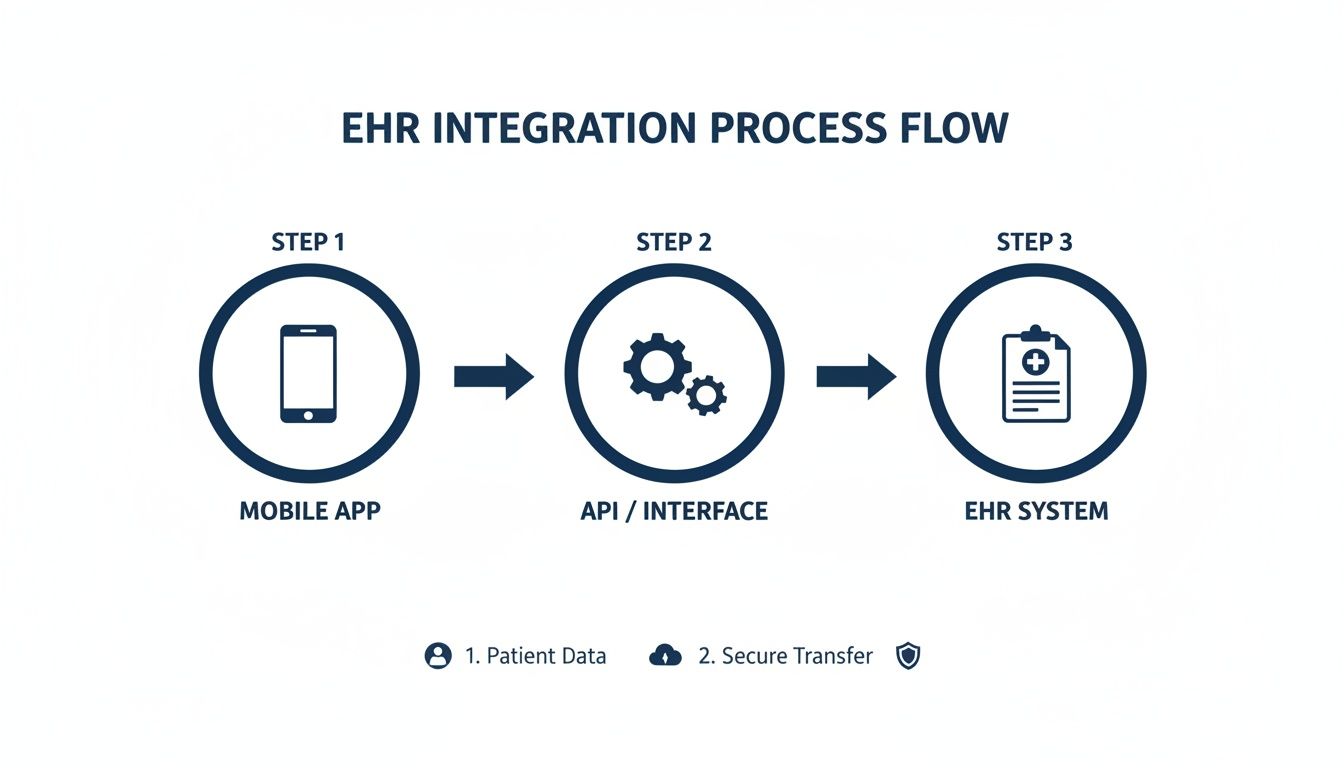
It all hinges on a secure API that acts as a translator, allowing patient data to flow seamlessly and safely between the app and the core medical record.
Deployment and Ongoing Maintenance
The final hurdles are getting the app into the Apple App Store and Google Play Store and then making sure it stays healthy for the long run. We handle the entire submission process, which has its own unique set of rules for healthcare apps.
Of course, just launching isn't enough. You need a solid plan to get noticed. That's where our guide with 9 tips for using app marketing to stand out in app markets comes in handy.
After launch, our work continues. We provide ongoing maintenance to push security updates, monitor performance, and adapt to any changes in compliance, ensuring your app stays effective and trustworthy long after its debut.
Ready to Bring Your Healthcare App to Life?
We've covered a lot of ground, from the big-picture goals all the way down to the specifics of HIPAA compliance and EMR integration. You now have a solid roadmap for what it takes to build a mobile app that truly serves patients and clinicians. The next move is turning that blueprint into a real, working tool for your practice.
This is where having the right partner becomes crucial. You don't just need a developer; you need a team that understands the weight of building technology for healthcare. It’s about finding people who have been in the trenches, who know how to build secure, user-friendly, and compliant solutions that solve actual problems in a clinical setting.
From a Great Idea to a Practical Tool
We believe the best technology shouldn't feel like technology at all. It should feel like a seamless part of your workflow—something that just works to improve patient outcomes. That’s why our entire process is built around a close partnership, making sure the final product is a perfect fit for your goals, your team, and your budget.
A successful healthcare app isn’t just about code; it’s about a clear vision and an expert partner. When you focus on solving a real problem for your patients or staff, you create a tool that delivers undeniable value and elevates the standard of care.
At Studio Blue Creative, our specialty is translating ambitious healthcare ideas into polished, practical digital products. We’re with you from the first brainstorming session through launch and beyond, providing the deep technical know-how and strategic guidance needed to get it right. And while the app is the main event, it's part of a larger picture; our article on the cost of social media management shows how we think about the entire digital ecosystem.
Let's Build Something That Matters
This journey doesn't have to be overwhelming. We’re here to bring clarity and confidence to every step, helping you build an app that will define the future of your practice. Whether you have a fully-formed plan or just the spark of an idea, our team is ready to listen.
Let's talk about what's possible.
Ready to see how we can help? Contact our team today for a no-obligation consultation. We’d love to help you build a mobile app that makes a genuine difference for your staff and the patients who depend on you.
A Few Common Questions
When you're thinking about building a healthcare app, a few practical questions always come up. It's only natural to wonder about the real-world costs, timelines, and what truly makes an app successful. Let's tackle the most common questions we get from healthcare leaders.
We want to give you the clarity you need to move forward with confidence. Think of this as the final piece of the puzzle, pulling together the key ideas we've covered so you can take that next step.
How Much Does It Cost to Develop a Healthcare App?
There's no single price tag for a healthcare app, as the cost is tied directly to its complexity. Every project is unique. The final number really depends on the specific features you need, the platforms you're targeting (iOS, Android, or both), and how intricate the integrations are—especially with EHR systems.
A simpler app with just the core features might start in the low five figures. But if you’re looking at a more complex application with real-time data synchronization, advanced security, and deep EHR integration, the investment will be significantly higher. We always start with a discovery phase to map everything out, ensuring we provide a transparent, detailed quote that lines up perfectly with your budget and clinical goals.
How Long Does the Development Process Take?
On average, a healthcare mobile app project can take anywhere from 4 to 9 months from start to finish. Of course, highly sophisticated solutions with extensive compliance hurdles and complex integrations might take longer. Several things influence the timeline, including how deep the feature set goes, how rigorous the security and compliance testing needs to be, and the complexity of any third-party system integrations.
To make sure everyone's on the same page, we create a realistic project roadmap right from the beginning. This detailed schedule outlines every single stage—from initial design and prototyping to development, testing, and launch—so you always know exactly what’s happening and when.
What Is the Most Important Factor for a Successful mHealth App?
While the technology, compliance, and features are all crucial, the single most important factor for success is a deep and empathetic understanding of the end-user's needs. Whether your app is for patients managing a chronic illness or clinicians trying to make their workflow less chaotic, its real value is measured by how well it solves a genuine problem for them.
An app that isn't intuitive, secure, and genuinely useful will fail to gain traction, no matter how advanced its technology is. A relentless focus on the user experience—making tasks simpler, information clearer, and processes more efficient—is what truly guarantees success and leads to better health outcomes.
Your journey into healthcare innovation starts with a conversation. At Studio Blue Creative, we specialize in turning complex healthcare challenges into practical, secure, and user-friendly digital solutions. Let's discuss how we can build the future of your practice together.
Article created using Outrank