
If you're looking to generate leads online, the journey begins not with a flashy ad campaign, but with a quiet, focused effort to understand two things: who your ideal customer is and why your business is their best possible choice.
This means creating a detailed buyer persona that feels like a real person and crafting a compelling Unique Value Proposition (UVP) that clearly sets you apart. Once you have this foundation, every strategy you implement will be more targeted, efficient, and successful in attracting and converting the right people for your business.
Building Your Foundation for Lead Generation
Jumping into advertising or content creation without a solid plan is like building a house on sand. Before you invest your time or money, laying the proper groundwork ensures that every subsequent effort is focused and effective.
This foundational stage is what transforms marketing from guesswork into a predictable system for attracting high-quality leads. It all comes down to answering two simple questions: who are you trying to reach, and why should they choose you?

Defining Your Ideal Customer Persona
Knowing your audience goes far beyond basic demographics. A truly effective buyer persona is a semi-fictional sketch of your perfect customer, built from real data and thoughtful insights. It’s about understanding their goals, challenges, and where they spend their time online.
Let's consider a real-world example: a local medical clinic in Jackson, Tennessee, specializing in non-surgical pain management. Their target audience isn't just "people with back pain." That's far too broad.
A more useful and actionable persona might look like this:
- Name: "Active Andy," age 45-60.
- Pain Points: He's dealing with chronic lower back pain that prevents him from playing golf or gardening. He's wary of surgery and wants to avoid becoming dependent on pain medication.
- Online Behavior: He uses Google to search for terms like "back pain relief without surgery near me" and reads health blogs in his spare time. He's also a member of local community Facebook groups, where he might ask for provider recommendations.
- Goals: His primary goal is to return to his active lifestyle and find a trustworthy local provider who understands his concerns about invasive treatments.
This level of detail changes everything. Now, the clinic can tailor every blog post, ad, and social media update to speak directly to "Active Andy's" specific hopes and fears.
Crafting Your Unique Value Proposition
Once you know who you're talking to, you need to give them a compelling reason to choose you. Your Unique Value Proposition (UVP) is a clear, concise statement that communicates the primary benefit you offer, how you solve your customer's problem, and what makes you different from the competition.
It answers the crucial question: "Why should I buy from you instead of someone else?" Your UVP should be prominently displayed on your website and landing pages.
For our Tennessee clinic, a weak UVP is simply "We Treat Back Pain." A strong UVP, aimed directly at "Active Andy," would be: "Get Back to Your Active Life. We offer advanced, non-surgical pain relief in Jackson, TN, so you can avoid the risks of surgery and medication." This statement resonates perfectly with his fears and aspirations.
A strong Unique Value Proposition is the cornerstone of your lead generation efforts. It connects your ideal customer's problem directly to your unique solution, making their decision to engage with you a natural next step.
Ensuring Your Website Is Ready for Traffic
Finally, your digital home base must be in order. Attracting visitors is pointless if your website provides a frustrating experience. Before launching any campaigns, ensure your site is:
- Fast Loading: A site that takes longer than three seconds to load will lose a significant number of potential leads.
- Mobile-Friendly: The majority of online searches happen on mobile devices. Your website must function flawlessly on a small screen.
- Easy to Navigate: A visitor should be able to quickly find the information they need and understand how to contact you within seconds.
These foundational elements—your audience persona, a clear UVP, and a technically sound website—are essential for anyone serious about learning how to generate leads online. With this groundwork in place, you are ready to build the rest of your lead-generating machine. You might explore how to generate leads on social media to turn brand awareness into actual conversions.
Creating High-Value Content to Attract Your Audience
The old methods of aggressive selling and interruption are no longer effective. Modern lead generation is about being genuinely helpful. The strategy is simple but powerful: solve your audience’s problems first, and you will earn their trust—and, in time, their business.
Content marketing is your most valuable tool for achieving this. The goal is to shift from chasing customers to creating a resource so useful that they are naturally drawn to you. By consistently publishing helpful, relevant content, you establish authority and create a magnetic brand presence, transforming your website from a static brochure into an inbound lead generation engine that works around the clock.

Building Your Content Strategy Around Your Audience
A successful content strategy begins with understanding what your ideal customers are actually searching for. Keyword research is the key to unlocking this information. Instead of guessing what people want to read, you can use data to discover the exact questions, pain points, and topics they are typing into Google.
Tools like Google Keyword Planner or Ahrefs can reveal the specific phrases your audience uses daily. For example, a local Tennessee nonprofit focused on conservation might find that people are searching for "native plants for TN gardens" or "local hiking trail cleanups."
This insight is invaluable. Instead of writing a generic post about their mission, they can create targeted articles like "A Guide to Planting Native Wildflowers in West Tennessee" or "Join Our Next Harpeth River Cleanup Event." This content directly answers a real person's question, draws them to the website, and immediately positions the nonprofit as a helpful local expert.
A Real-World Example of Content in Action
Consider a financial advisory firm in Franklin, Tennessee, that wanted to attract more young professionals as clients. Their existing marketing was broad and wasn't connecting with this specific demographic.
We helped them develop a content strategy based on keyword research around financial questions relevant to 30-somethings. They began publishing a series of educational blog posts on topics like:
- "How to Maximize Your 401(k) in Your 30s"
- "A First-Time Home Buyer's Financial Checklist for Williamson County"
- "Balancing Student Loan Repayment and Retirement Savings"
Each article provided clear, actionable advice. By optimizing these posts for search engines, they started appearing on the first page of Google for relevant local searches. The results were outstanding. Within six months, their website traffic from organic search increased by 150%, and consultation requests from their target demographic tripled. They didn't sell; they educated. The leads naturally followed.
The Power of the Lead Magnet
Once you've attracted visitors with valuable content, you need a way to continue the conversation. A lead magnet—a free, high-value resource offered in exchange for an email address—is the perfect tool for this.
A lead magnet must be so compelling that a visitor feels they are getting an excellent deal. Generic "sign up for our newsletter" offers are no longer sufficient. The key is to provide a targeted solution to a specific problem.
A great lead magnet is an irresistible bribe that offers a quick win. It solves a very specific problem for your ideal customer, giving them an immediate taste of the value you provide and making them eager to hear more from you.
The data confirms this approach. Content marketing is a leading channel for generating leads online, responsible for over 51.5% of all lead acquisition. Furthermore, 91% of B2B companies report that content marketing generates more leads than traditional methods. This is a game-changer, allowing businesses to gain visibility without a massive ad budget. You can read the full research about these lead generation statistics to see just how effective this strategy is.
Choosing the Right Lead Magnet for Your Business
The best lead magnet depends on your business and your audience. A simple checklist may be perfect for a busy professional, while a detailed eBook will appeal to someone conducting in-depth research. The goal is to match the format to your audience's immediate needs.
Here is a table illustrating how different lead magnets can work for various businesses.
Effective Lead Magnet Ideas for Different Businesses
| Lead Magnet Type | Best For | Real-World Example |
|---|---|---|
| Checklists | Service-based businesses, consultants, B2B | A home inspector offering a "New Homebuyer's Pre-Offer Inspection Checklist." |
| eBooks or Guides | Healthcare, finance, complex B2B services | A financial advisor providing a free guide titled "5 Strategies to Prepare for Retirement in Tennessee." |
| Webinar Access | Software companies, marketing agencies, training providers | A digital marketing agency hosting a live webinar on "How to Use Google Business Profile to Get More Local Customers." |
| Templates | B2B, creative services, professional services | A web design firm offering a downloadable "Website Content Planning Template" for small businesses. |
By thoughtfully creating and promoting these high-value resources, you build a reliable system for converting anonymous website visitors into qualified leads, making your content a central pillar of your business growth.
Getting Your Offer in Front of the Right People
Creating an excellent offer and a polished landing page is a great start, but it's only half the battle. The most valuable content is useless if your ideal customers never see it. The next step is to strategically drive the right kind of traffic to your website. This is about knowing where your audience spends their time online and meeting them there with a relevant message.
A multi-channel approach is almost always the most effective. Think of it as building several bridges to your business. By using a mix of platforms—like search, social media, and email—you create a resilient system that delivers a steady stream of quality prospects rather than relying on a single source of visitors.
Mastering Local SEO for Immediate Impact
For most Tennessee-based businesses, healthcare practices, and nonprofits, the most valuable leads are located right in your community. This is where local search engine optimization (SEO) becomes a powerful tool. The objective is simple: when someone nearby searches for the services you offer, you want your business to be at the top of the search results.
Your most important tool for this is your Google Business Profile (GBP). It acts as your business's storefront on Google Search and Maps, and a fully optimized profile can drive phone calls, website clicks, and foot traffic directly to you.
Let's use a real-world example of a physical therapy clinic in Jackson, TN. To optimize their GBP, they would:
- Ensure Accuracy: Verify that their address, phone number, and business hours are 100% correct.
- Use Specific Categories: Instead of a generic "Healthcare," they should use precise categories like "Physical Therapy Clinic" or "Sports Medicine Clinic."
- Encourage Patient Reviews: Positive reviews are a significant trust signal and a key factor in local rankings.
- Post Regular Updates: Sharing photos of the clinic, announcing new services, or posting health tips keeps the profile fresh and signals to Google that the business is active.
By focusing on these local signals, the clinic makes it incredibly easy for someone in Jackson searching "physical therapist near me" to find them first. For a deeper dive, explore our complete guide to local SEO best practices.
Strategic Paid Advertising for Targeted Reach
Organic growth through SEO is essential for long-term success, but sometimes you need to generate leads immediately. This is where paid advertising, or pay-per-click (PPC), comes in. Platforms like Google Ads allow you to place your business directly in front of people who are actively searching for a solution.
The key to a positive return on investment (ROI) is precision. Avoid wasting your budget on broad campaigns. Instead, focus on specific, long-tail keywords that indicate a user is ready to take action. For instance, a nonprofit focused on animal adoption would see far better results by bidding on "rescue dogs for adoption in Memphis" than on a vague term like "dogs."
Treat your paid ad budget like a strategic investment, not just another expense. Success isn't about getting the most clicks; it's about targeting the right audience with the right message, turning those clicks into qualified leads you can actually measure.
Leveraging Social Media and Influencer Marketing
Social media is more than just a place to post updates—it’s a powerful lead generation tool. It's where you can engage in real conversations, build a community, and run highly targeted ad campaigns.
Imagine a small e-commerce brand in Nashville that sells handmade leather goods. They could combine several social media tactics to significantly boost their online sales:
- Targeted Facebook Ads: They could run ads showcasing their best-selling wallet, targeting users in Tennessee who have shown an interest in "handmade goods," "leather wallets," or "local artisans."
- Authentic Influencer Collaborations: Instead of a major celebrity, they could partner with a few Nashville lifestyle bloggers. These influencers have smaller but highly engaged local followings that trust their recommendations, driving authentic traffic to the brand.
- Engaging Instagram Content: They could use Instagram Stories to offer behind-the-scenes looks at their crafting process and run a giveaway where users must tag a friend to enter, organically expanding their reach.
This combination of paid and organic social media activity creates a powerful growth cycle. The data supports this: 68% of marketers say social media generates more leads for their business, and 93% of brands have acquired a new customer from a video on social media. When done correctly, these campaigns can turn local followers into loyal customers.
Optimizing Landing Pages to Convert Visitors Into Leads
Every ad, social media post, and email you send directs potential customers toward a critical moment of decision on your landing page. This is the digital handshake where a curious visitor decides whether to become a tangible lead for your business.
Think of your landing page as a focused conversation with a single objective. Unlike your homepage, which serves multiple purposes, a landing page is designed to do one thing and one thing only: persuade a visitor to take a specific action.

The Anatomy of a High-Converting Landing Page
A landing page that consistently generates leads has several key elements working together. Each component has a specific role in guiding the visitor smoothly toward your call-to-action without any distractions.
Here are the essential components:
- A Powerful Headline: This is your first impression. It must instantly confirm that visitors are in the right place and promise a clear solution to their problem.
- Persuasive, Scannable Copy: People rarely read long blocks of text online. Use short paragraphs, bullet points, and bold text to highlight the value of your offer. Always focus on the benefits for the customer, not just your features.
- Trust-Building Social Proof: People trust other people. Include testimonials, case studies, reviews, or logos of clients you've worked with to show that others have had a positive experience with your business.
- A Single, Clear Call-to-Action (CTA): This is the most crucial part. Tell visitors exactly what you want them to do next, whether it’s "Download Your Free Guide" or "Request a Consultation." Be direct and unambiguous.
Real-World Example: A Healthcare Provider’s Success
We worked with a multi-location healthcare provider in Tennessee that was getting significant traffic to their "Request an Appointment" page but had a very low conversion rate. The page was cluttered with information and featured a long, intimidating form asking for everything from insurance details to medical history.
We rebuilt the page with a singular focus on conversion.
Here’s what we changed:
- Simplified the Form: We reduced the form to just four essential fields: Name, Email, Phone, and Preferred Location.
- Added Patient Testimonials: We placed three short, impactful quotes from happy patients directly next to the form to build immediate trust at the point of decision.
- Clarified the Headline: We replaced the generic "Contact Us" with the action-oriented "Schedule Your Appointment and Start Feeling Better."
The results were immediate. Within the first month, appointment requests submitted through the landing page increased by over 40%. By removing friction and adding trust signals, we transformed a leaking bucket into a powerful lead generation tool. To engage visitors in real-time and capture even more leads, you could also integrate a lead generation chatbot.
The Importance of Message Matching
One of the most common mistakes in digital marketing is a disconnect between an ad and its landing page. The principle of message matching is simple: the promise you make in your ad must be the very first thing a visitor sees on your landing page.
If your Facebook ad promotes a "Free Guide to Local SEO," your landing page headline cannot be "Digital Marketing Services." It must be "Get Your Free Guide to Local SEO." This consistency reassures visitors that they are in the right place, which dramatically reduces bounce rates and guides them toward your goal.
A great landing page is the ultimate culmination of your marketing efforts. It’s where your brand promise meets audience action. Getting it right means turning ad clicks into real business opportunities, consistently and predictably.
Fine-Tuning with A/B Testing
Even the best-designed landing page has room for improvement. This is where A/B testing comes in. It involves creating two versions of your page with a single difference—such as a different headline, button color, or image—and showing each version to a portion of your audience to see which one performs better.
The results can be surprising. We've seen tests where changing a button color from blue to orange increased clicks by 21%, or where a more direct headline converted at a much higher rate. These small, data-driven adjustments can lead to significant improvements in your lead generation over time.
Measuring Success and Nurturing New Leads
Acquiring a lead is a significant achievement, but it's only the beginning. The real success in lead generation comes from what you do next. Transforming initial interest into a lasting business relationship requires a smart process for tracking, nurturing, and staying organized.
This is how you move from performing random marketing tasks to building a predictable system for growth. It’s about understanding what’s working, building trust with new contacts, and ensuring no opportunity is missed.
Tracking What Actually Works
Before you can improve your strategy, you need to know where your best leads are coming from. Is it your local SEO efforts, a specific Facebook ad, or a blog post from six months ago that continues to attract traffic? Guessing is not a strategy.
A tool like Google Analytics 4 (GA4) is invaluable for this, and it’s completely free. By setting up simple "conversion goals," you can track every time a visitor fills out a form or downloads your lead magnet. GA4 shows you the exact path they took, revealing which channels are your most effective performers.
For a local nonprofit, this might reveal that their blog posts about volunteer opportunities are driving three times more sign-ups than their paid social media ads. This powerful insight tells them exactly where to invest their time and resources for the greatest impact.
The point of tracking isn't just to stare at charts; it's to find insights you can act on. When you know which channels are bringing in quality leads, you can confidently double down on what’s working and cut your losses on what isn't.
Nurturing Leads with Automated Email Sequences
The moment someone provides their email address, the opportunity to build a relationship begins. A prompt, helpful follow-up can make all the difference, and an automated email nurture sequence is the perfect way to manage this without manual effort each time.
Think of it as a pre-planned conversation that builds rapport for you. Imagine a healthcare clinic offering a free guide on "Managing Chronic Pain." Their automated sequence could look like this:
- Immediate Delivery: The first email arrives instantly with a link to the guide, delivering on the promise made.
- Two Days Later: A follow-up email shares a short patient success story about pain management, adding a human touch and social proof.
- Five Days Later: Another email offers a quick tip or answers a common question about treatment options, positioning the clinic as an expert resource.
- Ten Days Later: The final email in the sequence gently invites them to schedule a no-obligation consultation to discuss their specific needs.
This approach methodically warms up a cold lead by providing value multiple times before asking for anything in return.
Keeping Everything Organized with a CRM
As leads start coming in from various sources, managing them with spreadsheets or sticky notes becomes unsustainable. A Customer Relationship Management (CRM) system is the solution. A CRM acts as a central command center for all your lead information.
Even the free versions of powerful platforms like HubSpot or Zoho CRM can be game-changers, helping you:
- Organize Contacts: Each lead gets a profile that stores their contact details and how they found you.
- Track Interactions: You can log every email, phone call, and meeting, creating a complete history of your conversations.
- Set Reminders: The system can automatically remind you to follow up, ensuring no lead is forgotten.
For a small business in Tennessee, a CRM can be the difference between a potential customer receiving a timely call back and being lost in a cluttered inbox. It professionalizes your entire process and ensures that every interested person receives the attention they deserve, turning your hard work into a reliable engine for new business.
Taking the Next Step: From Strategy to Action
We've just outlined a complete blueprint for generating leads online, from defining your ideal customer to nurturing new relationships. This journey is built on four core pillars: a solid foundation, valuable content, targeted traffic, and optimized conversion points. Each element builds on the last, creating a powerful system for growth.
However, knowing the steps and consistently executing them while running a business are two different things. Juggling content creation, managing ad campaigns, and optimizing your website can quickly become overwhelming, leaving even the best strategies unimplemented.
Turning Knowledge Into Measurable Results
The key to success is turning this knowledge into consistent, focused action. A dedicated partner can make all the difference, providing the expertise and execution needed to transform your digital presence into your most powerful lead-generation engine. An experienced team can help you navigate the complexities and avoid common pitfalls.
The process is cyclical, requiring constant attention to measurement, nurturing, and organization to be effective.
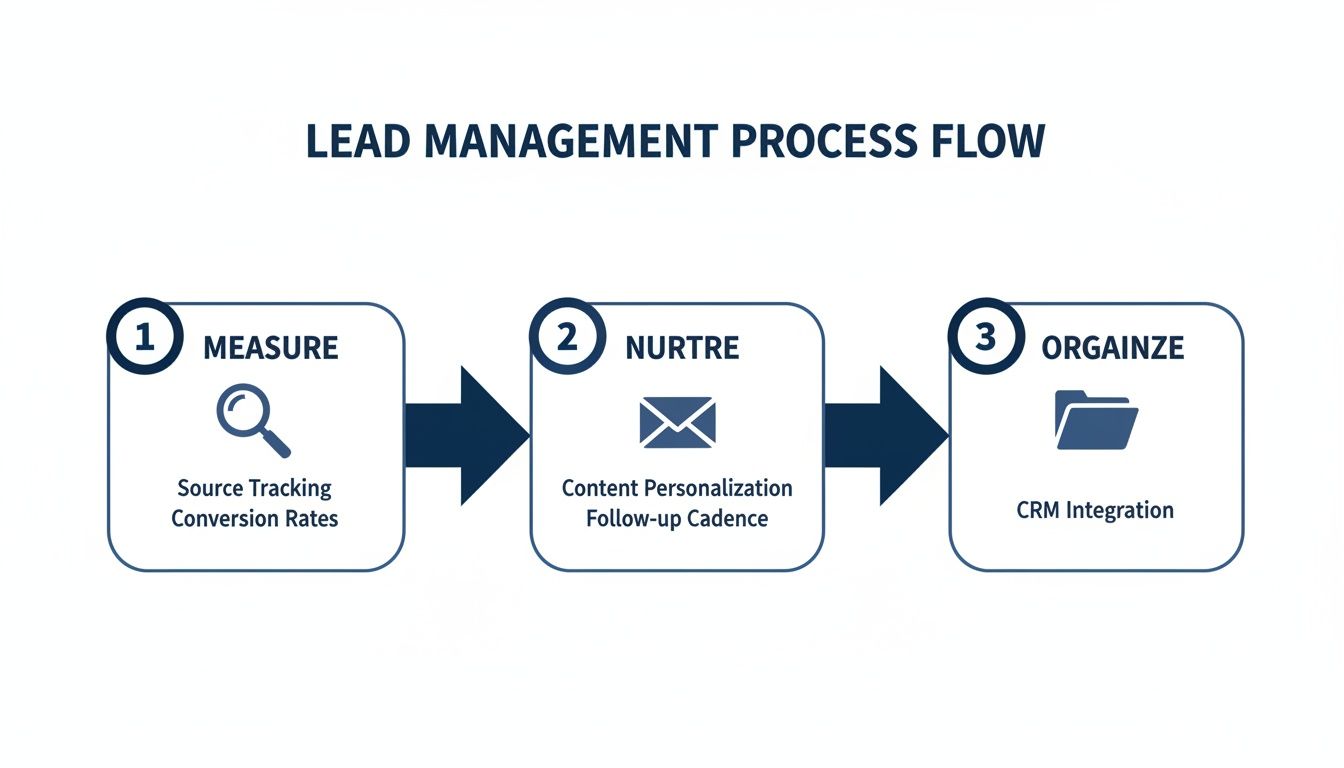
This illustrates that acquiring a lead is only the beginning. The real value is unlocked when you have a structured system for follow-up and management.
Your Invitation to Grow
If you're ready to see measurable growth and want an experienced, veteran-owned team to guide you, we invite you to have a conversation. We specialize in helping businesses like yours implement these strategies effectively, turning clicks into customers and ideas into real-world results.
Let's discuss your specific goals and create a clear plan to achieve them. Whether that means improving your local SEO here in Tennessee or building a high-converting website, our team has the hands-on experience to deliver. It all starts with a simple conversation.
The most successful lead generation strategies are not just planned; they are consistently executed, measured, and refined. A partnership can provide the momentum needed to achieve real, sustainable business growth.
Your digital presence holds incredible potential. We would be honored to help you unlock it.
Ready to turn your strategy into action? Contact Studio Blue Creative today, and let's build something great together. We look forward to hearing from you.