

SEO for healthcare providers is about one thing: ensuring that when a potential patient needs care, they can find you online. It's the process of helping your practice's website appear in search engines like Google, connecting you with people actively looking for doctors, specialists, or medical information. In a world where every health question starts with a search, this isn't just marketing—it's an essential part of modern patient care.
Why SEO Is Your Practice's New Front Door
The days of patients finding doctors through the phone book or solely by word-of-mouth are behind us. Today, your visibility on Google is the new front door to your practice, and a thoughtful SEO strategy is the key that unlocks it.
When someone experiences a new symptom or needs to find a specialist, their first move is to pull out their phone. Imagine a parent in Nashville frantically searching "pediatrician near me with weekend hours" or someone looking for the "best physical therapist for knee pain in Memphis." If your practice isn't showing up for these specific searches, you are essentially invisible to a large number of potential patients who are ready to make an appointment.
The Modern Patient Journey Starts Online
The numbers paint a clear picture. Research shows that 77% of patients turn to search engines before booking an appointment, and a staggering 80% research medical conditions online first. But here's the most critical statistic: 75% of those people never click past the first page of Google's results. If you're not there, you're missing out on the vast majority of potential new patients. You can find more details in these healthcare SEO stats that highlight just how vital online visibility has become.
This is where organic traffic—visitors who find you through unpaid search results—becomes your most valuable asset. It's the digital equivalent of a trusted referral, connecting you with patients at the exact moment of their need. A solid SEO plan ensures that when someone searches for the services you offer, your practice is one of the first they see, offering a positive solution to their problem.
To put it in perspective, let's map out what this looks like for a typical patient today.
The Modern Patient Journey at a Glance
This table breaks down the key digital touchpoints a prospective patient goes through before scheduling an appointment, highlighting where SEO makes a critical impact.
| Patient Action | Your Practice's SEO Opportunity |
|---|---|
| Experiences a symptom and searches for "lower back pain causes." | Your helpful blog post on common back pain issues ranks high, establishing trust. |
| Decides to see a specialist and searches "chiropractor near me." | Your Google Business Profile appears in the local map pack with excellent reviews. |
| Clicks on your website from the local search results. | A fast-loading, mobile-friendly site with clear service pages keeps them engaged. |
| Reads about your practitioners and their qualifications. | Your "About Us" page and doctor bios build authority and a personal connection. |
| Looks for patient testimonials and reviews. | Your website features positive reviews, reinforcing your strong online reputation. |
| Clicks the "Book an Appointment" button. | A simple, clear call-to-action converts their search into an actual visit. |
As you can see, SEO isn't a single action; it's a series of opportunities to meet patients where they are and gently guide them toward your care.
A beautiful website is pointless if no one can find it. SEO ensures your expertise and services are visible to the community you serve, turning your digital presence into a consistent source of new patient appointments.
Investing in SEO is a fundamental part of building a thriving, modern healthcare practice. It's about showing up, building trust, and making it easy for patients to move from a simple search to the compassionate care you provide.
Feeling a bit overwhelmed by where to start? We can help. Give us a call at 731-402-0402 or send us an email to map out a clear, effective SEO strategy for your practice.
Winning the Local Search for Nearby Patients
For most healthcare providers, the opportunity to attract new patients is won on a local map. When someone searches for "pediatric clinic near me" or "emergency dentist in Nashville," they need immediate, relevant results. This is where local SEO becomes the most powerful tool in your digital strategy, connecting you directly with the community you serve.
Your Google Business Profile (GBP) is the cornerstone of this strategy. It's often the very first interaction a potential patient has with your practice online—a digital storefront that appears in both Google Search and Maps. Simply having a profile isn't enough; optimizing it with rich, accurate information is what makes you stand out from the clinic down the street.
Put yourself in a patient's shoes. They want to see your exact location, confirm your hours, read reviews from other patients, and see photos of your facility. A completely filled-out profile signals to both Google and patients that your practice is active, credible, and ready to provide care.
Mastering Your Google Business Profile
Let's take a real-world example: a 'pediatric clinic in Nashville, TN.' To truly own its local search results, the clinic needs to meticulously complete every section of its GBP.
- Services: Don't just list "Pediatrics." Get specific. Detail every service you offer, such as "Well-child visits," "Sports physicals," "Vaccinations," and "Newborn care." This detail is what helps you show up in more targeted, high-intent searches.
- Photos: Upload high-quality, real images of your clinic. Share photos of the welcoming waiting room, modern examination rooms, the exterior of your building for easy identification, and friendly photos of your staff (with their permission, of course). This builds familiarity and trust before a patient ever walks through the door.
- Q&A: Proactively answer the questions you know patients have. Add your own questions like, "What insurance plans do you accept?" or "Do you offer same-day appointments for sick children?" and provide clear, helpful answers. This small step can save your front desk a phone call and demonstrates your commitment to patient convenience.
Your Google Business Profile is more than a listing; it's a dynamic preview of the patient experience. A detailed, active profile with positive reviews directly influences a patient's decision to choose your practice over a competitor.
The modern patient journey has become a predictable path from search to appointment. This visual flow shows exactly where local SEO intercepts patients at those critical decision points.
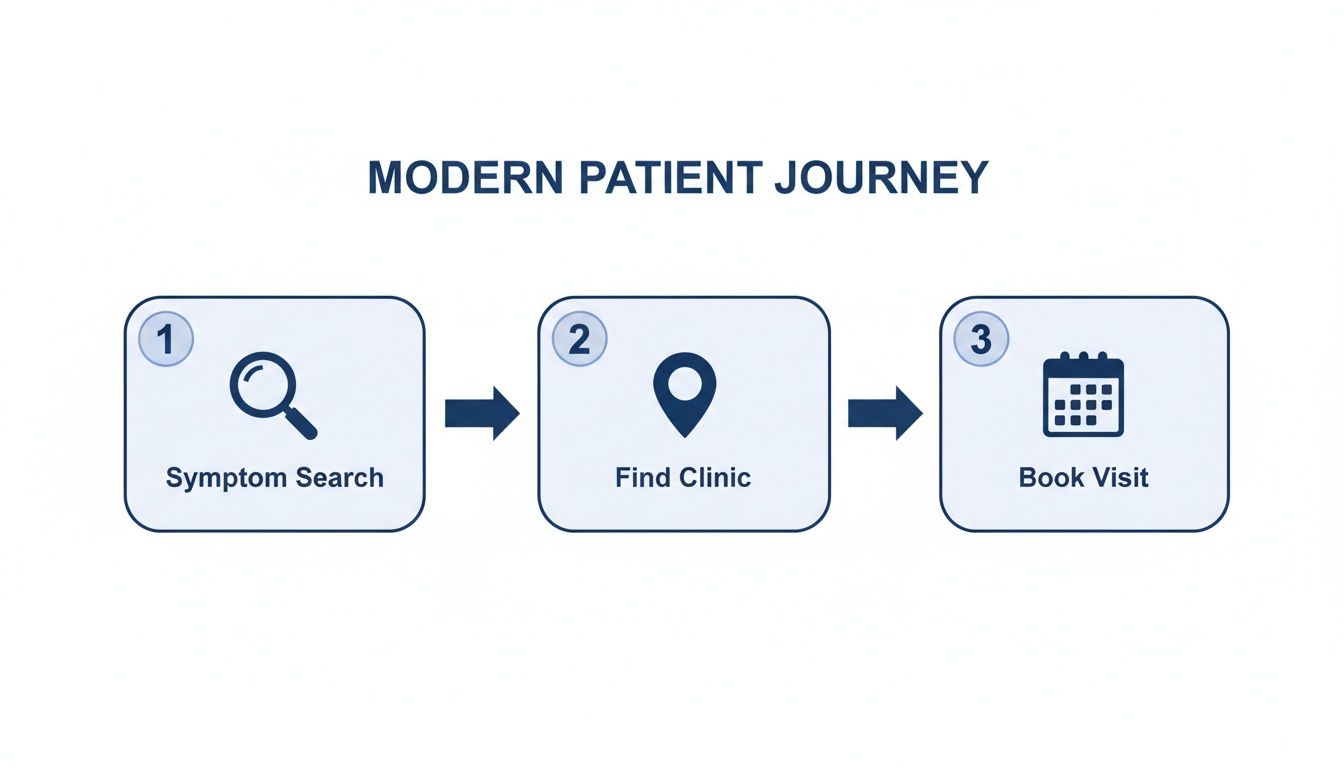
This process highlights how essential it is to be visible during the "Find Clinic" stage if you want to turn a searcher into a scheduled patient.
The Power of Consistency and Reviews
Beyond Google, your practice's information is scattered across dozens of online directories, from healthcare-specific sites like Healthgrades and Zocdoc to general ones like Yelp. It is absolutely critical that your NAP (Name, Address, Phone Number) is identical across every single one. Inconsistencies confuse search engines and can erode the very trust that helps you rank higher.
And of course, nothing builds trust like authentic patient reviews. A staggering 46% of all Google queries are location-based, and it's no coincidence that practices with over 100 Google reviews often rank significantly higher. With 63% of searches now happening on smartphones, having a mobile-friendly site is non-negotiable—something 90% of top healthcare sites have already figured out.
Encouraging reviews requires a gentle, privacy-conscious approach. Your front-desk staff can be your biggest asset here. After a positive interaction, they can simply say:
"We're so glad we could help you today. If you have a moment, we would be so grateful if you shared your experience on Google. It truly helps other patients in the community find our clinic."
This simple, positive script turns a great office visit into a powerful online testimonial. To really dial in your approach, you can delve deeper into effective local SEO strategies. Focusing on these core local elements builds a strong foundation that consistently attracts patients right in your neighborhood. You can also check out our guide on local SEO best practices for more detailed tips.
Ready to become the go-to provider in your area? Let's talk. Call us at 731-402-0402 and we’ll help you build a local SEO plan that fills your appointment book.
Creating Content That Builds Unshakable Trust
When a patient is looking for a doctor, their decision often boils down to a single, critical question: “Can I trust this person with my health?”
Your website is often the very first place they look for an answer. The content you publish is your best opportunity to earn that trust before they ever step foot in your office. This is about so much more than just listing your services; it’s about proving your commitment to patient care with every single word.
Google has a formal name for this: E-E-A-T. It stands for Experience, Expertise, Authoritativeness, and Trustworthiness. For anyone in healthcare, these aren't just trendy SEO terms. They are the non-negotiable standards your content must meet because you operate in what Google calls a "Your Money or Your Life" (YMYL) field. Simply put, inaccurate or untrustworthy information on your site could have serious real-world consequences.

That means a generic, one-paragraph description of a complex medical service just isn't going to build the confidence a patient is looking for. If you want to build that unshakable trust, your content needs to demonstrate your credibility from every angle.
From Service Page to Trusted Resource
Let's get practical. Take a common service page, like "Sports Physicals," and see how we can evolve it from a basic placeholder into a resource that a genuinely concerned parent would find incredibly helpful and reassuring.
Instead of just stating that you offer them, a page built on trust would include:
- A Clear Explanation: Break down what a sports physical actually involves at your clinic. Use simple, direct language and avoid confusing medical jargon. For example, explain that it includes checking vitals, reviewing medical history, and performing a physical exam to ensure the athlete is safe to play.
- The Provider's Perspective: Feature a short bio or a direct quote from the doctor who handles the physicals. Imagine Dr. Evans explaining, "These check-ups are so crucial because they can help us spot underlying conditions that might not be obvious, ensuring every young athlete can participate safely." This immediately showcases real Experience and Expertise.
- First-Hand Visuals: A short video tour of the exam room or photos of your actual staff interacting with young patients (with proper consent, of course) goes a long way. This shows your real-world Experience.
- A "What to Expect" Checklist: Give parents a simple, bulleted list of what to bring (like school forms and immunization records) and how to prepare their child. This helpful guidance builds instant Trustworthiness.
See the difference? You've shifted from selling a service to providing genuine guidance. That's the bedrock of patient trust.
E-E-A-T isn't a checklist to trick Google. It's a framework for proving what you already are: an experienced, expert, and trustworthy healthcare provider. Your content should simply reflect that reality.
Answering Questions Before They Are Asked
A truly effective content strategy doesn't stop at your service pages. It extends into a helpful, informative blog that positions you as the local authority on common health questions. The idea is to become the go-to resource in your community before someone even realizes they need to book an appointment.
Think about the actual questions parents are typing into Google. They aren't searching for "orthopedic services"; they're searching for "what to do for a sprained ankle."
Imagine building a blog strategy around these types of questions:
- When Should My Child Get Their First Sports Physical?
- Common Sports Injuries in Young Athletes and How to Prevent Them
- What's the Difference Between a Sports Physical and a Regular Check-Up?
Each article is another chance to prove your expertise and helpfulness. When you answer these questions clearly and with compassion, you start building a relationship grounded in trust.
The data backs this up. While organic traffic accounts for a massive 53% of healthcare site visits, a staggering 58% of searches end without a click. Your content has to be compelling enough to be the one that earns that click. You can discover more insights about the future of healthcare SEO to see why this kind of value-driven content is no longer just a nice-to-have.
It takes real effort to create content that builds trust, but it's one of the most durable and effective ways to grow your practice. You're not just playing a game for search engines; you're building a reputation that attracts the right patients and keeps them coming back.
If you’re ready to turn your website into an asset that builds trust and attracts patients, we can build a strategy that works. Give us a call at 731-402-0402 to get started.
Giving Your Website a Technical Health Checkup
Let's be honest, the term "technical SEO" can make anyone's eyes glaze over. But you don't need to be a developer to understand the basics, and getting them right is non-negotiable for any medical practice.
Think of it this way: a fast, secure, and easy-to-use website is about patient care. A worried parent frantically searching for your clinic's hours on their phone doesn't care about your site's code—they just need an answer, now. A frustrating delay or a confusing layout can send them straight to a competitor.
Your website is the digital front door to your practice. Does it inspire confidence? Is it easy for patients to walk through? These technical fundamentals directly impact patient trust and, just as importantly, how easily Google can understand and recommend your practice to people in need.
Is Your Site Built for the Modern Patient?
First things first: your website absolutely must be mobile-friendly. A huge number of your potential patients will find you on their phone, often while they're on the go. If they have to pinch and zoom just to find your phone number, they're gone. It’s that simple.
Next up is site speed. If your homepage takes more than a few seconds to load, you're creating an immediate roadblock. Today's patients expect instant information. A slow website feels unprofessional, and that’s the last impression you want to give someone seeking medical care.
Finally, security is paramount. Your site must have an HTTPS certificate, which is what puts that little lock icon in the browser bar. This encrypts the connection, protecting patient privacy and signaling to both users and Google that you take their security seriously.
Helping Google Understand What You Do
Beyond the patient experience, technical SEO is also about making it crystal clear to search engines what your practice is all about. This is where a powerful (and often overlooked) tool called Schema markup comes into play.
Schema is a specific type of code you add to your website that acts like a set of labels, explicitly telling Google important details about your clinic. For a medical practice, this is a game-changer. It helps Google serve up rich, detailed information right in the search results.
For example, with MedicalClinic schema, you can spell out:
- Your specific medical specialty
- Your hours of operation
- The types of insurance you accept
This gives you a massive advantage. When a patient searches for a local doctor, they can see this key info at a glance, making them far more likely to click through to your site.
Think of Schema markup as pre-filling a form for Google. Instead of making the search engine guess your details, you're handing it a perfectly organized file, which increases your chances of being featured prominently.
So, how much does this really matter? A recent survey found that a staggering 79% of healthcare providers see website optimization and SEO as their top tactic for attracting new patients. That puts it far ahead of things like social media.
This aligns perfectly with patient behavior, where 82% of patients now use search engines to find a new provider. The data is clear. With the right technical foundation, you put your practice in the best possible position to be the one they find. You can read the full research about these healthcare SEO trends to get a deeper look at the shifting landscape.
Core Technical SEO Health Checklist
Not sure where to start? This quick checklist can help you spot the most common technical issues that could be holding your practice back. Go through your site and see how it stacks up.
| Technical Element | Why It Matters for Patients | Quick Check (Yes/No) |
|---|---|---|
| Mobile-Friendly Design | Ensures patients can easily find info on any device, especially in urgent situations. | |
| Fast Load Speed | A slow site creates frustration and can make patients doubt your professionalism. | |
| HTTPS Security | Protects patient privacy and builds trust that their information is safe. | |
| Clear Site Structure | Like good clinic signage, it helps patients and Google easily find what they need. | |
| No Broken Links | Broken links (404 errors) lead to dead ends and a poor user experience. |
This checklist isn't exhaustive, but if you have a "No" in any of these boxes, it's a clear sign your website's technical health needs attention.
Performing a regular technical checkup ensures your site is more than just a digital brochure. It becomes a high-performing tool that’s fast, secure, and perfectly structured to attract both patients and search engines.
Feeling like your website needs a checkup? Give us a call at 731-402-0402 or send us an email. We’ll help you diagnose any issues and get your site in perfect health.
Marketing Confidently with HIPAA and Patient Privacy
Let's talk about something that makes a lot of healthcare marketers nervous: the Health Insurance Portability and Accountability Act, or HIPAA. It can feel like you’re walking a tightrope, trying to attract new patients without violating strict patient privacy rules.
But here’s the good news: powerful SEO for healthcare providers and rock-solid patient privacy can absolutely go hand-in-hand. It just takes a clear understanding of the rules of the road. With the right approach, you can build trust and grow your practice confidently and ethically.
The foundational rule is actually quite simple: you can never use or share Protected Health Information (PHI) for marketing unless you have explicit, signed consent from the patient. This isn't just about names or medical charts. PHI covers anything that could potentially identify a patient, from a photograph to a detailed story about their treatment journey.
Your Digital Front Door Must Be Secure
Think about your website's contact forms for a second. Are they secure? A standard, unencrypted "Contact Us" form is a huge compliance risk. Any form where a patient might even hint at sensitive information—like scheduling an appointment or asking a question—has to be encrypted to protect that data as it travels across the internet.
The same goes for email. Casually emailing back and forth with patients about their health using a standard email service is a serious HIPAA violation. Your practice needs to be using secure messaging portals or encrypted email services for any and all patient communication involving PHI. This isn't just a technical box to check; it’s one of the first and most important ways you build trust with a potential patient.
Protecting patient privacy online is non-negotiable. Every digital interaction, from a contact form submission to an email, must be handled with the same level of security and confidentiality as an in-office visit.
Creating Compelling Content the Right Way
So, how do you show off the incredible work you do without crossing any lines? The secret is to focus on your expertise while making any patient details completely anonymous.
- Case Studies: Instead of telling a story about "Jane D. from Memphis," describe a common patient scenario. Talk about the condition, the innovative treatment you provided, and the positive outcome in general terms. For example, "A 45-year-old patient came to us with chronic knee pain that limited their daily activities. Through a combination of physical therapy and a new, non-invasive procedure, they were able to return to hiking within three months." This powerfully demonstrates your skill without ever pointing to a specific individual.
- Testimonials and Photos: If you want to feature a patient's photo, use their name, or share a direct quote, you must have a signed HIPAA authorization form. This form has to specifically state they agree to their information being used for marketing. There are zero exceptions here.
A critical piece of staying compliant is performing regular risk assessments. This helpful HIPAA Risk Assessment Template provides a solid framework to guide providers through the process and ensure all the bases are covered.
When you make privacy a priority, you're doing more than just avoiding hefty fines. You're sending a clear message that your patients' well-being is the most important thing to you, both in the exam room and online. This kind of trust is the bedrock of a successful practice. To dive deeper, check out our guide on building a digital marketing strategy for healthcare.
Marketing with integrity is the most powerful tool you have. If you need help developing a compliant SEO and content strategy that puts patient privacy first, give us a call at 731-402-0402. We’re here to help you grow your practice the right way.
Turning Website Visitors into New Patients
Getting traffic to your website is a great start, but let's be honest—the real goal is turning those visitors into scheduled appointments. This is where your website’s design and user experience become absolutely critical. When a potential patient lands on your page, they need to know exactly what to do next, without a moment of confusion or frustration.
The formula for a high-converting service page is surprisingly simple. It’s all about clarity and action. Things like a prominent ‘Request an Appointment’ button, an easy-to-find phone number, and a straightforward contact form can make all the difference. Often, it's the small, thoughtful tweaks that have the biggest impact.
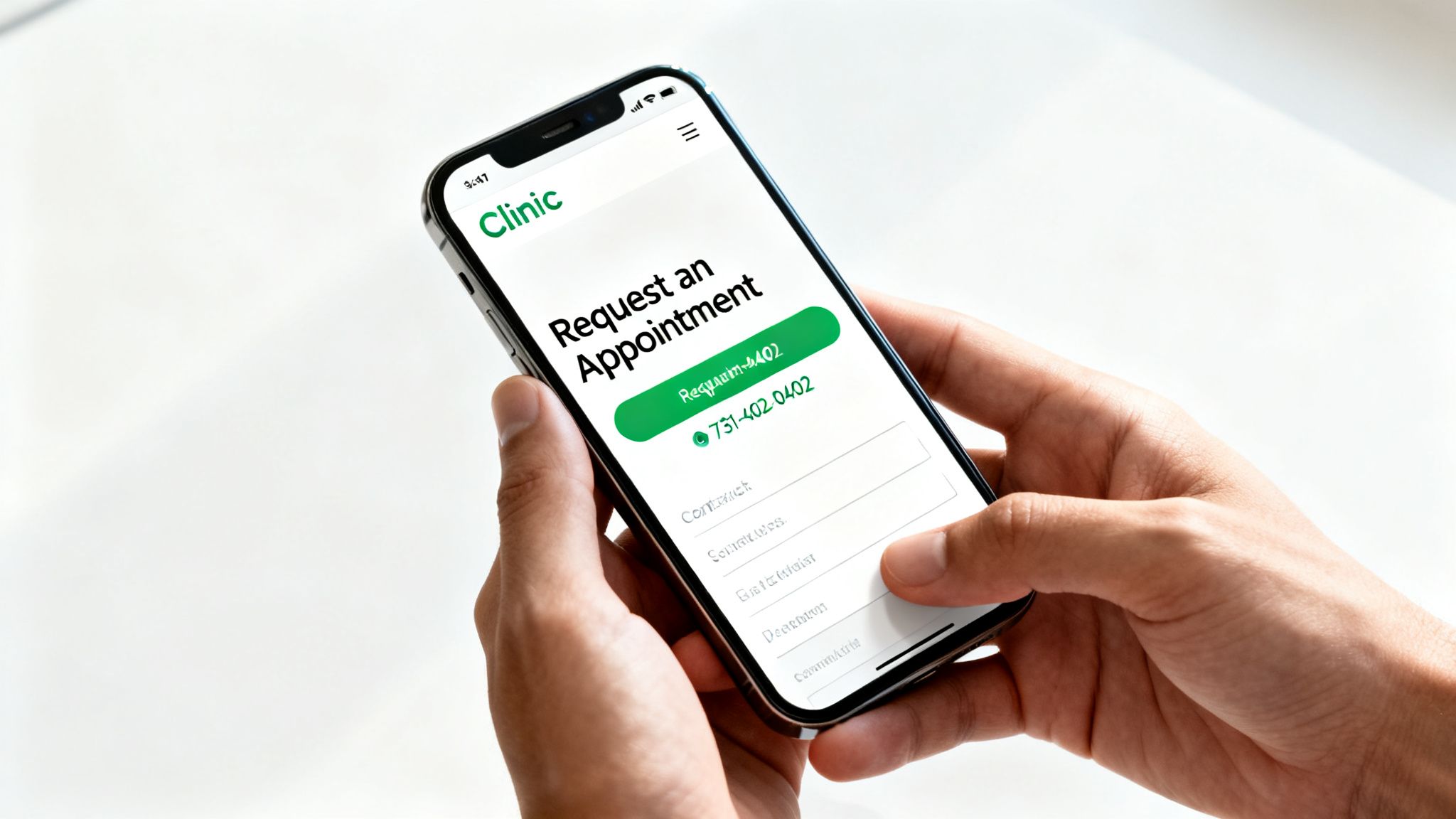
This is the point where a solid SEO strategy translates directly into practice growth.
Making the Connection Effortless
Put yourself in a patient's shoes. They find your site on their smartphone while on the go. Is your phone number just plain text, or is it a clickable link that dials your office instantly? That one simple adjustment removes a barrier and can dramatically increase your inbound calls. The path from discovery to contact has to be as seamless as possible.
The impact of these on-page adjustments is well-documented. For instance, a dental practice we worked with saw a 150% increase in organic traffic and 87% more online bookings in just six months by pairing content improvements with these kinds of conversion-focused tweaks. For smaller clinics, a strong local SEO presence can reduce the cost per new patient from paid ads by up to 30%, creating a more sustainable growth model.
The Anatomy of a High-Performing Page
A webpage designed to convert isn't cluttered or complicated. It guides the user toward one clear action: booking an appointment.
- Above the Fold: Your phone number (731-402-0402) and a bold "Book Now" button should be visible the moment the page loads. No scrolling required.
- Simple Forms: Keep your contact forms short and sweet. Ask only for the essentials: name, phone number, and email. Long, complicated forms are a major turn-off.
- Clear Calls-to-Action (CTAs): Use direct, action-oriented language. "Request Your Appointment" is far more compelling than a vague "Submit."
Your website isn’t just a digital brochure; it’s a tool designed to fill your appointment schedule. Every element on the page should work together to make it incredibly easy for a visitor to take that next step and become a patient.
By focusing on these conversion principles, you ensure that the valuable traffic you earn from your SEO efforts doesn't go to waste. You create a smooth, reassuring journey that ends with a new patient walking through your door. For a deeper dive into this topic, you can learn more about how to increase website conversions in our detailed guide.
Ready to turn more of your website clicks into new patients? Call us at 731-402-0402 or send us an email to start the conversation.
A Few Common Questions About Healthcare SEO
Jumping into digital marketing for your practice can feel overwhelming. Let's clear up some of the most common questions we hear from healthcare providers, focusing on what this all really means for your patient growth.
How Long Does This SEO Stuff Actually Take?
This is always the first question, and the honest-to-goodness answer is: it's a marathon, not a sprint. You should start seeing real, meaningful movement in your rankings and, more importantly, your patient inquiries within four to six months.
SEO isn't a switch you can just flip on. Those first few months are all about laying a solid foundation—we're talking about fixing the technical gremlins on your website, fine-tuning your Google Business Profile, and building out content that patients and search engines trust. The growth is gradual, but it's cumulative. It builds on itself, delivering a steady stream of new patients over the long haul. That's a world away from paid ads, which disappear the second you stop paying the bill.
Is SEO More Important Than Running Paid Ads?
They're different tools for different jobs, but when it comes to building a lasting asset for your practice, SEO is king.
Paid ads, like the ones you see at the top of a Google search, are fantastic for getting immediate visibility. Need to promote a new service like flu shots in the fall or fill your schedule for a specific campaign? They're perfect for that.
But a well-executed SEO strategy builds something more valuable: organic trust. Think about it—which results do you usually click on? Most people instinctively trust the organic listings more because they feel earned, not bought. A smart marketing plan often uses both, but your SEO foundation is what will keep your phone ringing for years to come.
Can I Just Do This SEO Thing Myself?
For some of the basics? Absolutely. You can definitely get in there and manage your Google Business Profile, ask happy patients for reviews, and double-check that your practice's name and address are correct everywhere online.
But true, effective SEO for healthcare providers is a different beast. It requires a deep understanding of technical website structure, a strategic approach to medical content, and a whole lot of consistent, dedicated effort. Between managing your practice and caring for patients, finding the time and staying on top of all the constant changes is a huge challenge.
Bringing in a specialist means you're not just guessing. It ensures every action is purposeful and aligned with your growth goals, which frees you up to do what you do best: take care of your patients.
Ready to stop wondering and start seeing real growth? The team at Studio Blue Creative builds straightforward, effective SEO strategies that turn websites into the number one source of new patients.
Give us a call at 731-402-0402 or send over an email. Let's build a plan for your practice.