Choosing between custom software vs off the shelf solutions comes down to a simple strategic question: are you looking for a quick fix for a common business problem, or are you building a long-term competitive advantage? Off-the-shelf software gets you up and running fast with a standard tool, while custom software is crafted to perfectly fit—and enhance—the unique way you do business.
Your choice here isn't just about technology. It's about deciding whether you're aiming for immediate operational speed or sustained strategic growth. By exploring what’s possible, you can find a solution that not only solves today's challenges but also fuels tomorrow's success.
Choosing The Right Software For Your Business Strategy
Picking new software is a major business decision, one that will echo through your operations, budget, and growth potential for years. Many companies fall into the trap of choosing the fastest or cheapest option, only to find themselves stuck with inefficient workarounds and frustrated teams later on. The wrong software can put a ceiling on your growth.
Imagine a local service business—let's call them "Precision Plumbing." They're juggling scheduling, invoicing, and customer details with a messy mix of spreadsheets and paper forms. The owner knows they need to go digital but faces that classic fork in the road: grab a popular, ready-made field service app or invest in a system built around their highly efficient, one-of-a-kind dispatching process?
Standard Processes vs Unique Workflows
The answer starts by looking at your business and asking: are our internal processes pretty standard, or are they the secret sauce that makes us successful?
Off-the-shelf software is brilliant for standardizing common tasks. Think about tools like QuickBooks for accounting or HubSpot for customer relationship management. They are built for the masses and work incredibly well when your business operates like most others in that specific area.
But what if your "secret sauce" is your workflow? For Precision Plumbing, it's their proprietary method for routing technicians that minimizes drive time and maximizes jobs per day. Forcing that unique, competitive process into a generic, one-size-fits-all box would destroy their edge. You end up losing efficiency and watering down your advantage.
This decision tree helps visualize that fundamental choice.
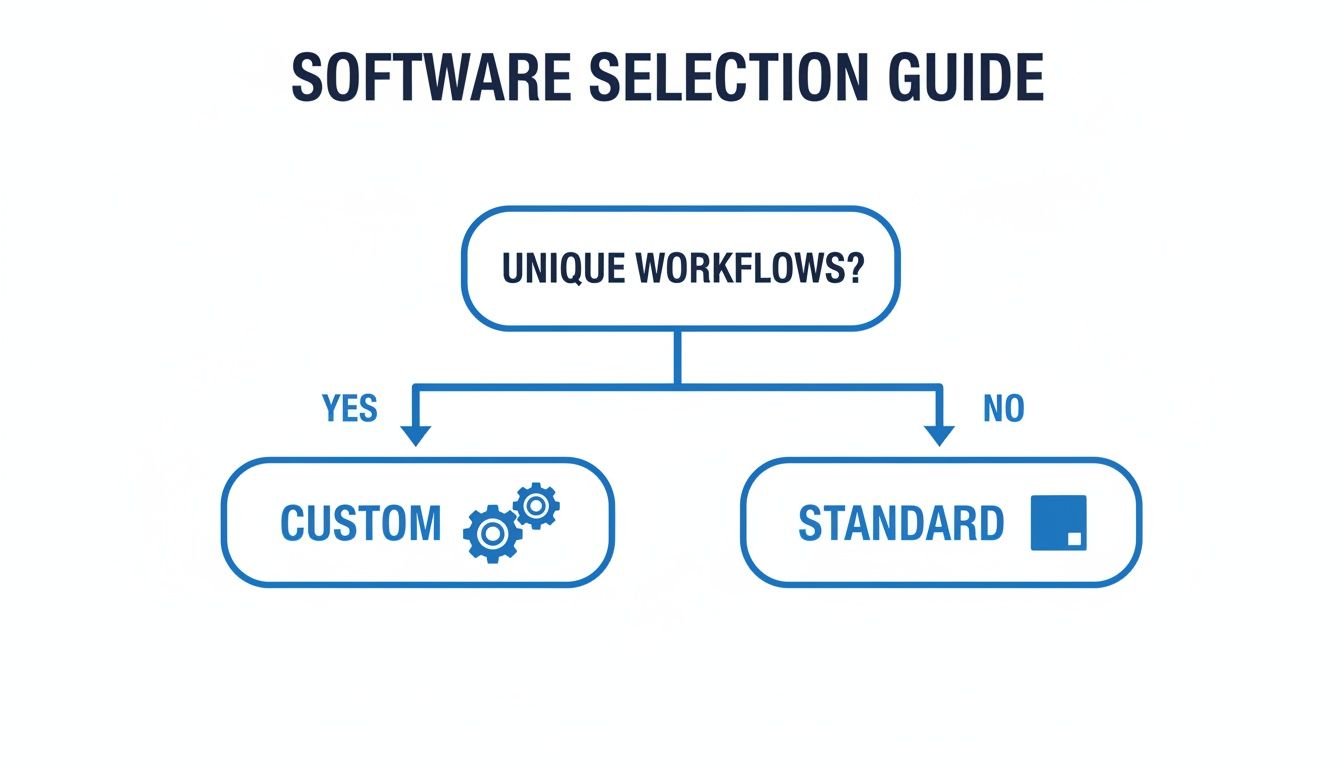
As you can see, the path to custom software begins the moment you identify that your operational needs are truly unique. Getting this first step right is a critical part of any company's digital journey. For a deeper dive, you can learn more about digital transformation for small business in our detailed guide.
To help frame this decision, here's a quick framework to see which path aligns with your most critical business factors.
Quick Decision Framework: Custom Vs Off The Shelf Software
| Factor | Choose Off-The-Shelf Software When… | Choose Custom Software When… |
|---|---|---|
| Business Problem | You need to solve a common, well-defined issue like basic accounting or email marketing. | Your core operations are your competitive advantage and can't be replicated by a generic tool. |
| Speed to Deploy | You need a solution up and running immediately with minimal setup. | You're planning for long-term growth and can invest time in a solution built to scale with you. |
| Budget Approach | Your priority is a low upfront cost, and you're comfortable with recurring subscription fees. | Your focus is on long-term ROI and crushing operational inefficiencies over time. |
Thinking through these factors shifts the conversation from a simple cost comparison to a strategic evaluation of what your business truly needs to win.
If you're starting to think a tailored solution might be the right fit for your unique workflows, give us a call at 731-402-0402. We're happy to have a no-pressure conversation about what's possible.
Comparing True Cost Of Ownership And Long-Term ROI
The price you see upfront is one of the most misleading numbers you'll look at when deciding on software. Off-the-shelf options love to dangle a low initial cost or a tempting monthly subscription, but that figure rarely tells the whole story. To make a smart financial choice, you have to dig deeper into the Total Cost of Ownership (TCO) and the potential for long-term Return on Investment (ROI).
That sticker price is just the tip of the iceberg. The real costs bubble up over months and years, often hidden in recurring license fees, per-user charges that punish you for growing, and the surprisingly high expense of cramming your unique business processes into a generic box.

Unpacking The Hidden Costs Of Off-The-Shelf Software
Ready-made software is built for the masses, but that one-size-fits-all approach is exactly where unexpected expenses start to pile up.
Let's imagine a healthcare clinic trying to automate its patient intake. An off-the-shelf Patient Relationship Management (PRM) system might look like a bargain at $200 per user, per month. But what happens when the clinic’s admin team grows from five people to ten? That cost doubles overnight to $2,000 a month—a whopping $24,000 a year—and they haven't gotten a single new feature for it.
That’s just one example of the costs hiding in plain sight. Here are a few others:
- Costly Workarounds: When the software doesn't fit a specific workflow, your team is forced to invent manual detours. That wasted time is a direct hit to your bottom line.
- Integration Headaches: Getting that generic tool to talk to your other critical systems often means paying for expensive third-party connectors or custom code, blowing up your initial budget.
- Vendor Lock-In: Trying to migrate your data out of a proprietary system can be so complex and costly that you're essentially trapped, forced to pay whatever the vendor demands down the road.
The initial savings from an off-the-shelf solution can vanish in a hurry once you start paying the ongoing price of forcing your business to fit the software, instead of having software that fits your business.
Calculating The ROI Of A Custom Solution
Custom software completely flips the financial script. Yes, the investment is heavier at the start, but the long-term returns come from solving your core business problems for good and unlocking new efficiencies. It's a one-time capital expense that becomes a valuable company asset, not a recurring operational cost that bleeds your budget dry.
Back to our healthcare clinic. They decide to invest $50,000 in a custom patient intake platform. This system is built from the ground up to mirror their exact workflow, automating everything from appointment scheduling and insurance verification to digital form submissions.
The investment starts paying for itself almost immediately.
- Efficiency Gains: The new system saves each of the ten admin staff members five hours a week they used to spend on manual data entry. That's 50 hours saved every single week. At an average loaded wage of $25/hour, the clinic is saving $1,250 a week, or $65,000 per year.
- Error Reduction: Automated insurance verification cuts claim denials by 15%, saving thousands more in lost revenue and the time spent on rework.
- Scalability at No Extra Cost: As the clinic thrives and adds 20 more employees, the software cost stays at zero. There are no per-user fees to penalize their success.
In this real-world scenario, the clinic's $50,000 investment is paid off in less than a year. From that point on, the $65,000+ in annual savings goes straight to the bottom line, delivering a powerful and sustained ROI. Understanding the numbers behind a project is crucial; for a detailed look at development expenses, check out our guide on the mobile app development cost breakdown.
When you look at custom software vs off the shelf solutions through the clear lens of TCO and ROI, the picture changes. It’s no longer about the initial price tag; it's about choosing between renting a temporary fix with ever-increasing costs or owning a permanent asset that generates value year after year.
Achieving Scalability And Competitive Advantage
Is your software an engine for growth, or is it an anchor holding your business back? This question gets to the heart of the custom software vs off-the-shelf debate. The path you choose directly shapes your ability to scale, react to market shifts, and carve out a lasting competitive advantage.
Off-the-shelf software is great for standardizing common tasks. But when your unique process is your biggest asset, standardization quickly becomes a liability. It crams your business into a pre-made box, putting a hard ceiling on your potential for growth and innovation.

Scaling Pains With Generic Tools
Let’s look at a real-world scenario. Imagine a logistics company that developed its own proprietary routing algorithm. This unique process lets them deliver packages 20% faster than anyone else. They start out managing this with a popular, off-the-shelf logistics platform.
For the first year, things are fine. But as their client base triples, the software’s cracks start to show. The system simply can't handle the complexity of their unique algorithm, forcing dispatchers into manual workarounds that eat away at their speed advantage. Every new feature they need is either missing or locked behind a pricier subscription tier.
This is a classic growth ceiling. The very tool they picked for its convenience is now actively stopping them from scaling the one thing that makes them special. They're stuck trying to fit their superior business model into inferior software.
Custom Software As A Proprietary Asset
Now, picture a different approach. Another logistics firm in the same boat decides to invest in a custom-built platform. This software is designed from day one to not just support their unique routing logic, but to amplify it.
As this company grows, the software scales right alongside them. Instead of hitting a wall, they have a flexible asset that evolves with their business. They can add new features, integrate with partner systems without a hitch, and refine their proprietary algorithm whenever they want. This custom software is more than just a tool; it has become a core piece of their intellectual property—a competitive moat their rivals can't easily cross.
This is where custom software delivers a true competitive edge. It lets you build a business model that competitors simply can't copy using off-the-shelf products. You can dig into more insights on how bespoke solutions drive innovation over on Baytech Consulting's blog.
Functionality That Fits Your Business, Not The Other Way Around
The difference in functionality between these two options is night and day. One gives you a general toolkit; the other gives you a precision instrument.
- Off-The-Shelf Functionality: You get a ton of features, but many will be totally irrelevant to your business. You end up paying for a whole suite of tools even if you only use a small fraction of them, and the one critical feature you actually need might be missing.
- Custom Functionality: Every single feature is built for a specific purpose that ties directly to your business goals. There’s no bloat or needless complexity—just a clean, efficient tool that helps your team do their best work.
An off-the-shelf solution gives you the features a vendor thinks you need. A custom solution gives you the exact features you know you need to win in your market.
This tailored approach has a huge impact on employee adoption and efficiency. When a tool is intuitive and perfectly matches how a team works, they use it more effectively. This cuts down on training time and minimizes errors, replacing frustration with productivity.
Ultimately, the choice comes down to your ambition. If your goal is to operate within standard industry practices, an off-the-shelf solution is a logical and efficient choice. It gets the job done.
But if your goal is to innovate and build a business that can scale without limits, you need software that supports that vision. Custom software isn't just about solving today's problems; it's about building the operational foundation for tomorrow's growth. It turns technology from a necessary expense into a strategic asset that fuels your competitive advantage.
If you feel like your current software is putting a ceiling on your growth, let's talk about what a custom solution could unlock for your business. Call us at 731-402-0402 for a straightforward conversation about your goals.
When To Choose Custom Software Over Off The Shelf
The “custom vs. off-the-shelf” debate comes down to a few practical questions. The right choice becomes clear when you look at your actual business model, your day-to-day operations, and where you want to go.
Sometimes, grabbing a ready-made tool is the smartest move you can make. It gets you up and running immediately. But for other businesses, a custom solution is the only real path to growth and a competitive edge that lasts.
Let's look at this decision in action.
The Right Time For Off The Shelf Solutions
Off-the-shelf software is the undisputed champ when it comes to solving common, standardized business problems quickly. It’s often the perfect fit for startups and small businesses with standard processes, tight budgets, and an urgent need to get going. These tools are built to solve universal challenges that thousands of other companies have already figured out.
Consider these real-world situations:
- A Startup Needing Basic Accounting: A new e-commerce shop has to track sales, expenses, and payroll. Their needs are totally standard. Grabbing a tool like QuickBooks is a no-brainer. It’s affordable, can be running in an afternoon, and solves a critical problem without any fuss.
- A Small Business Launching Email Marketing: A local boutique wants to send a weekly newsletter. A platform like Mailchimp has templates, list management, and analytics ready to go. Building a custom email platform would be a colossal waste of time and money when a proven tool already exists.
In these cases, the problem is well-defined and widely shared. The goal isn't to reinvent the wheel—it’s to adopt a best-practice solution and focus your energy on what you do best.
Real World Use Cases For Custom Software
The case for custom software becomes compelling when your operations are unique, complex, or the very thing that gives you an edge over the competition. A generic tool won't just feel clunky; it could force you to abandon the exact processes that make you successful. For these unique needs, exploring a bespoke software development service becomes a positive step forward.
At Studio Blue Creative, we've seen this firsthand with clients who simply couldn't make an off-the-shelf product work.
Case Study One: A HIPAA Compliant Healthcare Platform
The Problem: A healthcare provider with multiple locations needed one system to handle patient data, appointments, and internal audits. The dealbreaker? It had to be completely HIPAA-compliant to protect sensitive patient info—a level of security that many generic CRMs just can't guarantee.
The Solution: We built a secure web application from scratch. The entire platform was designed with end-to-end encryption, strict access controls, and detailed audit logs to meet and exceed HIPAA's tough requirements. It brought all their separate scheduling and records systems into a single, clean interface.
The Outcome: The provider gained a single, clear view of their entire operation, which cut down on administrative headaches and got rid of data silos. The custom compliance features gave them peace of mind, and the automated audit tools saved their staff hundreds of hours a year.
Case Study Two: A Specialized Registration System For Nonprofits
The Problem: The Tennessee Wildlife Federation (TWF) runs a popular program with a complicated registration and certification process. Their old system was a messy combination of manual forms and spreadsheets, which meant bottlenecks, data entry errors, and a frustrating experience for everyone involved.
The Solution: We created a custom registration portal designed around their unique workflow. The new system automates everything—from sign-ups and payments to document checks and generating certificates. Administrators now have a central dashboard to manage it all in real-time.
The Outcome: TWF saw a huge jump in efficiency. Their staff could finally focus on their mission instead of being buried in paperwork. And participants got a smooth, modern registration process, which helped boost engagement and satisfaction with the program.
These examples show that building custom software is often a strategic necessity. It’s for when your business is too specialized, your compliance needs are too strict, or your competitive advantage is too important to trust to a generic solution.
If these stories sound familiar, it might be time to see what a custom solution could do for your organization. Give us a call at 731-402-0402 or send us an email to start a no-pressure conversation about your goals.
Understanding Implementation Timelines And Integration
When you're deciding on new software, time-to-value is everything. Off-the-shelf solutions look tempting with their promise of a quick start, but the reality of getting them to actually work for your business can stretch on for months. On the flip side, custom software has a longer build time, but it often delivers real value faster once it's launched because it skips the integration and training headaches that come with generic tools.
The big appeal of a ready-made solution is speed. You can often sign up and get access the same day. But that’s just step one. The real work begins when you have to migrate your data, bend the system to your needs, and—most critically—retrain your team to abandon their proven workflows for the software's rigid processes. This is where a "quick" solution can bog you down.
The Reality Of Off-The-Shelf Implementation
Picture a mid-sized distribution company that just adopted a popular, off-the-shelf inventory system. They were sold on being fully operational in a week.
Three months later, they’re still putting out fires. The new software demands data in a very specific, non-negotiable format, which kicked off a massive data cleanup project nobody saw coming. Worse, their team's battle-tested process for handling returns doesn't mesh with the software's workflow, leading to daily frustrations and clunky, manual workarounds. The "fast" solution has become a major drag on operations.
This story is more common than you'd think. It exposes the hidden time sinks of pre-built software:
- Data Migration Headaches: Your data has to play by the new system's rules. This often means weeks or months of tedious prep work. For a deeper dive, check out some effective data migration best practices in our guide.
- Workflow Disruption: Instead of the software conforming to your business, your business is forced to conform to the software. This change management can take months and often sparks resistance from employees.
- Integration Hurdles: Getting the new tool to talk to your other essential systems (like your CRM or accounting software) can require costly third-party connectors or custom API work, adding unexpected delays and expenses.
Demystifying The Custom Software Lifecycle
Building custom software is more involved upfront, but the process is transparent and predictable. It’s a partnership designed from day one to solve your specific problems, not just hand you a generic tool. While a project typically takes between 3 to 9 months, every phase is built around making sure the final product integrates perfectly from the moment it launches.
With custom development, the heavy lifting of implementation and integration happens during the build, not after. The result is a solution that drops into your workflow like a missing puzzle piece, not a square peg you're trying to hammer into a round hole.
Our process is built on clarity and collaboration, keeping you in the loop at every stage.
- Discovery and Planning (2-4 Weeks): We start by digging deep into your business goals, daily workflows, and biggest pain points. This phase gives us a detailed project roadmap and a crystal-clear scope.
- Design and Prototyping (3-6 Weeks): We build wireframes and interactive prototypes so you can see, feel, and test the software before a single line of code is written. This ensures the final product is a natural fit for your team.
- Development and Testing (8-20 Weeks): Our team builds your software in manageable sprints, with regular check-ins to get your feedback. Integrations with your existing systems are woven directly into the application's DNA.
- Deployment and Training (1-2 Weeks): Since the software was designed around your team's exact needs, training is intuitive and adoption is nearly instant. We manage the launch and stick around to provide dedicated support.
By the time a custom solution is delivered, the hard work of integration and workflow alignment is already done. The custom software vs off the shelf timeline debate isn't just about how fast you can launch—it's about how fast you can get to real, friction-free value.
If you’re ready to discuss a solution that’s built for your business from the start, call us at 731-402-0402.
So, How Do You Make the Final Call?
Choosing between a custom-built solution and an off-the-shelf product isn't just about picking a tool. It's a strategic decision that needs to align with where your business is headed. When you get right down to it, you're weighing the pros and cons we've talked about.
You're trading immediate deployment for long-term, unrestricted scalability. You're balancing predictable subscription fees against the powerful ROI of owning a proprietary asset. But most importantly, you're deciding between fitting into a standard process and forging a real competitive advantage.
A Simple Checklist to Guide Your Thinking
To cut through the noise, just ask yourself these three questions. Your honest answers will probably make the path forward pretty clear.
- Process: Is our core workflow a standard industry practice, or is it our unique "secret sauce"—the very thing that makes us better than the competition?
- Scalability: Will our growth eventually be capped by the software’s features? Or can the software grow right alongside us, without adding punishing per-user costs that penalize our success?
- Advantage: Do we just need a tool to get a job done, or are we building an operational system that our competitors can't just go out and buy?
If your answers lean toward unique workflows, unlimited growth, and building a true competitive asset, then it’s a strong sign that a custom solution is the right strategic move.
The goal is to move beyond reading articles and have a real conversation about your specific business challenges. An expert partner can help you see the possibilities and build a clear roadmap.
Ready to build a scalable solution that fits your business perfectly? Let's talk. Call us at 731-402-0402 or send us an email to start a no-pressure conversation.
Frequently Asked Questions
When you're weighing the options between building custom software and buying something off the shelf, a few key questions always come up. Let's tackle the ones we hear most often from business owners trying to make the right call.
Is Custom Software Only For Large Enterprises?
Not anymore. While that might have been true years ago, the game has changed. We're seeing more small and mid-sized businesses build custom solutions because they have a very specific problem that pre-packaged software just can't fix.
A focused, well-designed custom app can be a massive competitive advantage. It streamlines your unique processes and delivers an ROI that generic software can't match.
What Happens If My Business Needs Change After The Software Is Built?
This is exactly where custom software shines. With an off-the-shelf product, you’re at the mercy of the vendor's update schedule and feature roadmap. With a custom solution, you own it. It's built to grow with you.
A good development partner won't just build for today; they'll build with an eye toward the future. It’s designed to be flexible, so adding new features or adjusting workflows as your business evolves is all part of the plan.
How Can I Justify The Investment In Custom Software?
You justify it by focusing on the business problem, not the technology. The conversation should start with a deep dive into what you're trying to achieve—before a single line of code is written.
Think in terms of clear, measurable goals. Maybe you want to cut down manual data entry by 20 hours per week or boost customer conversions by 15%. When you attach real numbers to the problem, the return on your investment becomes clear and easy to defend.
The right software isn’t just a tool; it’s an engine for your growth. If you’re ready to talk about your business goals and see how a custom solution can give you a real competitive edge, the team at Studio Blue Creative is here to help.
Give us a call at 731-402-0402 or send us an email. Let’s build something that works for you. You can also learn more about our approach at https://studiobluecreative.com.