
Website security vulnerabilities are, in simple terms, weak spots in your digital foundation. They’re exploitable flaws in your site’s code, its server setup, or even in the third-party tools it connects to. Think of them as unlocked doors or open windows on your digital property, giving attackers a clear path to your valuable data and functionality.
Ignoring these gaps isn't just a technical oversight; it can lead to devastating data breaches, real financial loss, and a hit to your reputation that’s hard to recover from. Taking a proactive approach to security is one of the smartest investments you can make in your business's future.
Your Website Is Your Digital Front Door
If your business had a physical storefront, you’d never leave the front door unlocked overnight. You wouldn't hand out spare keys to strangers or just ignore a broken window, right? Your website is that digital front door, open to the entire world 24/7, and it demands the same level of attention—if not more.
Every login page, contact form, and piece of software your site runs is a potential entry point for someone with bad intentions. In the digital world, these weak points are called website security vulnerabilities. They aren't just minor technical glitches; they're serious business risks. Forgetting to update a single plugin is like leaving a side door propped open. It might feel insignificant, but it's an open invitation for trouble.
This image shows the kind of constant vigilance needed to monitor and protect your digital assets from a vast array of potential threats.

Just as a security guard keeps an eye out for anything suspicious, a good security strategy means spotting vulnerabilities before they can ever be used against you.
The Scale of Modern Web Threats
Keeping a website secure is a bigger challenge than ever. The sheer volume of new threats popping up every day is staggering, which means just reacting to problems after they happen is a losing game. A proactive defense isn't a luxury anymore; it’s a core business necessity.
The numbers are pretty eye-opening. Over 21,500 new Common Vulnerabilities and Exposures (CVEs) were publicly disclosed in just the first half of this year. That’s a jump of 16-18% from the same time last year. At this rate, experts predict the total could blow past 50,000 CVEs for the year worldwide. That breaks down to more than 130 new, unique vulnerabilities discovered every single day. If you want to dig into the data, you can explore these vulnerability trends and statistics on deepstrike.io.
A website that was perfectly secure yesterday could be completely vulnerable today. This constant flood of new threats is exactly why continuous monitoring and partnering with experts who live and breathe this stuff is so important.
Our goal here is to help you see security not as some confusing technical problem, but as a critical part of your business strategy. Building a secure online presence is achievable, and it's absolutely essential for protecting your customers, your data, and your bottom line. Feeling overwhelmed? Let’s start a conversation. You can email us or give us a call to talk about how we can help fortify your digital front door.
The Top Threats Every Business Owner Should Know
Let's be honest, talk about website security can feel like a different language. When experts throw around terms like "Cross-Site Scripting" or "Insecure Deserialization," it's easy for your eyes to glaze over. But you don't need to be a coder to understand the risks.
Think about it in terms you already know: the physical security of your business. You lock the doors, set an alarm, and have procedures for who gets a key. The most common website vulnerabilities are just the digital version of leaving a back door propped open or giving a stranger the master key. They're common, predictable mistakes with potentially devastating consequences.
Cybersecurity experts have a go-to list for these critical risks, known as the OWASP Top 10. This isn't just a guide for defenders; it's also a playbook for hackers, showing them the most reliable ways to break into websites and applications.
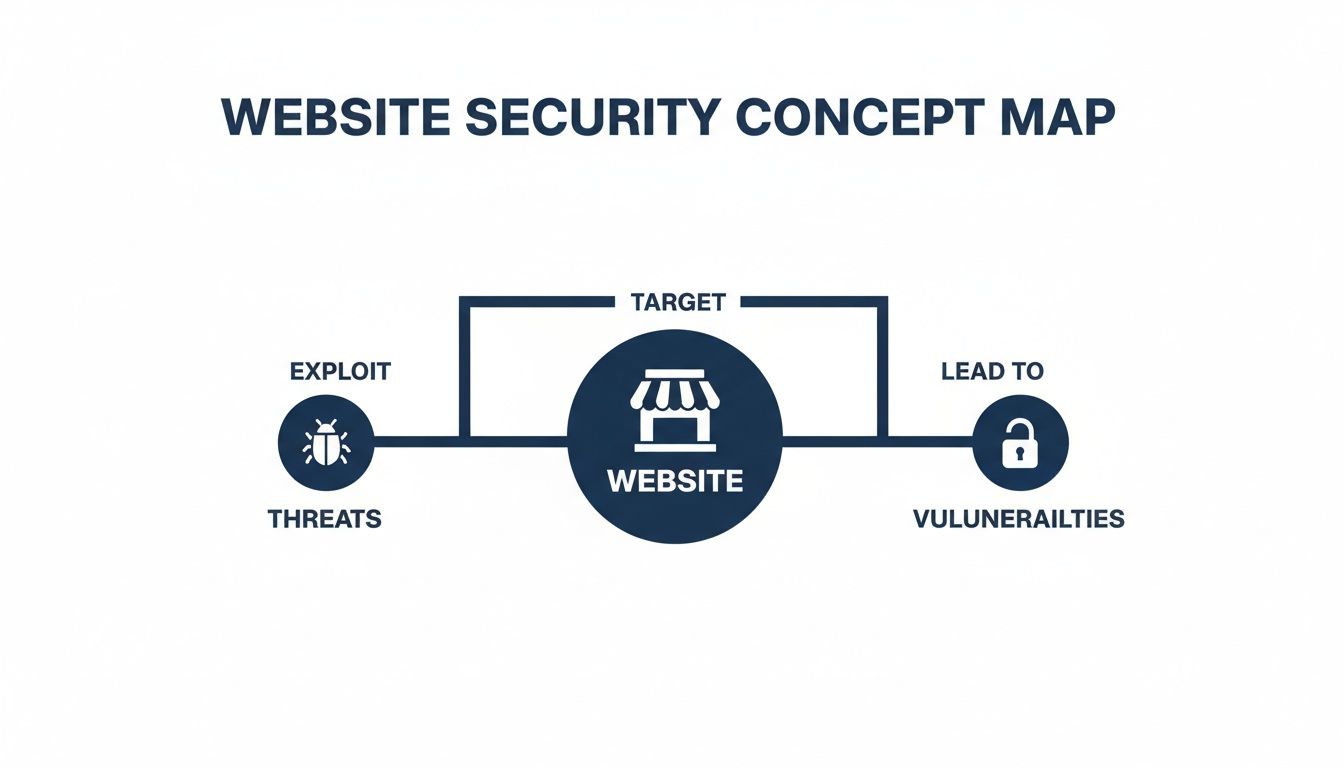
The key takeaway here is simple: threats are always out there, but they only turn into a damaging attack when they find a weakness on your site to exploit.
To bring this home, let's look at what these vulnerabilities actually mean for your business. The table below breaks down a few of the biggest threats into simple analogies and the real-world damage they can cause.
Common Vulnerabilities and Their Business Impact
| Vulnerability Name | Simple Analogy | Real-World Business Risk |
|---|---|---|
| Broken Access Control | A faulty key card system that gives an intern access to the CEO's office and server room. | Customers can see each other's private data; unauthorized users change critical settings or steal information. |
| Injection Flaws | A thief tricks your receptionist into revealing the combination to the company safe with a clever phrase. | Attackers can steal your entire customer database, delete your data, or take over your website. |
| Cryptographic Failures | Storing customer credit card numbers in a clear glass jar on the front counter instead of a locked safe. | A data breach exposes sensitive user information (passwords, PII) in a readable format, leading to massive fines and loss of trust. |
As you can see, these aren't abstract technical problems—they have direct, painful consequences for your bottom line, your reputation, and your customers' safety. Let's dig a little deeper into how they work.
1. Broken Access Control: The Faulty Key Card System
Broken Access Control is consistently ranked as the #1 most critical website security risk, and for good reason. At its core, it means your website isn't doing a good enough job of checking who is allowed to do what. It's like that faulty office key card that gives an intern's badge access to the server room.
For a real-world example, imagine a customer logs into their account on your e-commerce site. By simply changing a number in the website URL (like from .../orders/123 to .../orders/124), they can suddenly view the personal details and order history of a completely different customer. This isn't a sophisticated hack; it's a simple flaw that can lead to a catastrophic data breach.
2. Injection Flaws: Tricking Your Website From the Inside
Imagine a con artist walking up to your front desk and using a cleverly worded phrase to trick an employee into handing over the keys to the building. That’s the real-world equivalent of an injection flaw.
With this attack, a hacker "injects" malicious commands into a form on your site, like a search bar or a contact form. If your website isn't built to spot this trick, it might just run that malicious command on its own database. A famous real-world example of this was the TalkTalk data breach, where attackers used a simple SQL Injection technique to steal the personal data of over 150,000 customers, resulting in a record-breaking fine and massive public backlash.
3. Cryptographic Failures: Leaving Sensitive Data Out in the Open
Using weak or nonexistent encryption is like writing down every customer's credit card number on a sticky note and leaving it on the front counter. That's essentially what Cryptographic Failures are—failing to properly protect sensitive data like passwords, personal details, or financial records.
This often happens when data is stored in plain text or scrambled with an outdated method that's easy for modern computers to break. The 2012 LinkedIn breach is a classic case; over 6.5 million user passwords were stolen and leaked online, largely because they were protected with a notoriously weak hashing algorithm (SHA-1) without any "salting." This made it trivial for attackers to crack the passwords and use them to access other accounts.
The Hidden Dangers in Your Digital Supply Chain
Your website rarely stands alone. These days, a modern site is a complex puzzle, pieced together with a network of third-party tools, plugins, and integrations. These components handle everything from processing payments and crunching analytics to powering customer chats and social media feeds. This network is your digital supply chain, and frankly, it's one of the most overlooked backdoors for attackers.
Think of yourself as a general contractor building a house. You hire subcontractors you trust for the plumbing, electrical, and HVAC. But what happens if the plumber uses a faulty pipe? It doesn't matter how solid your foundation is—the entire house is now at risk of a major flood. The buck stops with you, the contractor. It's the exact same with your website. You're responsible for every piece of code you add, even if someone else wrote it.
Each of these third-party tools—like a new plugin or an analytics script—is like plugging another device into your website's core system, creating a brand new potential entry point.

Every single integration adds another layer of code and, with it, another potential weak spot that attackers can exploit to sneak past your main defenses.
When Trusted Tools Become Threats
A security hole in just one of these trusted third-party tools can quickly escalate into a direct, severe threat to your entire business. Attackers love targeting popular plugins or widely used software libraries. Why? Because finding a single vulnerability gives them a skeleton key to potentially thousands of websites at once. It's an incredibly efficient way for them to scale their operations.
This isn't just a hypothetical problem; it’s happening right now, more and more often. Breaches originating from third-party vendors are skyrocketing. A recent global report found that a staggering 35.5% of all data breaches were traced back to a third-party compromise, a huge jump from 29% the year before. You can dive deeper into these third-party breach trends from SecurityScorecard to see the full picture.
For a real-world example, look at the Magecart attacks. These groups didn't crack the security of e-commerce sites directly. Instead, they compromised third-party scripts running on those sites—like live chat tools or analytics services. By injecting malicious code into these trusted tools, they were able to skim credit card details from thousands of customers of major brands like British Airways and Ticketmaster.
You Are Only as Strong as Your Weakest Link
This all boils down to a critical rule of modern web security: you must vet every single plugin, script, and partner integration. An outdated plugin or a poorly secured API from a vendor can completely unravel all your other security efforts.
This is especially true in sectors like healthcare, where every integration has to meet tough compliance standards. For instance, our work on mobile app development for healthcare always involves a deep, rigorous vetting of every component in the digital supply chain.
Protecting your website means looking beyond just the code you've written yourself. It demands a wider view, treating every third-party component with the same scrutiny you apply to your own work. If you're not sure where to even start with auditing your digital supply chain, we can help. A quick call can get you on the path to a much safer digital presence.
Practical Steps to Fortify Your Website
Knowing about potential threats is the first step, but real security comes from taking action. Fortifying your website isn't about finding a single magic bullet; it's about building layers of defense that make your site a much harder and less appealing target for attackers. Think of these steps as positive investments in your business's reputation and your customers' trust.
Let's walk through some foundational tactics that will genuinely strengthen your website's defenses.
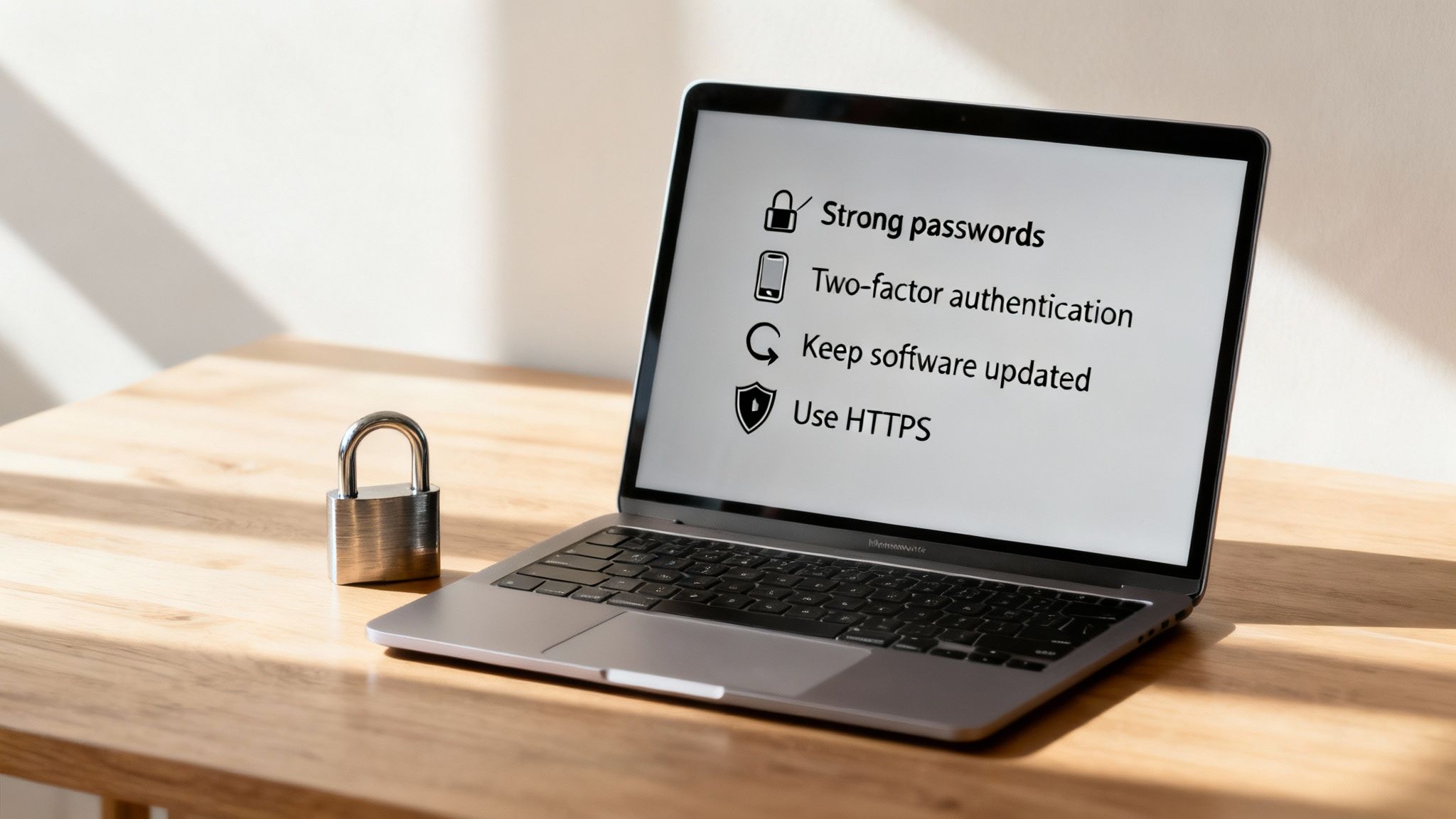
Establish Strong Access Controls
Often, the path of least resistance for an attacker is a weak or stolen password. This is your front door, and locking it properly is a simple, high-impact way to boost your security right away.
Start with a strong password policy for everyone, especially administrators. This means mandating a mix of uppercase and lowercase letters, numbers, and symbols, with a minimum length of 12-16 characters. Just as importantly, push your team to stop recycling passwords across different services.
From there, enable Two-Factor Authentication (2FA) everywhere you can. 2FA adds a powerful second checkpoint, forcing users to verify their identity with something they have—like a code sent to their phone—in addition to something they know. This one move can shut down the overwhelming majority of automated login attacks, even when a password has been compromised.
Maintain a Strict Update Schedule
Outdated software is a welcome mat for hackers. As we covered with third-party risks, a single unpatched plugin can pry open a door to your entire system.
Regular and timely updates are not just for adding new features; they are one of the most effective security tools at your disposal. Most updates from reputable developers include critical patches that fix newly discovered vulnerabilities before they can be widely exploited.
Get into a rhythm of checking for and applying updates to every single piece of your website:
- Core Software: This is your foundation, whether it's a CMS like WordPress or your e-commerce platform.
- Plugins and Extensions: Every add-on is a potential entry point and must be kept current.
- Themes: Don't forget your theme—it's code, and it needs patching just like everything else.
Encrypt All Data in Transit
Frankly, there’s no excuse for any professional website to operate without HTTPS today. An SSL/TLS certificate encrypts the connection between a user's browser and your server. This scrambles any data they submit—from a simple contact form to sensitive credit card details—making it unreadable to anyone trying to eavesdrop.
Modern browsers actively warn users when a site is "Not Secure," which is a surefire way to erode trust and even hurt your search rankings. Implementing HTTPS is a baseline requirement. When you're handling user data, you also need to be mindful of data protection regulations. You can get a better handle on this by reading our guide on GDPR compliance for WordPress.
Conduct Regular Security Audits
You can’t fix a problem you don’t know you have. A regular security audit or vulnerability scan is like a routine health check-up for your website. These tools systematically poke and prod your site, looking for known weaknesses, server misconfigurations, and other gaps that an attacker would try to exploit.
Changing your mindset to see audits as a crucial investment, not an expense, is a game-changer. For more ideas on defending your site, check out these practical steps to enhance protection. This proactive approach means you get to find and fix issues on your own schedule, not in the middle of a crisis.
Feeling overwhelmed? We can help you implement these steps and build a security plan that makes sense for your business. A quick call or email is all it takes to start the conversation and safeguard your online presence.
Building Security In, Not Bolting It On
Truly effective security isn't something you tack on at the end. It’s not a last-minute patch or a final checklist item before you go live. To build digital platforms that are genuinely trustworthy, security must be woven into the fabric of your project right from the very first brainstorming session. This approach is called a Secure Development Lifecycle (SDLC).
Think about it like building a new car. You wouldn't assemble the entire vehicle and then try to figure out where to cram the airbags and seatbelts. Of course not. Safety features are designed into the frame and the core structure from day one. Trying to bolt security on after the fact is just as clumsy and far less effective; you end up with awkward patches that only cover up deeper website security vulnerabilities.
A Security-First Mindset at Every Step
When security is integrated from the start, every decision gets viewed through a security lens—from the first discovery meeting to the final deployment. This transforms security from a potential roadblock into a guiding principle, guaranteeing a stronger, more resilient final product. A structured process like this prevents the common, avoidable errors and builds a solid foundation for the long haul.

It’s right here, in this early planning stage, that we map out data flows, define who can access what, and choose our technologies. All of this is done with one goal in mind: minimizing your attack surface before we even begin.
A true SDLC means security is a constant conversation, not a one-time audit. Here’s a peek at how that actually works:
- Discovery and Design: Before writing a single line of code, we analyze potential threats. For a healthcare app, this means figuring out precisely how to protect patient data to meet strict HIPAA rules. For an e-commerce site, we’d architect the system to completely isolate payment information from the very beginning.
- Development: While coding, our developers follow strict security guidelines. This isn't just about avoiding common mistakes; it's about actively writing defensive code that anticipates how an attacker might think.
- Testing and Review: Security is everyone's job. We use rigorous peer code reviews, where a second set of expert eyes inspects every new feature for potential flaws. This simple, collaborative process catches subtle errors that an individual developer might easily miss.
- Deployment and Maintenance: Launching the site is just the beginning. We put systems in place for continuous monitoring, regular updates, and a clear incident response plan for any new threats that emerge down the road.
Automated Defenses and Human Expertise
Building securely today requires a smart mix of automated tools and sharp human oversight. One of the most critical practices we use is automated dependency scanning. As we've discussed, your digital supply chain—all the third-party libraries and frameworks your project relies on—can be a huge source of website security vulnerabilities.
Our automated tools constantly scan every single component of your project against a massive database of known vulnerabilities. If a new threat is discovered in a library your site uses, we get an alert immediately. This lets us patch the issue before anyone has a chance to exploit it.
This automated vigilance goes hand-in-hand with human expertise. For example, when we work with healthcare clients, HIPAA compliance is absolutely non-negotiable. Every feature is built not only to work well but also to meet the specific legal and ethical requirements for protecting sensitive data.
This commitment isn't just about avoiding problems; it’s about building a platform that gives you real peace of mind. When security is part of the blueprint from day one, you get a more robust, scalable, and trustworthy digital presence. If this proactive, security-first approach sounds like the right fit for your next project, let’s talk. Reach out to us by email or phone, and let's discuss how we can build something secure and successful together.
Ready to Build on a Secure Foundation?
Let's be honest: keeping up with website security vulnerabilities can feel like a full-time job. The threats are relentless, the tech is always changing, and the potential fallout for your business is huge. But you don't have to go it alone. Real security isn't a one-and-done task; it's a continuous commitment.
Whether you're just starting out or looking to fortify a site that's been around for years, a proactive security partner is key to sustainable growth. It’s the difference between reacting to a crisis and having a strategy that bakes security into your business from day one.
This image shows a team working together, mapping out a project where security and strategy are at the heart of the discussion.

This is the kind of collaboration that spots potential issues and handles them long before they can ever affect your customers or your reputation.
Grow Your Business with Confidence
A solid security posture isn't just a defensive move—it's a business enabler. It builds trust with your audience and frees you up to focus on what you actually love to do: run your business. Imagine pursuing new ideas without that nagging worry about the latest cyber threat.
We believe that kind of peace of mind should be within reach for every business. Our approach marries deep technical knowledge with a genuine understanding of your goals, making sure every security decision we make is also a step forward for your success.
Security isn't just about protecting what you have; it's about creating a safe environment where your business can thrive without fear of disruption.
Let’s talk. We’d love to hear about your project, discuss your security concerns, and map out a practical plan that helps you grow with confidence. Reach out to us by email or phone, and let’s start building a more secure digital future for your business, together.
Your Website Security Questions, Answered
When it comes to website security, it's easy to get lost in the jargon. Let's cut through the noise and tackle some of the most common questions business owners ask about keeping their digital storefront safe.
“My Business Is Small. Why Would Hackers Target Me?”
This is a question I hear all the time, and it’s based on a common misconception. Most hackers aren't meticulously hand-picking their targets; they're running automated scripts that crawl the web 24/7, sniffing out easy-to-exploit vulnerabilities on any site they can find.
To these bots, your business's size is completely irrelevant. In fact, smaller businesses are often more attractive targets because they're less likely to have a dedicated security team on standby. A breach isn't just about a broken website—it's about stolen customer data, a tarnished reputation you've worked hard to build, and even legal trouble.
“How Often Should I Run a Security Scan?”
The honest answer? It depends. The right cadence for security scans hinges on your site's complexity and the sensitivity of the data you handle.
For a standard business or marketing website, a professional vulnerability scan every quarter is a great starting point. This gives you a regular check-up to catch new threats as they emerge. But if you’re running an e-commerce store or handling sensitive information (like in healthcare), you need to be far more vigilant. In those cases, monthly or even continuous automated scanning isn't just a good idea—it's essential.
“Is a WordPress Website Secure?”
Yes and no. At its core, the WordPress platform is built to be secure, provided you keep it updated. The real security gaps almost always come from the ecosystem built around it.
The weak links in the WordPress chain are almost never the core software itself. The real culprits are typically outdated plugins, poorly coded themes, weak passwords, or a misconfigured server.
Keeping a WordPress site truly secure is an active, ongoing job. It means diligently updating everything—the core, plugins, and themes—and enforcing strong security hygiene across the board. It's a continuous process, not a "set it and forget it" task.
Protecting your website is a journey, not a destination. But you don’t have to walk that path alone. The team at Studio Blue Creative has spent over a decade building and securing complex websites and applications. Let's talk about your project and create a security plan that lets you focus on growth.
Get in touch with us today.
Article created using Outrank
Find out if ChatGPT recommends your business.
Right now, your customers are asking AI for recommendations. The AI is naming somebody. Is that name yours? Run our free AEO Scorecard — we test 3 of your real queries against ChatGPT and Claude and email you a personalized report.