You’re probably reading this because your business hit the point where “I’ll handle the marketing myself” stopped being realistic.
You’ve got a website that needs updates. Your Google Business Profile needs attention. Your ads account is burning money or sitting untouched. SEO sounds important, but every article says something different. Meanwhile, you still have to run payroll, answer customers, and do the actual work that keeps the business alive.
That’s usually the moment a small business starts looking for a digital agency for small business support. Not because the owner wants to hand everything off. Because they need a partner who can take messy, technical, time-consuming digital work and turn it into a system that drives business growth.
The Search for a Digital Partner in a Crowded Market
The hard part isn’t deciding you need help. The hard part is figuring out who can help.
A lot of agencies sell confidence. Fewer sell clarity. Fewer still can connect marketing strategy to the underlying technical work that makes it perform, things like site speed, conversion paths, tracking setup, CRM integration, secure forms, custom workflows, and compliance issues that can’t be patched over later.
That confusion makes sense when you look at the market. In 2025, there are 87,197 digital advertising agencies in the U.S., and that number has grown by over 16% annually for the past five years, according to IBISWorld’s digital advertising agency data. More options sounds good until you’re the one trying to compare them.
Practical rule: If every agency sounds interchangeable, you’re probably looking at service lists instead of decision criteria.
A real partner doesn’t just say “we do SEO, paid ads, web design, and social.” Plenty of firms can say that. The better question is whether they can diagnose your business problem, build the right digital asset for it, measure the outcome, and adjust when reality doesn’t match the plan.
That’s where most small business owners get stuck. They don’t need another vendor. They need someone who can think strategically, execute technically, and communicate like a grown-up.
Defining Your Digital Needs Before You Start Searching
Before you call agencies, get clear on what you need. Not what sounds impressive. Not what a sales deck makes fashionable. What the business needs next.

There are 36.2 million small businesses in the U.S. as of 2025, and 8 in 10 plan to increase their use of digital tools, based on the small business statistics summarized here. That means your competitors are also improving their websites, sharpening local search visibility, adding automation, and tightening their lead process. A clear digital strategy isn’t optional anymore.
If you want a second perspective on the selection process itself, this guide on How to Choose a Digital Marketing Agency for Real Growth is worth reading alongside your own planning notes.
Start with business problems, not services
Most owners start with requests like these:
- “We need SEO.”
- “We need a better website.”
- “We need help with social media.”
- “We should probably run ads.”
Those aren’t wrong. They’re incomplete.
A better starting point sounds like this:
- Lead problem: Too few qualified calls, form fills, or booked consultations.
- Conversion problem: Traffic comes in, but visitors don’t take action.
- Credibility problem: The site looks dated, inconsistent, or thin on proof.
- Operational problem: Staff wastes time on manual intake, scheduling, donor management, or data entry.
- Compliance problem: The business needs secure forms, privacy guidance, accessibility awareness, or regulated workflows.
That last category gets ignored in generic agency conversations. It shouldn’t. If you’re in healthcare, nonprofit, membership, education, or any business collecting sensitive data, your “marketing” problem may be a systems problem.
Build a needs list and a wish list
I like to separate what must happen now from what would be nice later.
Needs list
- Revenue drivers: What directly affects leads, sales, appointments, or repeat business?
- Technical repairs: What is broken, slow, hard to update, or not tracking correctly?
- Customer friction: Where do prospects get confused, drop off, or fail to contact you?
- Internal bottlenecks: What staff process should be automated or simplified?
Wish list
- Brand upgrades: New photography, refreshed messaging, expanded content.
- Platform expansion: New channels, new campaigns, new audience segments.
- Advanced features: Portals, calculators, integrations, custom dashboards, mobile app support.
When you mix needs and wishes together, agencies often price the whole pile. Then you end up paying for nice-to-haves before the basics are fixed.
Answer five questions before you reach out
Write these down. Keep the answers plain.
What do we need the digital effort to do for the business?
More phone calls, more booked demos, more e-commerce sales, fewer admin hours, better donor flow, stronger recruiting. Pick the business outcome first.What’s broken right now?
Be blunt. Slow site. Poor mobile experience. Weak content. No rankings for important searches. No tracking. No follow-up process.What systems do we already use?
Think WordPress, Shopify, Google Analytics, GA4 events, CallRail, HubSpot, Salesforce, donor software, scheduling software, or a homegrown database.What can our team realistically support?
Some businesses can approve content weekly. Others can barely respond to an email. That matters. Strategy has to fit capacity.What would make this engagement feel like a win?
Faster intake. Better lead quality. Clear reporting. Fewer manual tasks. A site your staff can maintain.
If you can’t explain the problem in a few plain sentences, the agency will end up defining it for you. That usually benefits the agency more than the business.
Define success in operational terms
A digital agency for small business work should tie into things you can feel in the business.
A good success definition might include:
- Sales impact: better lead quality, more booked appointments, stronger close opportunities
- Efficiency gains: fewer manual handoffs, cleaner intake, simpler reporting
- Customer experience: easier navigation, faster forms, clearer messaging
- Measurement: agreed conversions, clean attribution, regular reporting that connects activity to outcomes
That prep work changes the whole tone of your conversations. Instead of asking, “What do you charge for SEO?” you can ask, “How would you improve local visibility, fix tracking, and support lead quality for a service business like ours?”
That’s a much harder question to bluff through.
An Evaluation Checklist for Your Potential Agency
Most agency websites look polished. That tells you almost nothing.
A credible digital agency for small business clients should be able to show how it thinks, how it builds, how it reports, and how it handles risk. If the conversation stays at the level of “we increase visibility” and “we create engaging campaigns,” keep digging.
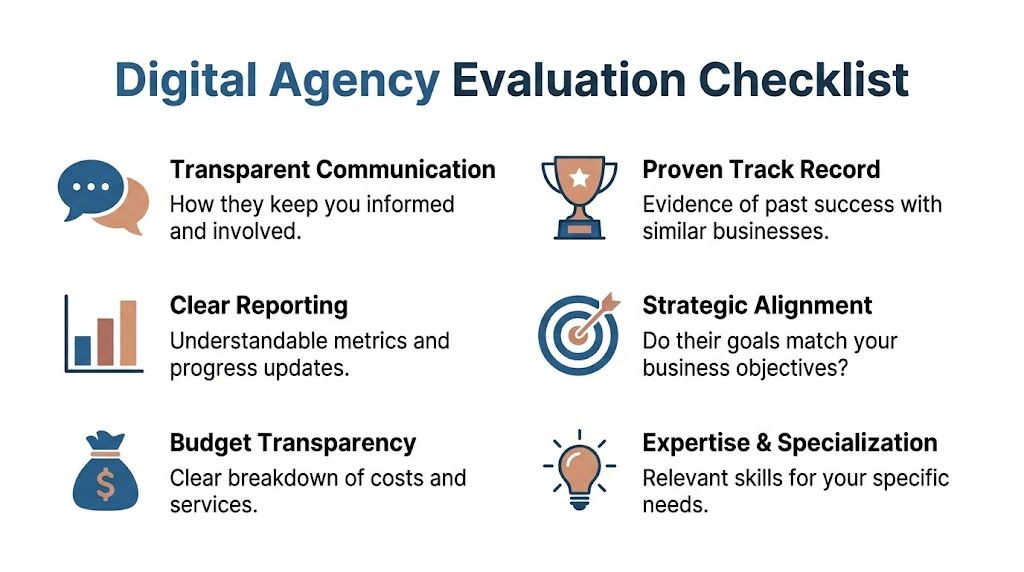
Technical depth matters more than most owners realize
A lot of small businesses hire for marketing and discover later they also needed technical problem-solving.
That shows up in practical ways:
- Website rebuilds that ignore conversion paths
- SEO campaigns on sites with poor structure or weak page performance
- Paid traffic sent to generic pages with no tracking
- Forms that don’t route cleanly into the CRM
- E-commerce stores that look fine but create friction at checkout
- Membership or registration systems patched together with too many plugins
Ask the agency what they can build and maintain. Can they work in WordPress without relying on bloated themes? Can they support Shopify or custom e-commerce needs? Can they map analytics events properly? Can they integrate with a CRM, donor system, scheduling tool, or registration platform? Can they advise on secure forms and data handling?
Those are not edge-case questions. They’re everyday small business questions.
Strategy should sound like diagnosis, not a menu
If an agency recommends the same stack to every business, that’s not strategy. That’s packaging.
Here’s what stronger strategy sounds like:
- They ask about sales cycle, not just traffic goals.
- They ask who closes the leads and what a qualified lead looks like.
- They ask whether the bottleneck is awareness, trust, conversion, or operations.
- They ask what happens after a form fill or phone call.
- They discuss which channels deserve attention now and which should wait.
The proposal should reflect your actual situation. A local clinic, a nonprofit membership organization, an online retailer, and a service contractor should not get the same plan with a logo swap.
Compliance isn’t a side note
This is one of the biggest blind spots in the market.
According to Left Lane Digital’s compliance gap discussion, 30% of agency clients are in regulated sectors like healthcare or nonprofits, but only 15% of digital agencies explicitly advertise expertise in standards like HIPAA or GDPR. That gap matters.
If you run a clinic, collect patient inquiries, manage donor data, or handle sensitive member information, you need to ask sharper questions than “Can you redesign our site?”
Ask instead:
- How do you approach secure forms and protected data flows?
- What’s your process for privacy-focused website planning?
- How do you factor accessibility into design and development?
- Have you handled regulated content approval workflows before?
- How do you coordinate marketing goals with compliance constraints?
An agency doesn’t need to posture as a law firm. It does need to know where risk lives and how to build with that in mind.
Watch for this: If the agency acts annoyed by compliance questions, they may be used to lower-risk projects than yours.
Reporting should be understandable and decision-friendly
Reports shouldn’t read like a data export. They should help you decide what to do next.
A useful reporting conversation covers:
| What to ask | What a good answer sounds like |
|---|---|
| What do you track? | Conversions tied to forms, calls, sales, or other agreed business actions |
| How often do we review results? | Regular reviews with context, not just dashboards sent by email |
| How do you handle weak performance? | They explain how they diagnose and adjust |
| Who explains the data? | A person who can translate metrics into business meaning |
If you want to understand the tools behind the work, this roundup of best SEO software for small businesses gives a helpful overview of platforms agencies often use for keyword research, technical audits, and performance tracking.
Communication should feel adult and direct
Every owner has heard some version of this: “We’ll take care of everything.” That usually sounds reassuring right before things get murky.
Ask practical questions:
- Who is my day-to-day contact?
- How quickly do you usually respond?
- What needs client approval?
- What do you expect from our team each month?
- How do you handle delays, blockers, or shifting priorities?
I’d also review a resource like how to choose an SEO agency and compare that advice against how a firm presents its own process. If the agency’s words and operating style don’t match, pay attention.
Real examples should match your kind of work
Case studies don’t need dramatic numbers to be useful. In fact, the most useful examples are often practical.
A good example might show that the agency:
- cleaned up a messy website structure
- improved local search visibility for a service business
- rebuilt a donor or registration flow to reduce friction
- created a site that staff can update
- connected ad campaigns to better landing pages and cleaner tracking
- supported a regulated organization without creating compliance headaches
That’s what you’re looking for. Proof of fit.
Crafting Your Request and Asking the Right Questions
Once you’ve narrowed the list, don’t send a vague “Need marketing help, what do you charge?” email. That invites canned responses.
A better request gives just enough detail to start a serious conversation. It tells the agency what business you run, what problem you need solved, what systems you already use, and what success needs to look like.
A simple outreach email that works
You don’t need a formal RFP. You need clarity.
Use something like this:
Hello, we’re a small business in [industry]. We’re looking for help with [main problem]. Our current setup includes [website platform, analytics, CRM, ad account, other systems]. We believe the biggest issues are [pain points]. We’d like support with [priority needs], and we want a partner who can also advise on [technical, compliance, integration, or reporting concerns]. Can you walk us through how you’d approach a project like this, who would be involved, and what the first phase would include?
That email does two useful things. It attracts thoughtful replies from serious agencies, and it discourages firms that only know how to sell prebuilt packages.
Questions that expose the real process
In first calls, don’t spend most of your time asking about price. Ask how they think.
Here are the questions that tend to separate operators from presenters:
- How would you diagnose our situation before recommending tactics?
- What would you want to review first in our current setup?
- What usually goes wrong on projects like ours?
- How do you decide whether the problem is traffic, conversion, messaging, or systems?
- What parts of this work are handled in-house?
- How do you set up tracking so we know what’s working?
- How do you handle content approvals and revisions?
- If we’re in a regulated or sensitive space, how do you factor that into planning?
- What happens in the first month after we sign?
- What would you need from our team to make the engagement successful?
The strongest answers are usually specific, a little unglamorous, and grounded in process.
Red-flag answers to watch for
Some answers sound polished but tell you very little.
Be careful when you hear things like:
“We can do everything.”
Maybe. But what do they do well, and what do they outsource?“SEO takes care of itself once we optimize the site.”
It doesn’t.“You don’t need to worry about tracking.”
You absolutely do.“We’ll know more after you sign.”
Fair to a point. But they should still describe their approach.“Compliance usually isn’t a big issue.”
Sometimes it is the issue.
If web design is part of the engagement, it helps to compare agency answers against practical guidance like how to choose a web design agency. You’ll quickly notice which firms think beyond colors and page layouts.
A useful first call leaves you with a clearer picture of your problem, even if you never hire that agency.
Comparing Proposals and Identifying a True Partner
When proposals arrive, don’t jump straight to price. Read for evidence that the agency listened.
A solid proposal sounds like your business. A weak one sounds like a template.

One of the clearest warning signs is a proposal that skips strategy and measurement. A lack of strategy and analytics is a primary reason campaigns fail, affecting over 52% of SMBs who misalign campaigns and waste budget, according to Allegiant Digital’s discussion of common mistakes. If a proposal can’t explain what will be tracked and how decisions will be made, it’s not ready.
What to compare side by side
Use a simple worksheet. Don’t overcomplicate it.
| Criteria | Agency A | Agency B | Agency C |
|---|---|---|---|
| Discovery process | |||
| Understanding of our business goals | |||
| Technical capabilities | |||
| Compliance awareness | |||
| Scope of work | |||
| Reporting approach | |||
| Timeline clarity | |||
| Pricing transparency | |||
| What they need from our team | |||
| Risks or assumptions identified |
That table forces better buying behavior. It keeps you from choosing based on presentation polish alone.
Read for listening, not buzzwords
A good proposal usually does a few things well:
- It restates your business goals in plain English.
- It identifies what they believe the main constraints are.
- It separates immediate priorities from later opportunities.
- It explains deliverables without hiding behind vague language.
- It includes a reporting and tracking method.
- It makes room for discovery when the situation is complex.
A weak proposal usually has the opposite traits:
- generic service descriptions
- no mention of your internal process or sales reality
- no technical detail
- no clear ownership
- suspiciously broad promises
- unclear revision or change-handling language
Cheap proposals often get expensive later
The lowest number on the page isn’t always the lowest cost.
Sometimes the cheap proposal leaves out essentials like analytics cleanup, conversion tracking, copy support, technical SEO, QA, redirects, form routing, training, or post-launch support. Then those items appear later as “additional scope.”
That’s not always dishonest. Sometimes it’s just rushed scoping. But it still costs you.
A stronger proposal names assumptions up front. If the site has unknown technical debt, they say so. If integrations may require extra work, they say so. If compliance review affects timeline, they say so.
This short video is useful if you want a practical lens for judging what an agency is really selling.
What a partner-oriented proposal feels like
The best proposals usually feel collaborative, not theatrical.
They often include:
- A first-phase plan: discovery, audit, setup, priorities
- Defined success signals: what they’ll measure and why
- Reasonable boundaries: what is included and what isn’t
- Shared responsibility: what they need from your team
- A sequence: fix foundation first, scale second
One practical option in this category is Studio Blue Creative, which offers SEO, SEM, web design, e-commerce, and custom development for organizations that need both marketing support and technical execution. That kind of hybrid capability matters when your growth problem and your systems problem are tied together.
Ensuring a Successful Partnership from Day One
The contract isn’t the finish line. It’s the handoff into the actual work.
The first stretch of a healthy agency relationship usually feels organized, calm, and slightly more rigorous than some clients expect. That’s a good sign. Strong onboarding protects both sides from confusion later.
What a strong kickoff looks like
A good kickoff meeting usually covers a few essentials in one sitting.
The agency confirms business goals, reviews priority audiences, maps existing systems, identifies known risks, clarifies approvals, and establishes who owns what. They should also define communication channels early. Email for approvals, project platform for tasks, call schedule for reviews, whatever fits the engagement.
The best kickoff calls also surface awkward truths early. Maybe the staff can’t turn revisions around quickly. Maybe the CRM is messy. Maybe the site has years of plugin bloat. Better to say that in week one than in month three.
The smoothest projects aren’t the ones without problems. They’re the ones where people name problems early and solve them without drama.
What your team needs to do
Clients sometimes expect the agency to “just take it from here.” That rarely works.
You still own key parts of the outcome:
- Fast approvals: Delayed feedback slows everything.
- Honest business context: Tell them what isn’t working internally.
- Access to systems: Get logins, permissions, and account ownership sorted early.
- Internal coordination: If multiple stakeholders need a say, define that process.
- Clear escalation path: Decide who makes the final call when opinions differ.
The agency can build, advise, write, optimize, and report. It can’t replace your business judgment.
A practical first-90-days rhythm
In the strongest engagements, the early period usually has a steady cadence.
Early phase
- confirm goals
- audit the current setup
- clean up tracking
- prioritize the highest-impact fixes
Middle phase
- launch or revise priority pages and campaigns
- improve conversion points
- fix technical issues
- align reporting with real business actions
Review phase
- assess early patterns
- remove underperforming elements
- refine messaging
- plan the next round based on evidence
That rhythm matters because most digital work improves through iteration. The first version gets you moving. The review process gets you smarter.
Measuring Real ROI and Growing Your Business
If all you get from an agency is more charts, that’s not growth. That’s decoration.
The key question is whether the work changes the business. Did better search visibility produce qualified inquiries? Did the new site improve lead flow? Did cleaner forms and integrations reduce admin time? Did campaigns bring in the kind of customer you want?

A well-managed SEM campaign can deliver around a 200% ROI, according to Ronin’s discussion of digital marketing agency success rates. But you only understand that outcome if you track the right things. Click-through rate alone won’t tell you much. Cost per lead, lead quality, closed business, and customer lifetime value tell you far more.
What to measure instead of vanity metrics
Focus on business-connected indicators:
- Lead generation: calls, form fills, booked consultations, demo requests
- Lead quality: are the right prospects coming in
- Conversion performance: are landing pages and site paths doing their job
- Sales follow-through: does marketing connect cleanly to the sales process
- Operational efficiency: are manual tasks dropping because systems are better
- Channel clarity: which efforts deserve more investment and which need to be cut
For social channels, this kind of measurement discipline matters too. A piece like how to measure social media ROI is useful because it pushes the conversation beyond likes and reach.
Growth gets easier when the foundation is solid
Small businesses don’t need every tactic. They need the right sequence.
If the website is weak, fix that. If tracking is unreliable, clean it up. If lead handling is sloppy, tighten the process. If your business has compliance pressure, address that before scaling campaigns. A digital agency for small business growth should help you do the next right thing, not sell the longest service list.
If you’re ready to turn your digital presence into a measurable growth engine, talk to a team that can handle both the strategy and the build. Call 731-402-0402 to start a conversation.
Frequently Asked Questions
What does a digital agency for small business actually do
A good agency helps you attract the right audience, improve your website or store, set up clean tracking, and convert attention into leads or sales. Depending on the firm, that can include SEO, paid search, web design, e-commerce, analytics, social media support, email, CRM integration, and custom development.
The better agencies also help prioritize. That matters because most small businesses don’t need everything at once.
Should I hire a specialist or a full-service agency
It depends on the actual problem.
If you already have a solid website, clean tracking, and a clear funnel, a specialist can make sense. If your issues span messaging, design, analytics, SEO, forms, CRM, and technical debt, a more integrated partner is often the better fit. Many small businesses don’t have a single-channel problem. They have a disconnected-system problem.
How do I know if an agency understands my business
Listen to the questions they ask.
If they only ask about budget and channels, they may be selling packages. If they ask about margins, lead quality, operations, close process, compliance, and internal capacity, they’re probably thinking at the business level. The best agencies usually improve your understanding of the problem during the sales process.
What if I need more than marketing
Then don’t hire a marketing-only vendor and hope they figure it out.
Some businesses need a better intake workflow, a donor or registration system, an app interface, a secure site rebuild, or an integration between the website and internal tools. If that’s your situation, evaluate technical capability early. Otherwise you may end up hiring one agency for traffic and another firm to fix the infrastructure underneath it.
How long does it take to see results
That depends on the work being done and the condition of the current setup.
Paid campaigns can produce useful signal quickly if the offer, targeting, landing pages, and tracking are in place. SEO, content, and website improvements usually take longer because they involve technical fixes, content quality, authority, and user behavior. The more broken the foundation, the more important the early cleanup becomes.
How involved do I need to be after hiring an agency
More involved than most owners expect, at least in the beginning.
You don’t need to do the agency’s job. You do need to approve priorities, provide business context, review messaging, and make timely decisions. Agencies perform better when the client is responsive, honest, and organized.
What’s the biggest mistake small businesses make when hiring an agency
Hiring based on promises instead of process.
A slick presentation can hide weak execution. A lower fee can hide missing scope. A big service list can hide shallow expertise. The safest choice is usually the agency that explains how it thinks, what it will do first, what it will measure, and what it needs from you.
What should I bring to the first call
Bring clarity, not polish.
Have a short summary of your business, your main pain points, your current website platform, any analytics or ad platforms you use, and what success would look like in practical terms. If you know where the friction is, say it plainly. That saves time and leads to better recommendations.
If you want a partner that can think beyond campaigns and help you build secure, scalable digital assets that support real business growth, Studio Blue Creative is worth a conversation. Whether you need SEO, SEM, web design, e-commerce support, or a more technical solution, the right next step is a plainspoken discussion about what’s working, what isn’t, and what should happen first. Call 731-402-0402 or reach out through the website to start the conversation.
Find out if ChatGPT recommends your business.
Right now, your customers are asking AI for recommendations. The AI is naming somebody. Is that name yours? Run our free AEO Scorecard — we test 3 of your real queries against ChatGPT and Claude and email you a personalized report.