

A small-business owner usually notices the website problem the same way. Traffic shows up, but the phone rings with poor-fit leads. Contact forms stay quiet. Existing customers still call to ask basic questions the site should have answered in seconds.
That gap is why choosing a web design company is harder than it looks. Agency sites tend to sound interchangeable, and terms like responsive, SEO-friendly, and conversion-focused do not tell you how a firm operates once your project starts. They also do not tell you whether the team can handle the issues that matter to your business, such as local search visibility, online scheduling, e-commerce, compliance, or integrations with the tools you already use.
This guide is built to help you make that call with more confidence. It goes beyond a list of names and points you toward a practical evaluation process, including criteria that matter in real projects and a side-by-side comparison later in the article. It also includes a Tennessee option, Studio Blue Creative, for businesses that want a local partner with broader strategy and development experience. If you want a stronger checklist before comparing agencies, this guide on how to choose a web design agency is a useful place to start.
Some companies on this list are a better fit for local service businesses that need lead generation. Others make more sense for e-commerce brands, multi-location companies, or organizations that have outgrown a template site and now need custom functionality. If mobile performance is part of the problem, this breakdown on making mobile websites is also worth reviewing, because a site that feels clumsy on a phone will undercut everything else you spend on marketing.
One final point before the list. The market is crowded, so the job is not finding an agency. The job is finding one whose process, technical range, and communication style match the way your business operates.
1. Studio Blue Creative
A common small-business scenario goes like this. The site looks dated, forms are inconsistent, nobody trusts the analytics, and the owner is also trying to fix search visibility, scheduling, or a clunky customer workflow at the same time. In that situation, a design-only shop usually creates more handoffs than progress.
Studio Blue Creative is a better fit for projects that reach beyond page design. The team works across strategy, UX/UI, secure development, SEO, analytics, e-commerce, mobile apps, and custom software. That range matters for companies that need the website to support lead flow, operations, and reporting instead of acting as a digital brochure.
The Tennessee location is part of the appeal, especially for businesses that want a regional partner with broader technical depth. Studio Blue Creative is veteran-owned and has long experience with small and mid-sized businesses, healthcare groups, nonprofits, and startups. That client mix usually signals a practical skill set. Clear messaging on the front end, careful development behind it, and a process that can handle approvals, compliance concerns, and custom requirements.
Why it works in practice
Small businesses rarely struggle with design alone. They struggle with disconnects between the website and the rest of the business. The site does not reflect the actual sales process. The forms do not route cleanly. The content does not answer buyer questions. The platform cannot support the next stage of growth.
Studio Blue Creative appears built for those situations.
Its work is especially relevant for businesses in four buckets:
- Growing local companies: You need a site that supports search visibility, lead capture, and clearer conversion paths.
- Healthcare and nonprofits: You need polished design, but you also need a team that understands security, accessibility, and process constraints.
- Operationally complex organizations: You may need integrations, portals, registration flows, or custom tools tied to the website.
- Businesses replacing a stalled DIY or template build: You need a team that can clean up scope, tighten requirements, and get the project to launch.
Practical rule: If your website project affects operations, compliance, or multiple software systems, choose an agency that can build the underlying system, not just the interface.
That distinction is easy to miss during sales conversations. It becomes expensive during implementation.
Where Studio Blue Creative has an edge
Many agencies can produce a polished WordPress site. Fewer can connect design, custom development, analytics, search strategy, and post-launch support without sending you to three separate vendors. For a small business, that lowers coordination risk and usually leads to cleaner execution.
Studio Blue Creative also stands out because its published work points to more than marketing pages. An EMG audit automation platform and a registration system for the Tennessee Wildlife Federation suggest a team that can solve workflow problems, not just visual ones. If your website needs to do real work after launch, that matters.
Cost is part of the decision too. Businesses comparing firms should review realistic small business website design cost ranges before they start collecting proposals. It helps separate projects that need a true custom build from projects that can succeed with a simpler scope.
For Tennessee companies, there is also a practical advantage in proximity. Local access does not guarantee a better result, but it often improves communication, discovery, and accountability during a project with a lot of moving parts.
Best fit and trade-offs
Studio Blue Creative is a strong match for healthcare groups, nonprofits, e-commerce businesses, and service companies that need more than a template refresh. It also fits owners who want strategic input during the build, not just production.
The upside is clear:
- Broad capability: Strategy, UX/UI, development, integrations, launch, and support stay under one roof.
- Experience across regulated and complex work: Useful when the project includes compliance concerns or custom workflows.
- Marketing awareness: SEO, analytics, and conversion planning are part of the build conversation.
- Longer-term usefulness: The team can support growth after launch instead of handing off a finished design file.
The trade-offs are real too:
- No public pricing: You will need a proposal to understand scope and budget.
- Not the cheapest path: Businesses that only need a fast brochure site may find simpler providers more cost-effective.
- Best value comes from fuller-scope projects: If you do not need strategy, integrations, or custom functionality, part of the agency's range may go unused.
If the goal is to choose a firm, not just admire a portfolio, Studio Blue Creative earns its place on this list because it gives small businesses a credible local option with real technical depth. That makes it a useful benchmark as you compare agencies later in the article.
2. WebFX
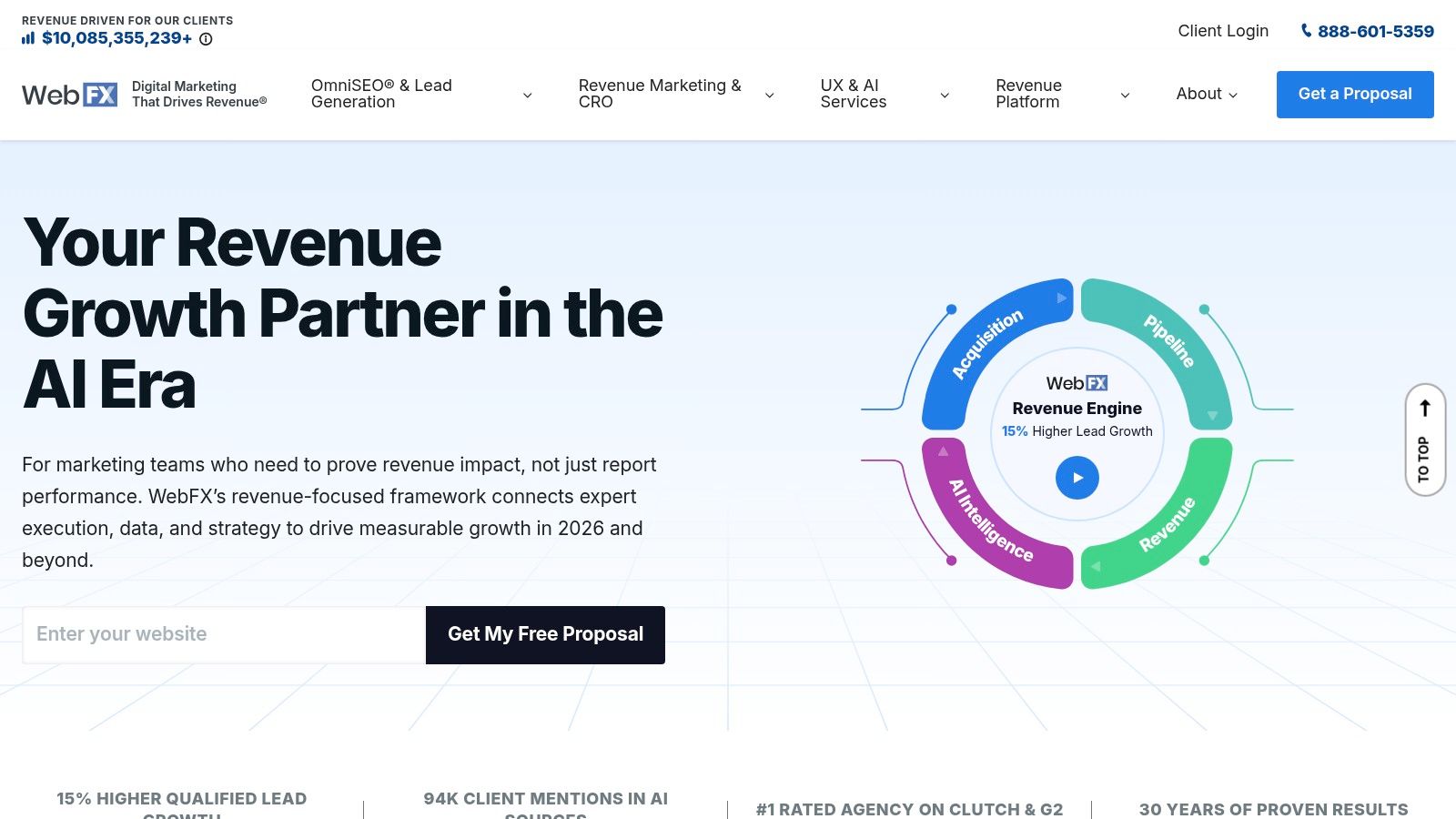
WebFX is one of the better-known options for small businesses that want a website tied directly to lead generation and marketing performance. That distinction matters. Plenty of agencies launch a site and leave you with a good-looking asset and no traffic plan. WebFX is built around the opposite model.
The practical appeal is speed, structure, and visibility into budget. The agency is known for offering pricing guidance and a faster build path for businesses that don't want a long custom process. If you're replacing an outdated site and need something live without dragging the project out for months, that's attractive.
Where WebFX fits best
WebFX is strongest when the website is one part of a broader growth plan. Think SEO, paid search, CRO, copywriting, accessibility-minded design, and reporting under one roof. That's useful for owners who don't want to coordinate separate vendors for design and marketing.
For a small business, this often solves a common failure point. The new website launches, but nobody has planned how pages will rank, how forms will convert, or how traffic sources will be measured. WebFX tends to build around those questions from the start.
A fast website build only helps if the message, calls to action, and measurement plan are already in place.
Another plus is that WebFX is one of the easier agencies to use for early budgeting conversations. If you're trying to compare costs across vendors, that transparency helps you avoid wasting time on proposals that don't match your budget reality. This article on small business website design cost is also helpful for framing what different scopes tend to involve before you start those calls.
Trade-offs to watch
WebFX isn't the most natural fit for every company. If you're a very small local business that needs a lean, relationship-driven project with lots of hands-on flexibility, a large national agency can feel process-heavy. That's not necessarily bad. It just means you'll want to know how much structure you want versus how much customization you need in the working relationship.
The other trade-off is scope expansion. A fast-launch package can make sense, but some businesses start there and then realize they also need deeper messaging work, local SEO architecture, content support, or custom functionality. At that point, the budget can move beyond what a micro-business expected.
For the right buyer, though, WebFX is a solid choice. It's especially useful if you want one team handling web design, traffic generation, and post-launch optimization rather than treating launch day as the finish line.
3. SmartSites
SmartSites stands out for a practical reason. It puts site ownership front and center, which matters if you've ever been burned by a rented-site model or a vague handoff agreement.
I pay close attention to that point when comparing agencies for small businesses. A polished website is useful. Control over the files, platform access, analytics, and hosting relationship is what protects you later if you switch vendors, bring marketing in-house, or need a developer to step in quickly.
Why small businesses choose it
SmartSites works across WordPress, Shopify, and Magento, so it can cover both lead-generation websites and online stores without forcing every project into the same system. That flexibility is a real advantage for companies that are still figuring out how their site needs to support the business over the next few years.
The agency also puts attention on the parts that affect performance after launch: site structure, page speed, analytics setup, and ongoing support. That makes SmartSites more relevant for owners who want a website that can keep improving instead of acting like a one-time design project.
Platform range is the key advantage here.
A local service company might start with WordPress, then need stronger location pages and better conversion tracking six months later. A retailer on Shopify might need landing pages for paid traffic, cleaner collection structure, or help connecting campaigns to revenue. SmartSites appears built for that kind of growth path, which is different from agencies that only shine during the visual redesign phase.
What I’d check before signing
The main question is fit. SmartSites looks strongest for businesses that want a standard marketing site or e-commerce build on a proven platform, then ongoing help refining it. If your project includes unusual integrations, highly custom functionality, or a more complex application layer, get specific about where templated platform work ends and custom development begins.
A few checks matter before you sign:
- Confirm ownership in writing: Make sure the contract clearly states who owns the website, design files, content, domain settings, and platform access.
- Define post-launch support: Ask what maintenance, edits, reporting, and optimization are included each month.
- Match the platform to the business model: WordPress, Shopify, and Magento each come with different costs, admin complexity, and growth limits.
If you're still sorting out those decisions, these small business website design tips are a useful companion because they cover the practical choices that affect whether a redesign brings in better leads or just gives you a newer-looking site.
SmartSites is a strong option for buyers who want platform flexibility, clear ownership terms, and support that continues after launch. In a guide built to help you choose, not just scan a list, that makes it a credible middle-ground option between bare-bones vendors and heavier agency engagements.
4. Hibu
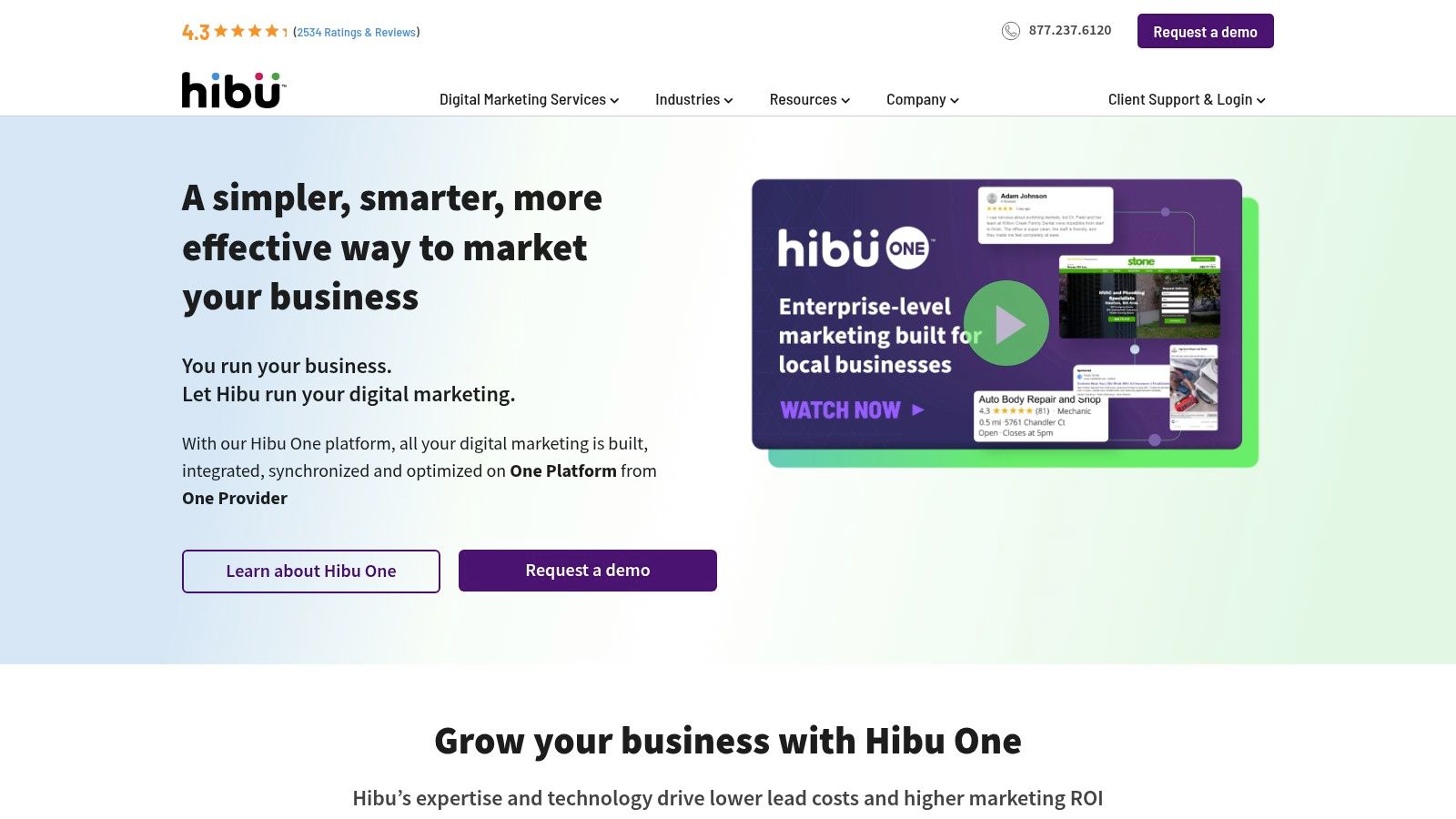
Hibu fits the owner who is tired of chasing freelancers, updating plugins, and wondering who to call when the site breaks. Its offer is simple. Pay a monthly fee and keep the website, hosting, SSL, basic SEO setup, copy help, and routine edits under one roof.
That model works well for a certain kind of small business. If your site is mainly there to explain services, rank locally, and bring in calls or form fills, Hibu removes a lot of operational drag. You are not piecing together hosting, design, maintenance, and marketing from four separate vendors.
Best for businesses that want one accountable provider
Hibu's real advantage is convenience with structure. The package is managed, the support path is clear, and the ongoing work is built into the relationship instead of treated like a new project every time you need a change.
For busy local operators, that matters. A plumber, dentist, roofer, or law office usually does not need a highly custom digital product. They need a site that stays live, loads properly, reflects the current business, and gives customers an easy way to reach out. Hibu is built around that reality.
I usually put Hibu in the "done-for-you" column of a selection framework. It sits on the opposite end from firms that give you more technical freedom but also expect you to make more platform and maintenance decisions.
The trade-off is control
The same package that makes Hibu easy to buy can make it harder to stretch. Businesses with unusual integrations, custom quoting logic, advanced content structures, or specialized tools often hit the edges of subscription website models faster than they expect.
That does not make the model bad. It means the fit has to be honest.
Strong fit: straightforward local business sites, predictable monthly costs, and owners who want one team handling updates and upkeep.
If the website is becoming a core operating system for the business, not just a marketing asset, I would ask tougher questions before signing. Clarify what is included, what counts as out-of-scope work, how quickly edits are handled, and how much flexibility you have if your needs change six months from now.
Hibu is a practical choice for small businesses that value simplicity over customization. In a guide built to help you compare agencies by operating model, not just brand recognition, that makes Hibu a useful option for owners who want fewer moving parts and a clear support structure.
5. Scorpion
Scorpion is built for service businesses that care more about booked jobs and qualified leads than design awards. That's a useful distinction because some of the best website design companies for small business are really growth systems with websites at the center, not pure design studios.
Scorpion's niche focus is local services. That includes industries like home services, legal, and medical. The company pairs websites with AI-enabled chat, online scheduling, lead scoring, and advertising support. If your business lives or dies by lead flow, that integrated approach is worth serious consideration.
Why this approach can outperform a prettier site
A lot of service businesses don't need a complex custom website. They need a site that answers common objections, routes inquiries correctly, and gives staff clean follow-up data. Scorpion understands that workflow better than agencies that mostly serve broad B2B or brand-heavy projects.
Its integrated stack is also a practical match for busy owners. Instead of managing one company for the website, another for paid ads, and another for lead tracking, you can keep the funnel together. For some businesses, that operational simplicity is more valuable than design flexibility.
There's also a broader market reason specialized firms matter. Existing category coverage often overlooks regulated and niche industries, even though research summarized by 10BestDesign notes that only 10-20% of top firms explicitly mention healthcare or nonprofit projects. That gap is exactly why specialized buyers should look past generic "top agency" lists.
The trade-off with integrated platforms
Integrated systems aren't for everyone. If you like assembling your own tool stack, choosing your own CRM, and controlling each moving part separately, Scorpion may feel too packaged. Some owners love all-in-one systems. Others feel constrained by them.
A few questions to ask before you commit:
- Lead handling: Who responds, how quickly, and where do inquiries land?
- Data visibility: What reporting do you get beyond surface-level lead counts?
- Portability: If you leave, what pieces of the stack come with you?
Scorpion is best for service-based SMBs that want fewer moving parts, stronger funnel coordination, and a vendor that understands local lead generation at the operational level.
6. Coalition Technologies
A small retailer usually hits the same wall at some point. The first site worked fine for a short catalog and a few monthly orders, then product pages multiplied, promotions became harder to manage, and simple design updates started affecting conversion paths. That is the kind of business case where Coalition Technologies makes sense.
Coalition stands out in this lineup for businesses that need a site to sell, not just explain. It supports Shopify, WooCommerce, BigCommerce, and Magento, which gives owners more room to match the platform to their catalog size, internal workflow, and growth plan. That matters because e-commerce platform choices are expensive to reverse once inventory, content, and marketing systems are built around them.
The practical advantage is range. A company selling ten SKUs has very different needs from one managing variants, seasonal campaigns, bundled offers, and search-driven category pages. Coalition is better suited to those more demanding setups than agencies that treat online stores as a side service.
Best fit for businesses planning around commerce complexity
Coalition is a stronger option for product-based companies with real e-commerce requirements. That can mean custom development, a store that needs technical SEO support, or a marketing plan tied closely to paid traffic and landing page performance.
For the right business, that combination saves time and avoids handoff problems between separate vendors.
The trade-off is straightforward. Coalition can be too much agency for a basic local business site. If you run a service company that needs five pages, clear messaging, and a contact form, you may end up paying for technical depth you will not use. In those cases, a simpler firm on this list, including a more regionally focused option like Studio Blue Creative for Tennessee businesses, may be a better fit.
A better way to evaluate Coalition is to ask how your store is likely to change over the next 12 to 24 months. Will the catalog expand? Will paid search feed product pages? Will merchandising, filtering, or content strategy become more important? If the answer is yes, Coalition is worth serious consideration.
Ask direct questions before signing:
- Which platform do they recommend for your current catalog and why?
- What parts of the build are custom versus theme-based?
- How do they handle product taxonomy, collection structure, and on-page SEO?
- What happens if you need new landing pages, promotions, or campaign support after launch?
The right fit is not the agency with the longest service menu. It is the one built for the problems your business is about to have. Coalition fits retailers and growth-minded sellers that need a website partner with deeper commerce experience, not just general small-business design capability.
7. Thrive Internet Marketing Agency
Thrive Internet Marketing Agency is a practical choice for small and mid-sized businesses that want a WordPress-focused website and ongoing digital marketing support from the same provider. That combination is common for a reason. A lot of business owners don't just want a redesign. They want help attracting traffic after launch.
Thrive's service mix includes WordPress design and development, SEO, PPC, social media, and content. For businesses that expect the website to anchor broader marketing campaigns, that package is attractive. You don't have to explain your business to one company for the build and another for growth.
Why WordPress still matters here
WordPress remains a default choice for many SMB websites because it gives businesses control, flexibility, and a large plugin ecosystem. In category research summarized by 10BestDesign, Media Junction and Socially Savvy Studio are noted for using WordPress on budget projects under $5,000, which reflects how often the platform remains the practical answer for small-business budgets and marketing needs.
Thrive benefits from that familiarity. If your team already knows WordPress, or if you want a site that's relatively easy to extend over time, that's a plus. It also makes ongoing content updates and SEO work more manageable than many proprietary systems.
Where Thrive fits best
Thrive makes the most sense for businesses in one of these situations:
- You want WordPress: Not a proprietary platform, not a rented site.
- You need marketing after launch: SEO, PPC, social, or content support.
- You may scale later: Start with the website, then expand into broader campaigns.
The main caution is budget fit. Smaller budgets may find full-service agencies harder to engage at the exact level they want, especially if the project is modest. But for businesses that want a site plus ongoing promotion from one team, Thrive is a credible and practical option.
Top 7 Small-Business Website Design Companies Comparison
| Provider | 🔄 Implementation | ⚡ Resource requirements | ⭐📊 Expected outcomes | 💡 Ideal use cases | Key advantages |
|---|---|---|---|---|---|
| Studio Blue Creative | Moderate–High (custom dev, integrations, compliance) 🔄 | Skilled engineering + performance marketing; quoted per project ⚡ | Measurable conversions and scalable secure solutions ⭐⭐⭐⭐ 📊 | Healthcare, nonprofits, custom platforms, rescue projects 💡 | End‑to‑end service; compliance experience; hands‑on guidance |
| WebFX | Low–Moderate (templates with custom options) 🔄 | Clear pricing guidance; rapid delivery teams; 30‑day option ⚡ | Fast launches with SEO/CRO and accessibility gains ⭐⭐⭐⭐ 📊 | SMBs needing speed, compliance, and integrated growth services 💡 | Transparent pricing; full‑service growth stack; rapid builds |
| SmartSites | Moderate (WP/Shopify/Magento builds, performance focus) 🔄 | Platform expertise and ongoing maintenance plans ⚡ | SEO and page‑speed improvements; asset ownership ⭐⭐⭐ 📊 | SMB ecommerce and lead‑gen that want ownership and SEO focus 💡 | Clients retain full ownership; performance optimization |
| Hibu | Low (turnkey subscription sites) 🔄 | Predictable monthly fee includes AWS hosting, SSL, basic SEO ⚡ | Consistent upkeep and local visibility; predictable costs ⭐⭐⭐ 📊 | Local businesses seeking managed hosting and fixed monthly pricing 💡 | Clear monthly pricing; turnkey hosting and editor tools |
| Scorpion | Moderate–High (industry integrations, AI features) 🔄 | Integrated marketing platform (chat, lead scoring, ads); custom proposal ⚡ | Strong lead capture and scoring for service businesses ⭐⭐⭐⭐ 📊 | Home services, legal, medical practices focused on lead gen 💡 | Deep vertical specialization; unified site + ads + lead tools |
| Coalition Technologies | Moderate–High (ecommerce & headless options) 🔄 | Broad platform support and SEO/CRO teams; custom budgets ⚡ | Ecommerce growth and conversion uplift for retailers ⭐⭐⭐⭐ 📊 | SMB retailers/manufacturers needing scalable ecommerce solutions 💡 | Strong ecommerce expertise; flexible technical approaches |
| Thrive Internet Marketing Agency | Moderate (WordPress-centric builds with marketing) 🔄 | WordPress specialists plus full‑service marketing teams; scalable ⚡ | Improved traffic and campaign performance post‑launch ⭐⭐⭐ 📊 | SMBs that prefer WordPress with ongoing SEO/PPC/social support 💡 | WordPress focus; bundled digital marketing services |
Ready to Build a Website That Actually Grows Your Business?
A small business owner finally signs off on a new site, launches it, and waits for better leads. A month later, the design still looks good, but the forms are weak, nobody trusts the reporting, and simple content updates require another agency ticket. That is usually the point where the website stops feeling like an asset and starts feeling like overhead.
Choosing from a list of the best website design companies for small business is only the first step. The more important call is choosing the kind of partner you want after launch. Good agencies do more than deliver pages. They help you handle search visibility, lead flow, integrations, compliance requirements, analytics, and the day-to-day reality of managing the site internally.
That is why this guide focused on fit, not just brand recognition. The comparison table and evaluation criteria matter because small businesses do not all need the same setup. A company that wants a fixed monthly service model may be well served by Hibu. A business that needs deeper SEO support and broad marketing resources may lean toward WebFX. A retailer with serious ecommerce requirements may need Coalition Technologies. A service business that lives and dies by lead handling may prefer Scorpion.
Regional fit matters too.
For Tennessee businesses and nearby markets, Studio Blue Creative gives owners a practical local option with broader technical range than many small regional shops. The team has worked across web design, SEO, social media marketing, search engine marketing, analytics, ecommerce, custom development, and app projects. That creates a tangible advantage when the site has to support more than marketing, including internal workflows, donor registration, clinic communication, or sales processes.
I have seen plenty of small businesses buy a polished redesign when what they needed was a better operating tool. The homepage looked sharper. The staff still struggled with updates, forms still underperformed, and the site still could not support the next growth stage. That is the trade-off owners need to evaluate before they sign anything.
Studio Blue Creative stands out most for organizations with operational complexity that does not fit a templated package. That includes healthcare groups, nonprofits, and growing businesses that need marketing and technical execution in the same engagement. Experience with responsive clinic websites, custom tools, and nonprofit registration systems suggests a team that understands how websites function inside the business, not just on the screen.
Communication is part of the decision too. Larger agencies can be a strong fit, but smaller clients sometimes get pushed into rigid processes or passed between account layers. Many businesses want direct answers, clear scope, and a team that can step into a new build or recover a project that has gone off course.
If that is the kind of support you need, Studio Blue Creative is worth a serious look. Call the Jackson, Tennessee team at 731-402-0402 for a no-obligation consultation, or send an email to start the conversation.
Find out if ChatGPT recommends your business.
Right now, your customers are asking AI for recommendations. The AI is naming somebody. Is that name yours? Run our free AEO Scorecard — we test 3 of your real queries against ChatGPT and Claude and email you a personalized report.