
Embarking on mobile app development for your startup is a significant journey. It's far more than writing code; it's a process of transforming a raw idea into a polished solution that genuinely solves a real-world problem. Success hinges on validating your concept, strategically planning a Minimum Viable Product (MVP), and making smart technology choices that ensure your investment propels you forward.
Your App Idea Needs a Blueprint, Not Just a Dream
Turning that brilliant "what if" into a market-ready app is a challenging but incredibly rewarding path. It's a journey filled with critical decisions that have little to do with the technical details. This guide moves beyond theory, offering a practical playbook forged from our experience helping founders navigate the exciting, often complex road from concept to a successful launch.
Our goal is to provide you with a clear, positive roadmap for validating your idea, defining a lean and effective MVP, and making intelligent tech choices. Drawing on real-world examples from startups we've partnered with—from innovators in healthcare to community-focused organizations—we'll help you sidestep common pitfalls and build a product with lasting value.
The Foundation of a Successful App
Long before the first line of code is written, the groundwork must be laid. A successful app is rarely an accident; it's the result of a methodical approach that prioritizes market fit and user needs. This initial phase is about asking the tough questions and discovering honest answers.
This roadmap visualizes the essential stages every startup should master to build a solid foundation.
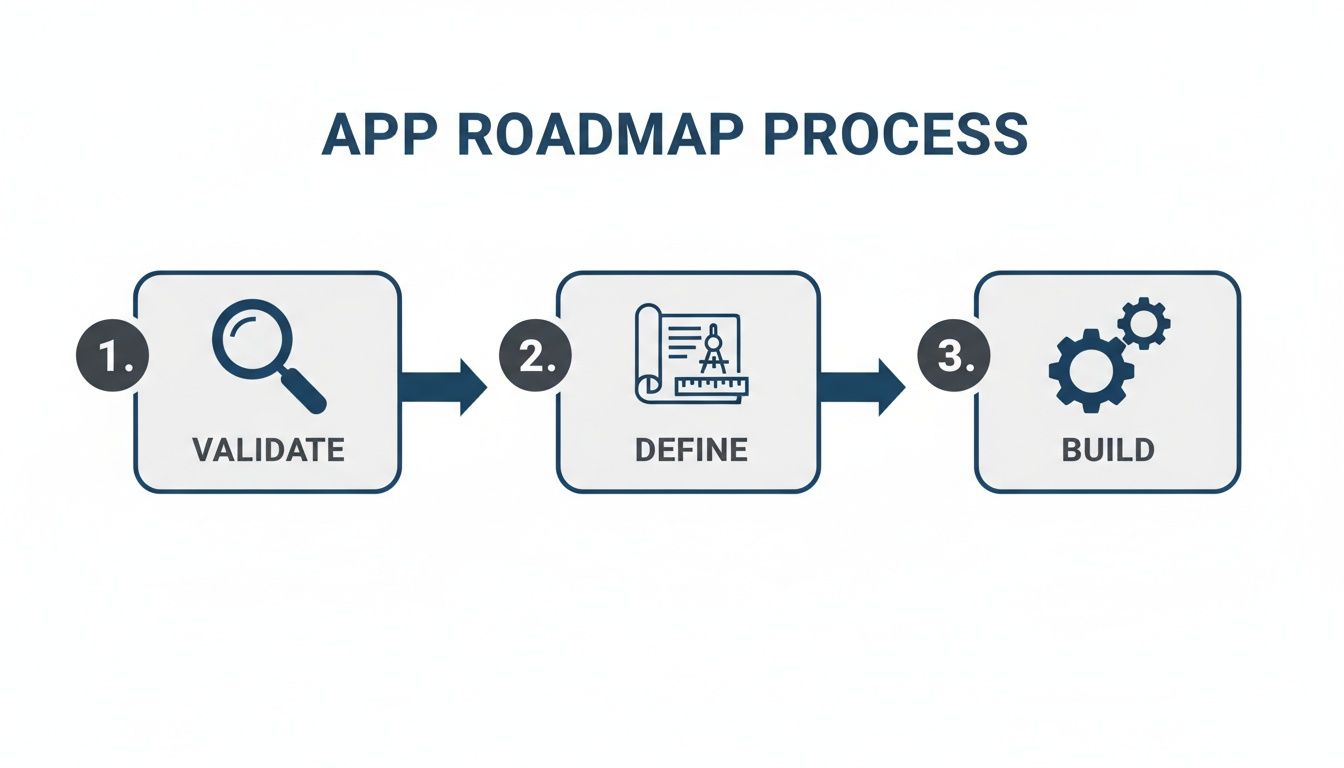
What this truly illustrates is that validation and definition are not mere suggestions—they are crucial, non-negotiable steps before you consider development. This is how you confidently avoid investing significant resources into an idea that hasn't proven its demand. While the pressure to jump straight into building is strong, pausing to plan here is where you prevent the most expensive mistakes and set yourself up for success.
To get you started on the right foot, here is a quick checklist summarizing the essential pre-development phases. Consider it a strategic check-in before committing your valuable resources.
Startup App Development Quick-Start Checklist
| Phase | Key Objective | Why It's Critical for Startups |
|---|---|---|
| Idea Validation | Confirm there's a real market need for your solution. | Prevents building a product nobody will use or pay for. |
| MVP Definition | Identify the absolute core features needed for launch. | Saves time and money by focusing on essential value first. |
| Tech Stack Selection | Choose the right technologies for scalability and budget. | Avoids costly re-platforming and technical debt down the road. |
| Cost & Timeline Estimation | Create a realistic budget and project schedule. | Secures funding and sets clear expectations for stakeholders. |
This table isn't just a to-do list; it’s a strategic framework. Embracing these phases is what distinguishes the apps that thrive from those that quietly fade away.
Understanding the Market Opportunity
The opportunity in the mobile space is immense and growing. The global mobile app development market is projected to expand from $252.89 billion in 2023 to an impressive $626.39 billion by 2030. Furthermore, global app earnings are on track to climb from $522.7 billion in 2024 to $673.7 billion by 2027, with subscriptions becoming a dominant revenue model. You can explore more in these mobile app development statistics.
"The most common and costly mistake is skipping market validation. Many founders fall in love with their idea and assume everyone will want what they envision, leading to a bloated, expensive product built on unverified assumptions."
This highlights a vital truth: while the market is expanding, success is earned, not guaranteed. It comes from creating something people genuinely need and value. It's about delivering a solution, not just a collection of features.
Ready to transform your idea into a practical, scalable product? We can help you navigate this entire process with confidence, from the first validation step to a successful launch. Contact us today for a consultation to discuss your vision and explore how we can bring it to life together.
Confirming Demand Before You Write Any Code
One of the most common pitfalls we see is a startup investing its passion, time, and significant capital into building a beautiful app, only to discover a lack of genuine market need upon launch. This is, without question, the single most avoidable and costly misstep.
Before a single line of code is written, it's essential to ground your idea in reality. This isn't about seeking validation from friends; it's about a disciplined search for truth from your potential customers, even if that truth reshapes your initial vision. Instead of broad surveys that yield polite but unhelpful feedback, the goal is to measure real intent and uncover genuine problems.
Low-Cost Methods to Test Your App Idea
The objective here is simple: gather tangible feedback with minimal financial risk. By creating simple tools, you can gauge genuine interest before committing to a full-scale build.
Here are a few proven methods to achieve this:
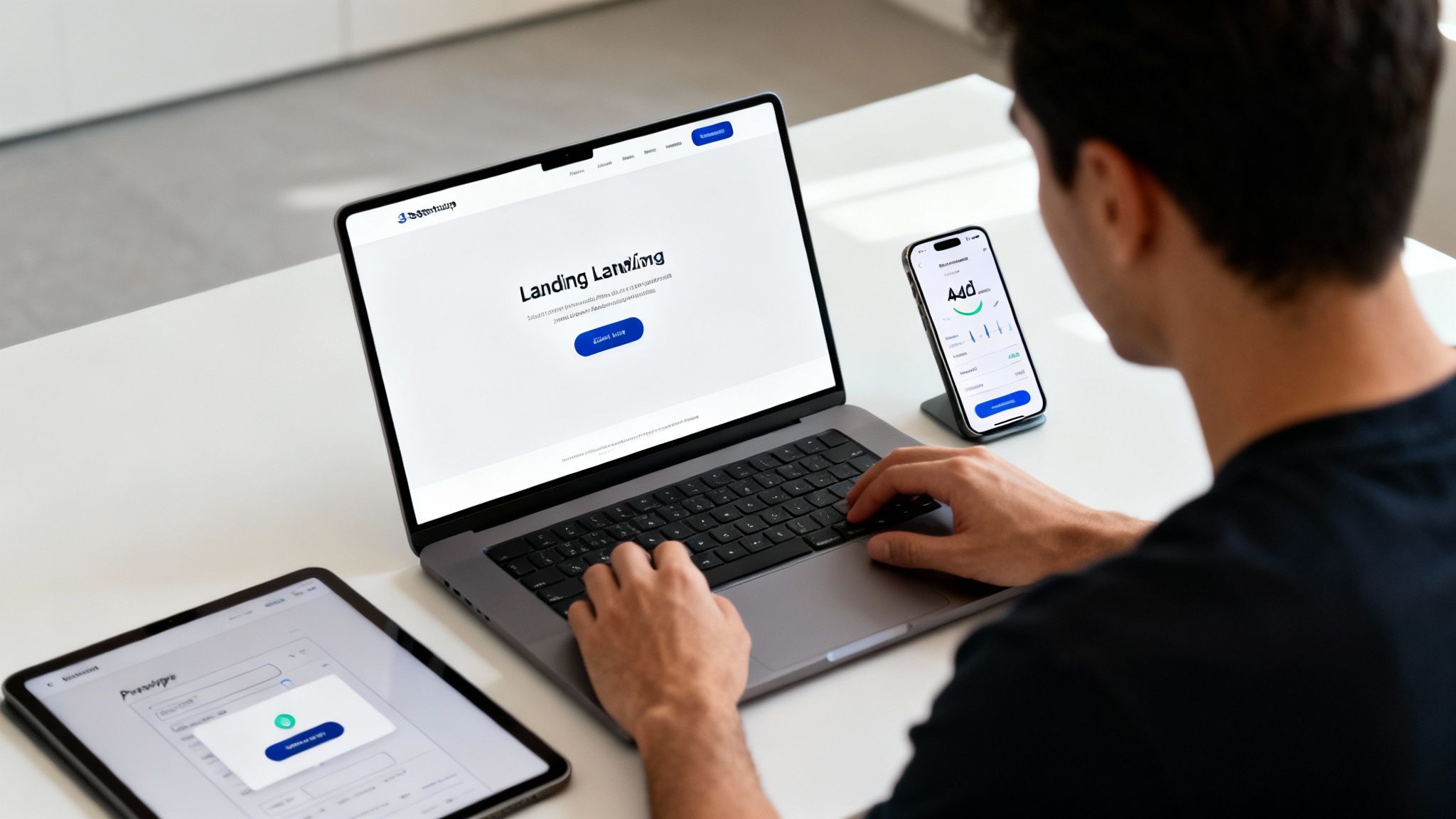
- Build a Simple Landing Page: Use a tool like Carrd to create a clean, one-page website. Clearly articulate your app's value proposition and include a clear call-to-action, such as an email sign-up for an early access list. The number of sign-ups is a direct, measurable indicator of market interest.
- Run Hyper-Targeted Social Media Ads: Allocate a small budget for ads on platforms like Facebook or Instagram. Target them precisely at your ideal customer profile and test different messaging. The clicks and conversions will reveal which aspects of your idea resonate most strongly.
- Conduct Insightful User Interviews: Move beyond focus groups. Sit down one-on-one with 10-15 individuals who represent your target audience. Your role is not to sell your idea but to listen intently. Ask open-ended questions about their current challenges and the solutions they currently use.
These steps provide more than a simple "yes" or "no." They deliver rich, detailed insights that will positively shape your features, marketing, and overall strategy. You can find more excellent tips in these 9 tips for using app marketing to stand out.
A Real-World Validation Example
Let's look at a practical scenario. A startup we advised had a concept for a "local service finder" app designed to connect homeowners with pre-vetted, reliable handymen for small jobs. Instead of immediately diving into development, they wisely invested just $500 to validate the idea first.
They began with a simple landing page. The headline was direct and benefit-driven: "Find Trusted, Local Handymen in Under 5 Minutes. Guaranteed." It highlighted key benefits—background-checked professionals, instant booking, and transparent pricing. The only action a visitor could take was to enter their email to "Get Notified When We Launch in Your Area."
Next, they launched a targeted Facebook ad campaign aimed at homeowners aged 30-55 in a specific suburban zip code. They tested two ad variations: one focusing on speed ("Need a Plumber Now?") and another emphasizing trust ("Tired of Unreliable Contractors?").
The results were illuminating. The ad focused on trust and reliability received 3x more clicks and led to a 40% higher email sign-up rate. This single data point revealed their market's primary pain point wasn't speed—it was the challenge of finding someone trustworthy to invite into their home.
Finally, they spoke with 10 of the individuals who signed up. They discovered that most were willing to wait an extra day for a vetted professional over getting someone unknown in an hour. This feedback fundamentally reshaped their MVP. The focus shifted from "instant booking" to building a robust review and vetting system.
This validation process saved them tens of thousands of dollars and months of development time by preventing them from building a core feature their market didn't prioritize.
Defining a Minimum Viable Product That Wins
Once you’ve validated your app idea, the temptation is to build every feature on your wishlist. This is a critical moment. Resisting "feature creep"—the silent killer of startup budgets and timelines—is paramount.
A Minimum Viable Product (MVP) isn't a scaled-down, incomplete app. It's the most focused, strategic version possible. The goal is to identify the single most significant problem your app solves and build just enough to solve that one problem exceptionally well. Everything else is secondary for now. This laser focus allows you to get to market faster, initiate the feedback loop with real users, and conserve precious capital for future growth.

A Framework for Ruthless Prioritization
To avoid feature creep, you need a system. One of the most effective frameworks is the MoSCoW method. It's a simple yet powerful tool that forces you to categorize every potential feature, making tough prioritization decisions much clearer.
Here’s the breakdown:
- Must-Have: These are the non-negotiable features. Without them, the app is fundamentally broken. For a ride-sharing app, this would be GPS tracking and the ability to book a ride.
- Should-Have: These are important features that add significant value but are not critical for the initial launch. The app functions without them. Think fare splitting or scheduling a ride in advance.
- Could-Have: These are the "nice-to-have" features that can be added if time and budget permit. Examples include letting a user choose the music for their ride or adding multiple stops.
- Won't-Have (This Time): These are features that are explicitly out of scope for the first version. You aren't saying "no forever," just "not right now." This manages expectations and keeps the team focused. A loyalty program would fall into this category.
Using this framework is a game-changer in the mobile app development for startups journey. It transforms an overwhelming wishlist into a focused, strategic action plan.
From Features to User Stories
Another powerful technique is to frame every feature as a user story. This isn't just industry jargon; it’s a fundamental shift in perspective that keeps the user at the center of development. A user story follows a simple format: "As a [type of user], I want [an action] so that [a benefit]."
This simple practice ensures you are building features that deliver tangible value, not just chasing technological novelty. For a deeper dive, the team at SubmitMySaas offers a fantastic guide on MVP development.
"Your MVP should be a scalpel, not a Swiss Army knife. It is designed to do one thing perfectly to prove your core hypothesis, not to do a dozen things poorly."
This quote perfectly captures the MVP philosophy. It’s about precision, impact, and learning, not about cramming in as many features as possible.
Real-World MVP in Action
Here is a practical example from one of our projects. A healthcare startup approached us with a vision for a comprehensive patient scheduling app. Their initial feature list was enormous—it included real-time insurance verification, detailed patient medical histories, prescription refill requests, and more.
Building this monolithic app would have taken over a year and required a significant budget. Instead, we used the MoSCoW method to achieve clarity and focus.
The MVP's Core Function:
Through our discovery process, we identified the single greatest pain point for their target users: the overwhelming frustration of finding and booking an available doctor's appointment. Based on this, the "Must-Have" features became elegantly simple:
- A user can search for a doctor by specialty and location.
- A user can view a doctor's available time slots.
- A user can book and confirm an appointment.
That was it. Everything else—from insurance integration to patient histories—was categorized as "Should-Have" or "Could-Have" and placed on the future roadmap.
This disciplined approach enabled the app to launch in just four months. More importantly, it provided a stream of invaluable real-world data. We quickly learned which doctors were most in-demand and which appointment times were most popular, which then directly and intelligently informed the roadmap for the next set of features. It was a smarter, data-driven path to building the full product. If you're considering how to budget for this kind of phased approach, our mobile app development cost breakdown can provide further insight.
Defining your MVP is one of the most impactful steps you will take. If you need help sharpening your vision and building a strategic roadmap, let's connect. Our team can guide you through this process to ensure you build the right product from day one.
Choosing Your Tech Stack and Development Partner
With a validated idea and a lean MVP defined, you’ve arrived at a critical juncture. The decisions you make now—about the technology that will power your app and the team you choose to build it—will have a lasting impact on your startup's future.
This phase is about more than just writing code; it's about architecting the operational backbone of your business. These choices will influence your budget, your timeline, and your ability to scale effectively down the road.
Let's break down the two primary decisions you're facing: your development approach (the tech stack) and your development team (in-house vs. an agency).
Native vs. Cross-Platform Development
The first major technical question is how to build your app for the two dominant mobile platforms: Apple's iOS and Google's Android. You have two main paths to reach users on both.
Native Development: This involves building two separate, distinct applications. One is created exclusively for iOS (using languages like Swift), and the other is built from the ground up for Android (using Kotlin or Java).
Cross-Platform Development: This modern approach utilizes a single codebase to create an app that functions seamlessly on both iOS and Android. Leading frameworks for this include React Native and Flutter.
For a startup where resources and speed are paramount, this choice is significant. It comes down to a strategic trade-off between performance, cost, and time-to-market.
The core trade-off is simple: Native offers the absolute best performance and deepest access to device features, but at roughly double the cost and time. Cross-platform gets you to market on both stores faster and more affordably, with performance that is more than sufficient for the vast majority of apps.
To help you determine the best path for your startup, here is a side-by-side comparison.
Development Approach Comparison: Native vs. Cross-Platform
| Factor | Native (iOS/Android) | Cross-Platform (React Native, Flutter) |
|---|---|---|
| Performance | Highest possible speed and responsiveness. The gold standard. | Excellent for most apps, but might lag for graphically intense apps like complex games. |
| Cost & Speed | Higher initial cost and a much longer timeline due to two separate codebases. | Lower cost and faster time-to-market. You're building once for both platforms. |
| User Experience | Flawlessly aligns with each platform's specific design guidelines (e.g., Apple's Human Interface Guidelines). | Delivers a consistent look and feel across both platforms, which can be a branding advantage. |
| Maintenance | Requires maintaining and updating two separate codebases. More work, more money. | Simpler maintenance with one codebase to manage for bug fixes and feature updates. |
For most startups, the efficiency and cost-effectiveness of a cross-platform approach is a powerful advantage. Unless your app requires high-performance 3D graphics or deep, specific hardware integration, a cross-platform solution will get you to market faster and more affordably.
In-House Team vs. Development Agency
Once you have a direction for your tech stack, the next step is deciding who will build it. Do you hire a full-time internal team, or do you partner with a specialized agency? The optimal choice depends entirely on your funding, timeline, and long-term objectives.
While hiring an in-house team may seem to offer more control, the hidden costs can be a significant burden for an early-stage startup. Beyond salaries, you're responsible for recruitment fees, benefits, payroll taxes, equipment, and potentially office space. It can take months just to find and onboard the right talent. For those considering global talent to manage costs, a guide to Offshore App Development can offer valuable insights.
Partnering with a development agency provides immediate access to a complete, experienced, and cohesive team. You gain strategists, designers, developers, and project managers who have successfully launched numerous products together. This model is built for speed, deep expertise, and predictable costs. You’re not just hiring coders; you’re investing in a proven process for success.
A Real-World Example in Action
We recently partnered with a community-focused nonprofit that needed to launch a resource-finder app for local families. Their budget was limited, and their target users were split almost evenly between iPhone and Android devices.
A native development approach was not feasible—they couldn't afford the cost or timeline of building and maintaining two separate apps. We guided them toward a cross-platform solution using React Native. This single, strategic decision was the key to their success.
- Maximize Their Reach: The app launched on both the App Store and Google Play simultaneously, ensuring everyone in their community had access.
- Stay Within Budget: Their development costs were nearly 50% lower than what a native build would have required.
- Launch Quickly: We were able to get the MVP into the hands of real users in under five months.
This decision was transformative. It enabled a mission-driven organization to make a tangible impact without financial strain, illustrating how critical the right technology and team choices are. This is a common challenge in specialized fields; you can learn more about our approach in areas like mobile app development for healthcare, where budgets and accessibility are also key priorities.
Engineering a Successful App Launch and Beyond
Having your app listed on the App Store or Google Play is a major milestone, but it's the starting line, not the finish. A successful launch is a thoughtfully planned event designed to build immediate momentum and create a foundation for long-term growth. This is where your marketing strategy truly comes to life.
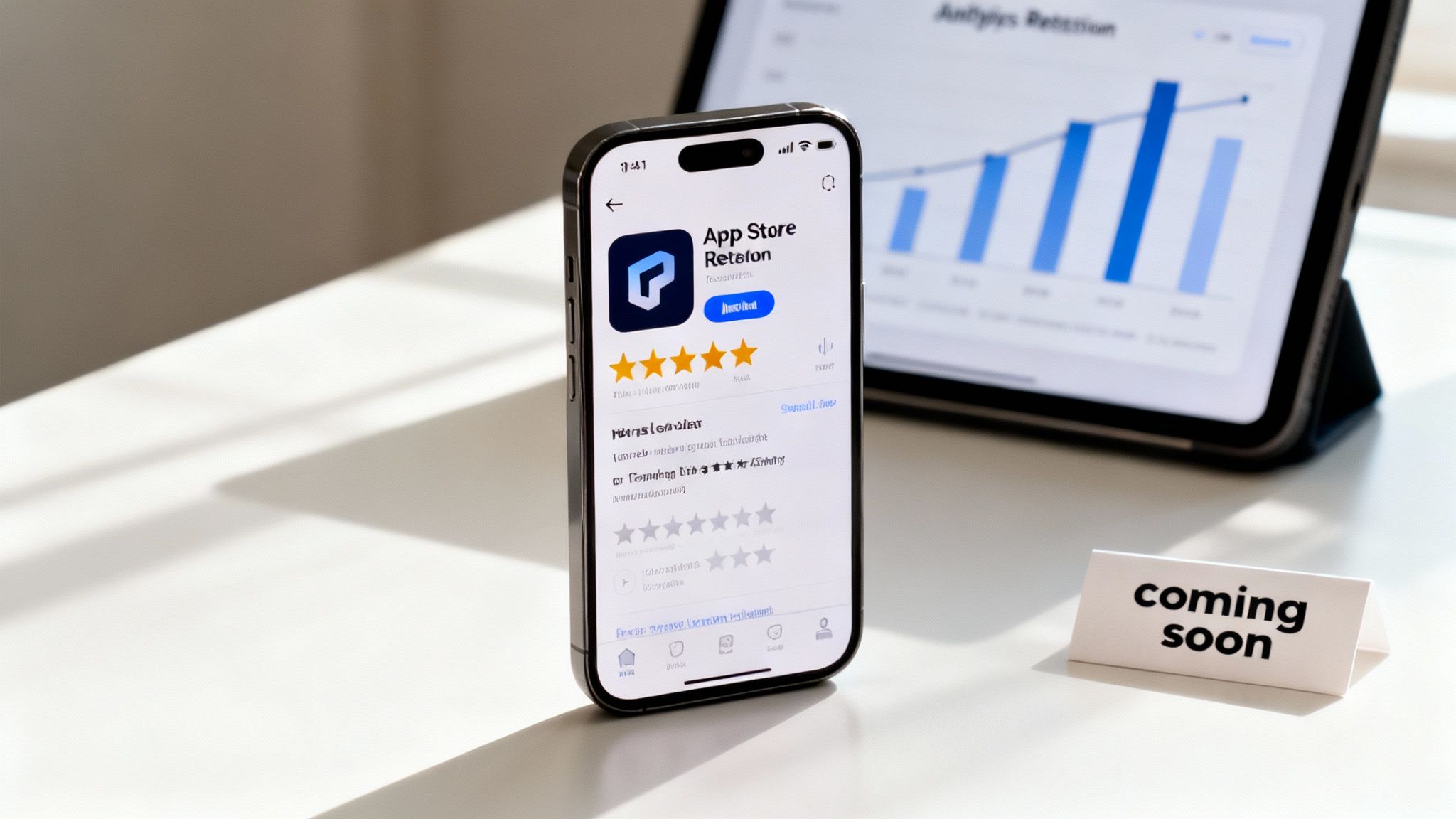
First and foremost, your app must be discoverable. If potential users can't find you, even the most brilliant app will fail to gain traction. This is where App Store Optimization (ASO) becomes your most valuable tool. Think of it as SEO for the app stores—it is absolutely essential for driving organic growth.
Optimizing Your App Store Presence
Your app store listing is your digital storefront. Every element must be carefully crafted to attract visitors and persuade them to download. It's a blend of art and science that directly influences your success.
Here's what to focus on:
- App Title and Subtitle: Your title should be memorable yet functional. Include your most important keyword to improve search visibility. For example, instead of just "Calmly," a meditation app could use "Calmly: Guided Meditation & Sleep" to capture both brand identity and user intent.
- Keyword Strategy: Understand what terms your audience is searching for. Tools like App Radar or Sensor Tower are invaluable for discovering relevant, high-traffic keywords to incorporate into your listing.
- Compelling Screenshots and Video: Don't just show static screens. Use your screenshots to tell a visual story that highlights your app's top three benefits, using clear and concise text overlays. A short preview video can increase conversions by over 20%.
These ASO fundamentals are non-negotiable for any startup aiming to stand out in a crowded marketplace.
Building Pre-Launch Buzz and Momentum
The most successful launches begin long before launch day. Building an audience before your app is available creates a wave of early adopters who are ready to download and engage from day one. This initial surge sends a powerful positive signal to the app store algorithms.
A simple "coming soon" landing page is a highly effective tool for this. Announce your app, showcase its core value, and include an email signup form to build a waitlist. For example, a fintech startup we worked with built a list of 2,000 interested users before launch simply by promoting their landing page in relevant online communities.
On launch day, they sent an email to their list, driving a concentrated burst of downloads that helped them climb the category charts. This also provided a direct channel for gathering crucial feedback and encouraging early reviews.
"Your first 100 users are more important than your next 10,000. They are your beta testers, your first evangelists, and the source of the honest feedback you need to iterate and improve."
Encouraging reviews is key. While you can't incentivize them, you can prompt satisfied users at the right moment—for instance, after they've successfully completed a key action in your app for the third time.
The Real Work Starts After the Launch
Downloads are a starting point, but long-term success hinges on retention and data-driven iteration. You must understand what users are doing inside your app, where they find value, and where they encounter friction.
Integrating analytics tools like Mixpanel or Amplitude from day one is essential. This data allows you to track user behavior, monitor feature engagement, and identify areas for improvement. These insights are the foundation of your product roadmap, telling you what to build next and how to enhance the user experience.
The mobile landscape is also constantly evolving. Today, 63% of developers are incorporating AI features into their apps. By keeping your initial scope focused and adopting a data-driven MVP approach, you can avoid the poor planning that leads an estimated 80% of apps to fail. You can find more insights on these mobile app development statistics on raascloud.io.
Ultimately, launching your app begins a continuous cycle: launch, measure, learn, and iterate. This feedback loop is what transforms a lean MVP into a mature, profitable platform that your users truly value.
Common Questions from Startup Founders
Starting the app development journey brings a host of questions. Over the years, we’ve spoken with countless founders and have heard the same thoughtful concerns time and again. Our goal is to provide clear, straightforward answers to help you navigate the path forward with confidence.
How Much Does It Really Cost To Build The First Version Of An App?
There's no single price tag for an app, as the cost is always directly tied to feature complexity.
For a focused, well-defined MVP developed by a professional agency, a realistic budget is typically in the range of $25,000 to $75,000. This generally covers the complete process: strategy, design, development, and launch support.
If your app concept involves more complex elements—such as a custom user interface, a robust backend server, multiple third-party API integrations, or specific compliance requirements (like HIPAA for a health app)—the investment can extend beyond $150,000.
The most effective way to manage your budget is to maintain a laser focus on your MVP. We always begin with a discovery phase to precisely define the scope, which enables us to provide a reliable budget before development begins.
How Long Does It Take To Develop An App For A Startup?
Similar to cost, the timeline is a direct reflection of your app's complexity. A tightly scoped and validated MVP can typically be designed, built, tested, and launched within 4 to 6 months. This timeframe encompasses everything from initial strategy sessions and UI/UX design to coding, quality assurance, and submission to the app stores.
If your app requires a more sophisticated backend or has a longer list of "must-have" features, the timeline can extend to 9 months or more. The single biggest factor in accelerating the process is clarity. A founder who has validated their idea and has a crystal-clear vision for their MVP will always move faster than one who is still defining the product during development.
What Is The Biggest Mistake Founders Make When Building An App?
The most common—and most costly—mistake we see is skipping market validation and attempting to build every conceivable feature from the start. It is easy to become so passionate about a vision that you assume customers will want exactly what you've imagined.
This assumption leads to a bloated, expensive product built on shaky ground. It almost always results in a delayed launch and a completely torched budget. The proven path is to first confirm you're solving a real problem, build a lean MVP that solves it brilliantly, launch, and then listen like your business depends on it—because it does.
This methodical, user-centric approach is the best way to mitigate risk and build a product that people genuinely want and are happy to pay for.
Should A Non-Technical Founder Build The App Themselves?
While no-code tools are increasingly powerful, attempting to build a scalable business on them as a non-technical founder is often a challenging detour. Professional mobile app development for startups requires deep expertise in programming languages, security protocols, scalable architecture, and nuanced user experience design.
The time a founder would invest in learning these skills is time taken away from crucial business-building activities like fundraising, marketing, and strategic partnerships. The opportunity cost is simply too high. Partnering with an experienced development team allows you to leverage their expertise to build a high-quality, secure, and scalable product in a fraction of the time, giving your startup a significant competitive advantage.
Turning an idea into a successful product is a major undertaking, but you don’t have to do it alone. The team at Studio Blue Creative has over a decade of experience helping startups like yours plan, build, and scale their digital products.
If you’re ready to move from vision to reality, we're here to help guide you. Contact us today for a no-pressure conversation about how we can help bring your app to life.
Find out if ChatGPT recommends your business.
Right now, your customers are asking AI for recommendations. The AI is naming somebody. Is that name yours? Run our free AEO Scorecard — we test 3 of your real queries against ChatGPT and Claude and email you a personalized report.