
A solid content marketing strategy for a small business isn't about just posting on social media and hoping for the best. It’s a real plan to create and share things your ideal customers actually find valuable, building trust and authority along the way.
Think of it as the foundation of your house. Get it right, and everything you build on top of it—blog posts, videos, social updates—will be strong and stable. Get it wrong, and you're just making noise online. This foundational work is what turns random content into a powerful asset that brings customers directly to your door.
Building Your Foundation for Business Growth
Let's be honest: as a small business owner, "content marketing" probably sounds like another thing to add to your never-ending to-do list. But what if it could be your most reliable engine for growth? Forget the jargon. This guide is all about building a content plan that actually works, even without a huge team or a massive budget.
We'll kick things off by setting clear, tangible goals. It’s less about "doing content" and more about figuring out what your business actually needs to achieve.
For a local contractor here in Jackson, TN, a great goal might be generating five new quote requests every week. For a boutique hotel, it could be increasing weekend bookings by 15% through a few targeted promotions. See the difference?
Define Your Business Objectives First
Before you even think about writing a blog post or shooting a video, you have to know what success looks like. Vague goals like "get more traffic" are impossible to measure and lead nowhere fast. You need to focus on specific outcomes that directly impact your bottom line.
Here are a few examples of what good goals look like for a small business:
- Increase qualified leads by 20% this quarter through the contact form on our website.
- Boost local foot traffic by promoting in-store events to specific zip codes on social media.
- Establish ourselves as the local authority by publishing one in-depth guide each month that answers our customers' most common questions.
Tying every single piece of content back to a concrete business goal is how you turn marketing from an expense into a measurable investment. This clarity makes it easy to say "no" to distractions and focus only on what gets results.
Get Personal with Your Audience
Once your goals are locked in, it’s time to get crystal clear on who you're talking to. This is a step so many small businesses skip, and it’s a huge missed opportunity. You don't need to appeal to everyone; you need to become essential to the right people.
The best way to do this is by creating simple customer profiles, sometimes called "personas." Let's imagine you're a plumber in Jackson. You might create a profile for 'Sarah,' a homeowner who needs a reliable plumber but is terrified of getting ripped off.
What keeps her up at night? Maybe she’s worried about being overcharged or having a crew leave a mess in her house. Where does she go for help? She probably asks for recommendations in local Facebook groups or pulls out her phone and searches "best plumbers near me."
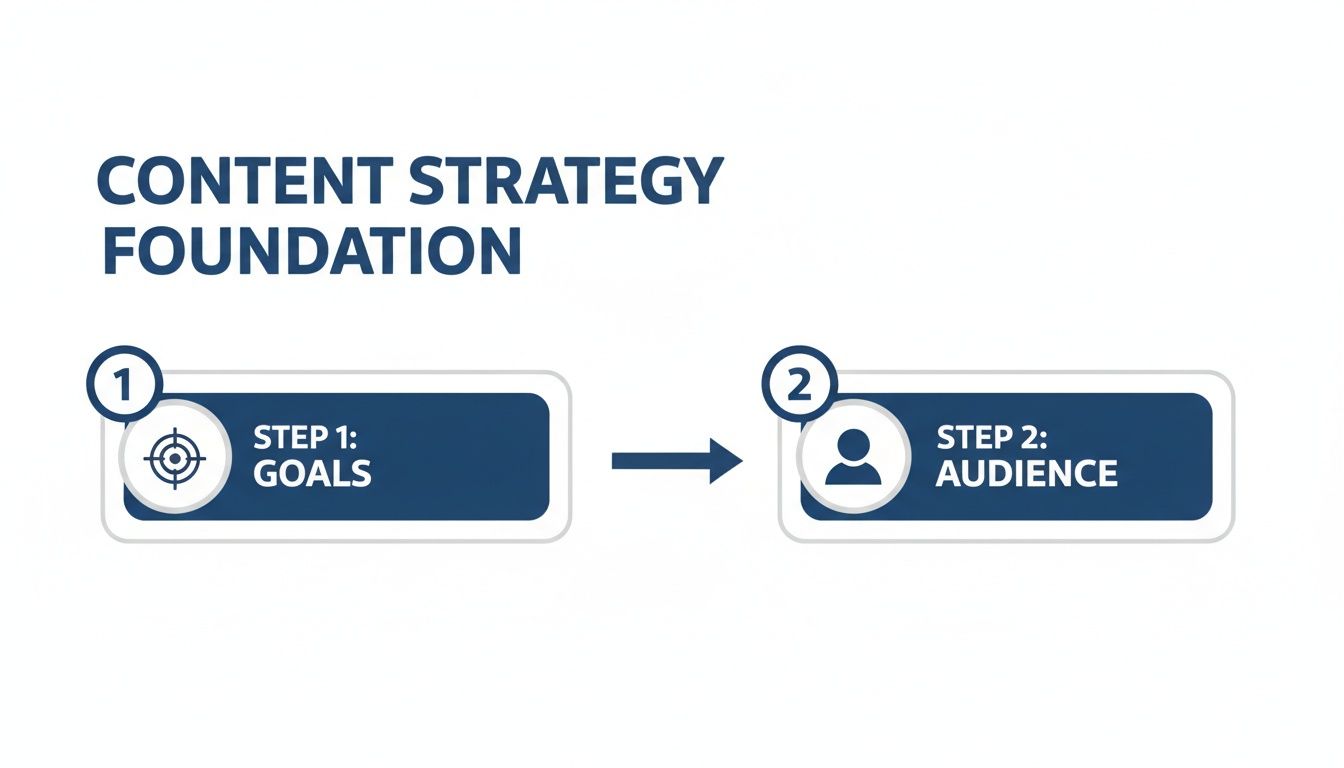
This simple flow drives home the point: a winning strategy always starts with clear business goals and a deep understanding of the customer you're trying to serve. Knowing Sarah’s specific pain points means every blog post, video, and social update can speak directly to her. This is the bedrock of effective content creation for small business.
When you truly know your 'Sarah,' your content starts to work for you. A blog post titled "5 Signs Your Water Heater is About to Fail (and How to Avoid a Messy Disaster)" will grab her attention instantly—far more than a generic post about "our plumbing services." This deep customer knowledge is the secret sauce to a powerful content marketing strategy for a small business.
Ready to build a content foundation that drives real growth? We can help you nail down your goals and identify your ideal customers. Give us a call today at 731-402-0402 for a no-obligation chat.
Developing Your Core Content Pillars and Formats
Now that you know your goals and who you're trying to reach, it's time to build the actual framework for your content. This is where we shift from the "why" to the "what" and "how." The goal isn't just to churn out random articles or videos; it's to build a focused library of resources that proves you're the expert.
You do this by establishing content pillars. Just think of these as the 3-5 core topics your business will own. These pillars are your North Star, making sure every single piece of content you create is relevant, on-brand, and genuinely helpful to your audience.
Identifying Your Content Pillars
Your content pillars should live at the intersection of your expertise and your customer's biggest headaches. For a small business, this is your sweet spot. A great pillar is specific enough to show you know your stuff, but broad enough that you can brainstorm dozens of individual content ideas from it.
Let's take a real-world example. A local financial advisor right here in Jackson, TN, could easily feel swamped by all the possible financial topics out there. Instead of trying to be everything to everyone, they could zero in on these powerful pillars:
- Small Business Tax Planning: This speaks directly to the needs of other local entrepreneurs.
- Personal Retirement Strategies: This helps individuals in the community plan for their future.
- Navigating Market Volatility: This positions them as a steady, expert voice when the economy gets shaky.
With pillars like these, coming up with ideas is a breeze. A blog post like "3 Common Tax Deductions Jackson Business Owners Miss" or a quick video on "How to React When the Stock Market Dips" fits perfectly. This laser-focused approach is a cornerstone of any successful content marketing strategy for small business.
Your content pillars are your promise to your audience. They define the specific value you will consistently deliver, building trust and positioning you as the go-to expert in your niche.
Choosing the Right Content Formats for Your Business
Once you know what you'll talk about, the next question is how you'll say it. Different formats work for different goals and different people. A busy homeowner might love a quick, 60-second video tip, but someone researching a major purchase will want to dive into an in-depth case study.

There’s a clear trend toward visual content, with short-form video being a favorite for 60% of small businesses. But don't sleep on the power of the written word. Blogs are now the third most popular format for a reason—small businesses are 23% more likely than average to see a return on their investment from blogging. It’s a workhorse for attracting long-term search traffic. You can discover more insights about these content marketing statistics and use them to shape your own strategy.
To help you figure out where to put your time and energy, let's break down the most popular formats and what they're best used for.
Choosing the Right Content Format for Your Goals
The secret is picking formats that actually fit your resources and your business goals. Don't feel pressured to create a podcast, a YouTube channel, and a daily blog all at once. It's so much better to do one or two things really, really well than to spread yourself too thin.
| Content Format | Primary Goal | Resource Investment | Real-World Example |
|---|---|---|---|
| Blog Posts | SEO & Lead Generation | Medium | A local roofer writes a detailed guide on "How to Spot Storm Damage on Your Roof," attracting homeowners searching for solutions and capturing leads. |
| Short-Form Video | Brand Awareness & Engagement | Low to Medium | A coffee shop in Jackson posts a quick Instagram Reel showing how they make their signature seasonal latte, building a local following. |
| Case Studies | Build Credibility & Trust | High | A web design agency creates a page detailing how they helped a local nonprofit increase online donations by 40%, proving their value to potential clients. |
| Email Newsletters | Nurture Leads & Drive Repeat Business | Low | A boutique sends a weekly email with styling tips and an exclusive coupon, encouraging past customers to visit the store again. |
Ultimately, choosing the right pillars and formats is all about being strategic. You don’t need a massive budget or a huge marketing department to make a real impact. You just need a clear plan that focuses on giving real value to your specific audience.
Feeling unsure about which content pillars and formats will work best for your business? We can help you build a practical and effective strategy. Call us at 731-402-0402 and let's start the conversation.
Getting Your Content in Front of Local Customers
Creating fantastic content is step one, but the real magic happens when local customers can actually find it. For a small business, showing up in local search results isn't just about bragging rights; it's about making the phone ring and getting people through the door. This is where a little search engine optimization (SEO) can turn your content from a hopeful shot in the dark into a magnet for nearby customers.
Don't worry, you don't need to become an SEO wizard overnight. The best place to start is by simply thinking like your customer. When they need what you offer, what words are they typing into Google? Your goal is to make sure your content answers that exact question in their language.
Weaving Keywords into Your Content Naturally
Good on-page SEO starts with using the right keywords, but this isn't about awkwardly stuffing them into your text. It's about naturally including the phrases your local audience is already searching for. The secret is to focus on local intent—phrases that clearly signal someone is looking for a solution in a specific geographic area.
Let's say you run a bakery here in Jackson, Tennessee. A blog post titled "Our Delicious Wedding Cakes" is a decent start, but it’s not going to grab the attention of local brides-to-be. A much more effective title would be something like, "The Best Custom Wedding Cakes in Jackson, TN."
That small tweak accomplishes three critical things:
- It tells Google exactly what you do (custom wedding cakes).
- It specifies where you do it (Jackson, TN), making you a top contender for local searches.
- It speaks directly to a potential customer with a specific need, making them far more likely to click.
You'd then sprinkle related phrases throughout the article, like "wedding cake bakeries near me," "Jackson wedding cake consultation," and "custom cake designs in West Tennessee." This approach makes your content highly relevant to search engines without sounding like it was written by a robot.
Supercharge Your Local Presence with Google
Beyond your website, your most important digital storefront is your Google Business Profile (GBP). Keeping this profile updated and active is one of the most powerful moves you can make for local visibility. In fact, a staggering 46% of all Google searches are for local information, and a polished GBP is your ticket to showing up in those results, especially in the coveted map pack.
Don't treat your Google Business Profile as a 'set it and forget it' task. Think of it as a mini-social media channel. Consistently sharing updates, photos, and engaging with customers signals to Google that you're an active, thriving local business.
A complete and active GBP is your best friend for driving foot traffic and calls. Make it a habit to:
- Add Fresh Photos and Posts: Regularly upload high-quality photos of your products, your team, or your storefront. Use the "Updates" feature to announce special offers, highlight a new blog post, or share company news.
- Encourage Customer Reviews: Positive reviews are huge. They provide social proof for new customers and are a major local ranking factor. Make a point to ask happy customers for a review and always respond professionally—to both the good and the bad.
- Ensure NAP Consistency: Your business Name, Address, and Phone number (NAP) needs to be identical everywhere online. That means your website, GBP, Yelp, Angie's List—everywhere. Inconsistencies can confuse search engines and drag down your rankings. We dive deeper into this and other key tactics in our guide to local SEO best practices.
When you combine keyword-rich content with a vibrant Google Business Profile, your content marketing strategy for small business starts to fire on all cylinders. It’s how you make sure that when a potential customer searches for something "near me," your business is the one they find.
Feeling a bit lost in the world of local SEO? Let's simplify it. Give us a call at 731-402-0402, and we can walk you through a practical plan to get your business seen by the right local customers.
Weaving Your Content Pillars into an Editorial Calendar
Consistency is the real secret sauce in content marketing. An editorial calendar is your roadmap to making that happen, turning your big-picture content pillars into a practical, week-by-week plan. It's what stops that last-minute panic of, "Oh no, what am I supposed to post today?"
Think of your calendar as a commitment to your audience. It ensures every single piece of content has a purpose and a place, helping you stay organized and focused on your goals without getting completely overwhelmed. Best of all? It doesn't need to be complicated.
From Big Ideas to a Practical Plan
A good calendar starts by breaking down your broad content pillars into specific topics your customers are actually searching for. This is where the magic happens, connecting what you want to be known for with what your audience needs right now.
Let's say you're a local landscaping business in Jackson, TN, and one of your core pillars is "Seasonal Lawn Care." Your calendar would translate that into timely, super-relevant topics:
- March: "When Is the Best Time to Aerate Your Lawn in West Tennessee?"
- June: "3 Common Summer Weeds in Jackson and How to Fight Them"
- October: "A Simple Fall Checklist for a Healthier Spring Lawn"
This approach keeps you from guessing. By mapping out your topics a month or even a quarter in advance, you can align everything with seasonal trends, local events, and your own business promotions. It transforms chaotic content creation into a predictable, strategic process.
Your editorial calendar is more than a schedule—it’s a promise. It shows you're a reliable source of information, building the kind of trust that turns followers into loyal customers.
Your Secret Weapon for Getting It All Done
Let's be real—finding time to brainstorm, write, and schedule content is a massive challenge when you're running a small business. This is where modern tools, especially artificial intelligence, can be a complete game-changer.
Small businesses are catching on fast. Approximately 67% of owners and marketers now use AI tools for their content marketing, and the results are pretty clear: 83% of marketers report a boost in productivity after adopting them. You can read more about how AI is boosting marketing productivity to see if it’s a good fit.
Imagine using a simple AI tool to:
- Brainstorm a dozen blog post ideas for your boutique in minutes.
- Write five engaging social media captions about a new product.
- Create a detailed outline for a "how-to" video.
These tools don’t replace your expertise; they amplify it. They do the heavy lifting, freeing you up to add your unique voice, personal stories, and business-specific details. This is how you create high-quality content consistently, even with a jam-packed schedule. For more insights on maximizing your social media efforts, you can check out our guide on the costs of social media management.
A Simple Template to Get Started
You don't need fancy, expensive software to manage your calendar. Honestly, a simple spreadsheet is often all it takes to get organized and stay on track.
| Publish Date | Topic/Title | Content Pillar | Format | Call to Action (CTA) | Status |
|---|---|---|---|---|---|
| April 5 | Spring Cleaning Tips for Your Gutters | Home Maintenance | Blog Post | "Call for a free estimate" | Published |
| April 12 | Before & After Deck Staining Project | Outdoor Living | Instagram Reel | "Link in bio to book" | Scheduled |
| April 19 | 5 Questions to Ask Before Hiring a Contractor | Building Trust | Short Video | "DM us your questions" | Filming |
| April 26 | Our Favorite Local Spring Events | Community Focus | Email Newsletter | "See you there!" | Drafting |
This simple structure helps you see your content flow at a glance, maintain a healthy mix of topics, and make sure every piece of content has a clear next step for your customer.
Feeling overwhelmed by the idea of planning it all out? We can help you build a simple, sustainable content calendar that gets real results. Give us a call at 731-402-0402, and let's create a plan that works for you.
Measuring Your Success and Proving the ROI
You're putting time and money into creating content. Is any of it actually working?
This is where the rubber meets the road. You have to know if your efforts are paying off. The only way to do that is to measure what matters, tying every blog post and video directly back to the business goals you set in the very beginning. This is how you shift from just being busy to being productive.
So many small businesses fall into the trap of chasing "vanity metrics"—things like social media likes or a spike in page views. Sure, they feel good, but they don't pay the bills. The real value in a content marketing strategy for small business comes from tracking the numbers that directly impact your bottom line.

It's all about connecting the dots between your content and real-world results, like more phone calls or quote requests.
Focusing on Metrics That Matter
If you want to prove your return on investment (ROI), you need to focus on Key Performance Indicators (KPIs) that signal genuine customer action. These are the numbers that tell you if your content is actually moving people closer to making a purchase.
Don't get lost in a sea of data. Just concentrate on a few high-impact KPIs:
- Conversion Rate: This is the big one. It's the percentage of people who take a specific, desired action after engaging with your content. That could be filling out a contact form, signing up for your newsletter, or downloading a guide. A healthy conversion rate means your content is doing its job.
- Lead Quality: Are the leads coming from your content the right kind of leads for your business? Tracking how many of those leads turn into actual, paying customers is a powerful way to measure the quality of your content. You can learn more about how to generate leads online in our detailed guide.
- Organic Traffic Growth: While traffic alone can be a vanity metric, a steady increase in visitors from search engines is a great sign. It shows your content is gaining authority and visibility, which is a leading indicator of future leads.
- Phone Call Tracking: For so many local businesses, a phone call is the most valuable lead you can get. Simple call tracking tools can show you exactly which pieces of content are making the phone ring.
To really nail this, it's crucial to understand what KPI metrics make a valuable report for small business.
Using Free Tools to Track Performance
You don't need to break the bank on expensive software to get started. Free tools like Google Analytics 4 (GA4) and Google Search Console are an absolute goldmine of information.
Inside GA4, you can set up goals to track every single time a user fills out your contact form or clicks your phone number. This gives you a clear line of sight into which blog posts are driving the most valuable actions for your business.
Your goal isn't just to see which content gets the most clicks. It's to identify which content brings you the most customers. This data-driven approach allows you to double down on what works and stop wasting time on what doesn't.
Budgeting for a Stronger Return
A smart budget is a critical part of making your content strategy work. From my experience, investing in higher-quality content almost always delivers a better return than spreading your budget too thin across a bunch of low-quality pieces. And it seems other businesses are catching on, with over half (54%) planning to increase their content marketing spend.
The data backs this up. Nearly half of businesses (47.6%) expect to spend between $5,000 and $25,000 monthly on content. Brands spending under $500 reported much higher rates of underperformance, while those investing $4,000+ saw significantly stronger success.
By tracking the right KPIs, you can confidently put your budget where it will have the biggest impact, making smart decisions that fuel real, tangible business growth.
Ready to build a content strategy that delivers a measurable return on your investment? Call us at 731-402-0402 or email us today, and let's discuss a plan that works for your budget and your business goals.
Your Questions About Small Business Content Marketing
As you start mapping out your content marketing, you’re going to have questions. That’s a good thing—it means you're thinking strategically about your business and not just guessing.
Let's walk through some of the most common questions we hear from small business owners.
How Much Should a Small Business Budget for Content Marketing?
There isn’t a single magic number here, but it's much more helpful to think about the value you're creating, not just the raw cost. You can absolutely get started on a smaller budget by creating the content yourself, but the data is pretty clear: businesses that invest strategically see much stronger, more consistent results.
A good way to start is by allocating a percentage of your overall marketing budget specifically to content.
The main thing to remember is to focus on quality over quantity. One well-researched article or a single professionally produced video will almost always outperform five cheap, generic blog posts.
The most critical part of your content budget isn't just for creation—it's for promotion. Set aside funds to make sure your great content actually gets in front of your ideal audience.
How Long Does It Take for Content Marketing to Show Results?
Think of content marketing as a marathon, not a sprint. While you might see some early positive signs, like a bump in social media engagement, the really meaningful results—higher search rankings and a steady flow of inbound leads—typically take 6 to 12 months of consistent effort to kick in.
The exact timeline depends on your industry, how competitive your market is, and the quality of your content.
But the real beauty of this approach is its compounding value. A blog post you publish today can keep attracting new customers for years, which makes that upfront investment incredibly powerful for your long-term growth. Patience and persistence are key.
Can I Do Content Marketing Myself or Should I Hire Someone?
This really comes down to balancing your time, skills, and budget. Plenty of business owners successfully manage their own content, especially if they genuinely enjoy writing and have that deep, personal understanding of their customers.
But it’s a major time commitment. If you find yourself struggling to stay consistent or you're not an expert in areas like SEO or video production, bringing in a professional can be a game-changing investment.
An experienced partner can accelerate your results and, more importantly, free you up to focus on what you do best: running your business. A hybrid approach often works well, too. You might handle the day-to-day social media posts yourself but hire someone to write your SEO-focused blog articles.
If you'd like to talk through your options and see what makes the most sense for your business, feel free to give me a call at 731-402-0402. We can figure out a path forward together.
Ready to turn your ideas into a real content marketing strategy for small business that drives measurable growth? At Studio Blue Creative, we partner with businesses like yours to plan, build, and optimize digital experiences that get results. Let's talk about your goals.
Call us at 731-402-0402 or email us today for a no-obligation consultation.
Find out if ChatGPT recommends your business.
Right now, your customers are asking AI for recommendations. The AI is naming somebody. Is that name yours? Run our free AEO Scorecard — we test 3 of your real queries against ChatGPT and Claude and email you a personalized report.