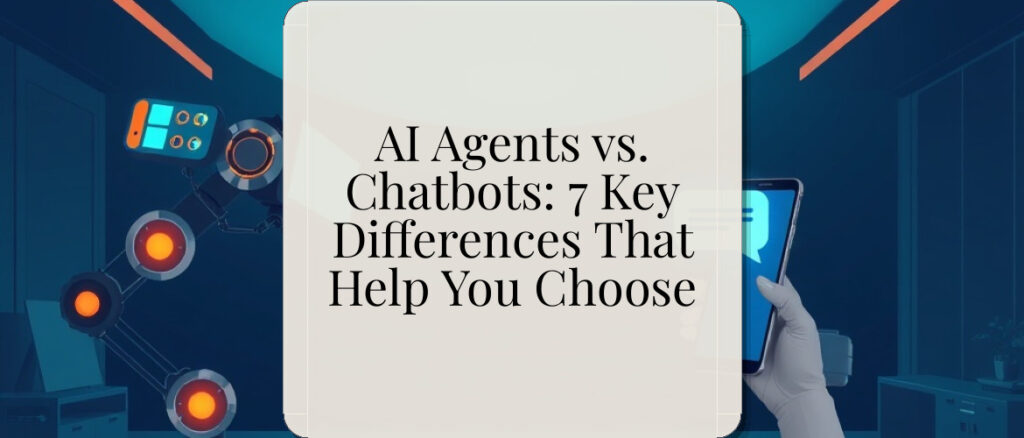
Chatbots follow scripted or AI-powered conversation flows — they answer questions, collect leads, and handle support tickets inside a chat window. AI agents go further: they can reason through multi-step problems, use external tools (search, calendars, CRMs, APIs), and take autonomous actions without a human in the loop. For most Nashville and West Tennessee small businesses, a chatbot is the right starting point for customer-facing support, while AI agents make sense when you need to automate complex, multi-tool workflows. The best choice depends on your budget, your processes, and how much autonomous action you actually need.
1. What Exactly Is a Chatbot? A Plain-English Definition
Before comparing the two technologies, it helps to understand what a chatbot actually is — because the word gets used loosely. At its core, a chatbot is a conversational interface designed to simulate a dialogue with a human user. Chatbots live inside a chat window (on a website, in Facebook Messenger, via SMS) and respond to inputs with pre-defined or AI-generated text. They do not, on their own, take actions outside that window.
Rule-Based Chatbots: Decision Trees in Disguise
The original chatbots — still common on many small-business websites — are essentially decision-tree engines. A visitor clicks a button, the bot offers three options, the visitor picks one, and so on. No real language understanding is involved. These tools are fast to deploy, cheap to run, and completely predictable. Their downside: they break the moment a visitor asks something outside the script.
- Typical cost: $0–$50/month for hosted platforms like Tidio or ManyChat
- Setup time: 2–8 hours for a basic flow
- Best for: FAQs, appointment booking links, simple lead capture
AI-Powered Chatbots: Natural Language, Smarter Replies
Modern AI chatbots layer a large language model (LLM) — think GPT-4o or Claude — on top of the conversation interface. They understand free-form questions, maintain context across a conversation, and can be trained on your business’s own documents. They still operate inside the chat window, but they feel dramatically more human. Platforms like Intercom Fin, Drift AI, or a custom-built solution on your WordPress site fall into this category.
- Typical cost: $50–$500/month depending on conversation volume
- Setup time: 1–5 days including knowledge-base training
- Best for: Customer support deflection, product Q&A, after-hours coverage
2. What Exactly Is an AI Agent? The Key Distinction
An AI agent is a fundamentally different category of software. While a chatbot responds, an agent acts. The distinction sounds subtle but has enormous practical implications for how much work the technology can take off your plate. Think of a chatbot as a very smart receptionist who can answer questions — and an AI agent as a junior employee who can actually complete tasks on your behalf.
Agents Reason, Plan, and Act — Not Just Reply
An AI agent is a software system that uses an LLM as its reasoning engine but is also equipped with tools it can invoke autonomously: web search, database queries, API calls, calendar writes, email sends, CRM updates, and more. When given a goal, an agent breaks it into steps, executes those steps using its tools, evaluates the results, and loops until the goal is complete — all without a human clicking buttons.
Example: Ask an AI agent to “follow up with every lead from last week who hasn’t booked a call” and it will query your CRM, draft personalized emails, send them, and log the activity — automatically.
Agentic Frameworks: What Powers Them
Popular frameworks for building AI agents include LangChain, AutoGen, CrewAI, and OpenAI’s Assistants API with function calling. Enterprise platforms like Salesforce Agentforce and Microsoft Copilot Studio also offer agent capabilities. For small businesses, a custom-built agent integrated directly into your existing tools — your WordPress site, your Google Workspace, your scheduling software — is often the most cost-effective path.
- Typical build cost: $1,500–$15,000+ for a custom agent (one-time)
- Monthly operating cost: $50–$300 in API and hosting fees
- Timeline: 2–8 weeks depending on integrations required
3. The 7 Key Differences Between AI Agents and Chatbots
The chatbot-vs-agent debate often gets muddled because vendors use the terms interchangeably for marketing purposes. Here are the seven concrete dimensions where the technologies genuinely differ — use these as your decision framework when evaluating options for your business.
Differences 1–3: Autonomy, Tool Use, and Memory
1. Autonomy: Chatbots wait for a human to type something and then respond. Agents can be triggered by events (a new form submission, a calendar event, a database change) and act without any human prompt at all.
2. Tool Use: Chatbots are confined to the conversation. Agents can call APIs, write to databases, send emails, browse the web, and interact with third-party software in real time.
3. Memory & Context: Most chatbots reset after a session. Agents can maintain persistent memory — they remember that a specific customer called last Tuesday, what was discussed, and what follow-up was promised.
Differences 4–7: Multi-Step Reasoning, Cost, Setup Complexity, and Risk
4. Multi-Step Reasoning: Chatbots answer one question at a time. Agents decompose complex goals into sub-tasks, execute them in sequence or in parallel, and self-correct when a step fails.
5. Cost Structure: Chatbots are subscription-based and predictable ($0–$500/month). Agents carry higher upfront build costs but lower per-task costs at scale — often saving businesses 10–40 hours of labor per week once deployed.
6. Setup Complexity: A chatbot can be live in an afternoon. An agent typically requires a developer, API credentials, and workflow mapping — plan for 2–8 weeks.
7. Risk & Oversight: Because agents take real actions, mistakes have real consequences (a wrongly sent email, a double-booked appointment). Good agent design includes guardrails, approval steps, and audit logs.
4. Real-World Use Cases: When a Chatbot Is the Right Call
Not every business needs an AI agent. For many small and mid-sized businesses across Middle Tennessee and West Tennessee, a well-configured chatbot delivers outstanding ROI with minimal complexity. Here are the scenarios where chatbots clearly win.
Customer Support and FAQ Deflection
If your team fields the same 20 questions every week — hours, pricing, service area, how to book — a well-trained AI chatbot can handle 60–80% of those inquiries without human involvement, according to Intercom’s 2024 customer service benchmark report. For a Nashville restaurant, a Brentwood law firm, or a Jackson HVAC company, this alone can free up 5–15 hours of staff time per week.
Lead Capture and After-Hours Coverage
Most small-business websites lose leads between 6 PM and 8 AM — when nobody is watching the inbox. A chatbot deployed on your site can greet visitors, qualify them with 3–5 questions, and either book a call directly into your calendar or capture their contact info for a morning follow-up. Studies show that responding to a lead within 5 minutes makes you 21× more likely to qualify them (MIT/InsideSales research). A chatbot makes that 5-minute response possible around the clock.
E-Commerce and Appointment-Based Businesses
For businesses that sell products online or run on appointments — salons, med spas, consultants, contractors — chatbots integrate cleanly with booking platforms like Calendly, Acuity, or WooCommerce. The bot handles the conversation; the integration handles the action. This hybrid approach gives you 80% of the agent benefit at 20% of the cost and complexity.
5. Real-World Use Cases: When an AI Agent Is Worth the Investment
AI agents are the right tool when your bottleneck isn’t answering questions — it’s doing things. If your team spends significant time on repetitive, multi-step tasks that touch multiple software systems, an agent can often handle those tasks faster, more accurately, and at a fraction of the labor cost. Here are the use cases where agents deliver the clearest ROI.
Complex Lead Nurturing and CRM Automation
If your sales cycle involves multiple touchpoints — an initial inquiry, a discovery call, a proposal, a follow-up, a contract — an AI agent can manage the entire sequence autonomously. It monitors your CRM for deal-stage changes, drafts and sends personalized follow-up emails, schedules calls, and updates records. A mid-sized Nashville B2B firm that implemented this type of agent in 2024 reported saving 22 hours of sales-admin time per week — equivalent to more than half a full-time employee.
Internal Operations and Document Processing
AI agents shine in back-office workflows that humans find tedious and error-prone: processing invoices, extracting data from PDFs, routing support tickets, generating weekly reports from multiple data sources. A West Tennessee logistics company, for example, could deploy an agent that reads incoming shipment emails, updates a Google Sheet, flags exceptions, and notifies the right team member — all without a human touching the data. Explore how Document AI can automate your document-heavy workflows.
Multi-Channel Customer Outreach
Agents can orchestrate outreach across email, SMS, and social DMs simultaneously — something no chatbot can do. For a Nashville real estate agency running a drip campaign across 500 prospects, an agent can personalize each message based on the prospect’s behavior (which listings they viewed, which emails they opened) and adjust timing dynamically. This level of personalization at scale is simply not possible with a rule-based or even AI-powered chatbot.
6. Cost Breakdown: What Should You Budget?
Budget is often the deciding factor for small businesses. Here’s an honest breakdown of what each technology costs — not the marketing-page numbers, but real-world ranges based on what agencies like Studio Blue Creative see when building and deploying these systems for Tennessee businesses.
Chatbot Pricing: From Free to $500/Month
Entry-level chatbot platforms (Tidio, Crisp, Tawk.to) offer free tiers sufficient for basic lead capture. Mid-tier AI chatbots (Intercom, Drift, custom GPT-powered bots) run $100–$500/month depending on conversation volume and features. A custom-built AI chatbot trained on your specific business data typically costs $800–$3,000 one-time plus $50–$150/month in API fees. For most small businesses, total first-year chatbot cost lands between $600 and $6,000.
AI Agent Pricing: Higher Upfront, Higher Return
Custom AI agents require development work — mapping workflows, building integrations, testing edge cases, and setting up guardrails. Expect to invest $1,500–$15,000 for a well-built agent, depending on the number of integrations and the complexity of the logic. Ongoing costs (LLM API calls, hosting, maintenance) typically run $100–$400/month. The ROI case is strongest when the agent replaces tasks that currently cost you $2,000+ per month in labor — a threshold many growing businesses hit quickly.
7. Integration Complexity: Fitting Into Your Existing Tech Stack
One of the most underestimated factors in the chatbot-vs-agent decision is how well the technology fits into the software you already use. A tool that requires you to change your entire workflow isn’t a productivity gain — it’s a productivity tax. Here’s what to expect from each option on the integration front.
Chatbots and Your Website: Usually Plug-and-Play
Most chatbot platforms offer a JavaScript snippet you paste into your WordPress site — done in 10 minutes. Native integrations with tools like HubSpot, Mailchimp, Google Calendar, and Zapier are standard. If your tech stack is relatively simple (a WordPress site, a Google Workspace account, maybe a Calendly link), a chatbot will slot in with minimal friction.
AI Agents and Your Tech Stack: Plan for Integration Work
Agents need to authenticate with every tool they’ll interact with — your CRM, your email provider, your database, your scheduling software. Each integration requires API credentials, error handling, and testing. This is where a development partner matters: a poorly integrated agent that occasionally sends duplicate emails or writes bad data to your CRM is worse than no agent at all. Budget for 2–4 weeks of integration and QA work before going live, and insist on a staging environment where you can test edge cases safely.
8. Security, Privacy, and Compliance Considerations
Security and compliance are topics many small businesses skip when evaluating AI tools — until something goes wrong. Whether you’re deploying a chatbot or a full AI agent, you need to understand how customer data is handled, where it’s stored, and what happens if the system makes a mistake.
Data Handling: What Goes Into the AI?
Both chatbots and agents process customer data — names, emails, questions, purchase history. Before deploying either, confirm that your vendor’s data processing agreement (DPA) is compatible with your obligations under applicable privacy laws. If you serve healthcare clients, HIPAA compliance is non-negotiable. If you handle payment data, PCI-DSS rules apply. Many SaaS chatbot platforms offer HIPAA-compliant tiers at a premium; custom-built agents can be architected to keep sensitive data on-premises or in a private cloud.
Guardrails and Audit Logs for AI Agents
Because agents take real actions, they need real guardrails. Best practices include: human-in-the-loop approval for high-stakes actions (sending contracts, processing refunds over a threshold), rate limiting to prevent runaway loops, full audit logs of every action taken, and rollback procedures for when something goes wrong. A reputable development partner will build these into the agent architecture from day one — not as an afterthought.
9. The Hybrid Approach: Starting With a Chatbot, Graduating to an Agent
The chatbot-vs-agent framing can create a false either/or choice. In practice, the most successful small-business AI deployments follow a phased approach: start simple, prove value, then expand. Here’s how that progression typically looks — and how to know when you’re ready to move up.
Why Most Businesses Should Start With a Chatbot
If you’ve never deployed conversational AI before, starting with an agent is like learning to drive in a Formula 1 car. A chatbot forces you to document your most common customer interactions, identify your highest-value automation opportunities, and build internal comfort with AI-generated responses — all of which make a future agent deployment faster, cheaper, and more successful. Most Nashville and West Tennessee businesses we work with start with a chatbot and upgrade to an agent within 6–18 months.
The Upgrade Path: When You're Ready for an Agent
You’re ready to graduate to an agent when you can answer yes to at least three of these questions:
- Do you have a clearly defined, repetitive workflow that currently takes 5+ hours/week of staff time?
- Does that workflow touch two or more software systems?
- Are the inputs and outputs of the workflow predictable enough to define rules for?
- Do you have a development partner who can build and maintain the integration?
- Do you have a budget of at least $2,000 for the initial build?
10. How Nashville and West Tennessee Businesses Are Using AI Right Now
Abstract technology comparisons are useful, but local context matters. Here’s a ground-level look at how businesses in the Nashville metro and West Tennessee are actually deploying chatbots and AI agents — and what the competitive landscape looks like heading into 2025.
Industries Leading Adoption in Middle Tennessee
Across the Nashville metro — Franklin, Brentwood, Murfreesboro, Hendersonville, Mount Juliet — the industries moving fastest on AI chatbots and agents are healthcare practices (appointment scheduling, insurance FAQ), real estate agencies (lead qualification, listing Q&A), home services contractors (after-hours lead capture, estimate requests), and professional services firms (law, accounting, consulting) using agents for client onboarding automation. Adoption is accelerating: a 2024 Salesforce survey found that 67% of small business owners planned to increase AI investment within 12 months.
West Tennessee Opportunity: Early Movers Win
In Jackson and surrounding West Tennessee markets, AI adoption among small businesses is still early-stage — which means significant competitive advantage is available to businesses that move now. A Jackson-area medical practice or retail business that deploys a well-built AI chatbot today will have 12–24 months of operational learning and customer data before competitors catch up. First-mover advantage in AI is real and measurable: businesses with 12+ months of chatbot data report 35–50% higher automation accuracy than newly deployed systems, because the AI has been tuned on real customer interactions.
Ready to Deploy AI for Your Business? Here's Your Next Move
You’ve now got the framework to make an informed decision between a chatbot and an AI agent. The honest answer for most small businesses: start with a chatbot, plan for an agent. But the specifics depend on your industry, your workflows, and your growth goals — and that’s exactly the conversation we love having with Tennessee business owners.
Start With a Free Consultation — No Jargon, No Pressure
At Studio Blue Creative, we work with small and mid-sized businesses across Nashville, Franklin, Brentwood, Murfreesboro, and Jackson to design AI systems that fit their actual workflows — not a vendor’s demo scenario. We’ll help you map your highest-value automation opportunities, recommend whether a chatbot or an agent is the right starting point, and give you a clear cost estimate before any work begins.
Explore our full range of custom AI agent solutions to see what’s possible for your business — from simple lead-capture agents to complex multi-tool workflow automations. You can also browse our AI chatbot services if you’re looking for a faster, lower-cost starting point.
Call us at 731-402-0402 or use our contact form to request a free estimate. We’ll respond within one business day.
Questions to Bring to Your First Conversation
To make your first consultation as productive as possible, think through these questions in advance:
- Which repetitive tasks eat the most staff time each week?
- What software tools does your team use daily (CRM, email, scheduling, accounting)?
- What does a lost lead or a missed follow-up cost you on average?
- Do you have existing documentation (FAQs, scripts, SOPs) the AI can be trained on?
- What’s your timeline — do you need something live in 30 days, or can you invest 8 weeks in a more sophisticated build?
Not sure where to start? Our AI systems overview walks through every service we offer, from chatbots and agents to workflow automation and document AI.
AI Chatbot vs. AI Agent: 10-Point Comparison at a Glance
Use this table to quickly map each technology's strengths to your business needs. Green cells indicate a clear advantage for that option.
| Dimension | Rule-Based Chatbot | AI-Powered Chatbot | AI Agent |
|---|---|---|---|
| Autonomy Level | None — scripted only | Low — responds, doesn't act | High — acts independently |
| Tool / API Use | None | Limited (booking links, forms) | Full (CRM, email, databases, APIs) |
| Multi-Step Tasks | No | No | Yes — plans and executes sequences |
| Persistent Memory | No | Session only | Yes — across sessions and users |
| Setup Time | 2–8 hours | 1–5 days | 2–8 weeks |
| First-Year Cost | $0–$600 | $600–$6,000 | $3,000–$22,000+ |
| Ongoing Monthly Cost | $0–$50 | $50–$500 | $100–$400 (API + hosting) |
| Best For | FAQs, simple lead capture | Support deflection, Q&A, booking | Complex workflows, CRM automation, multi-channel outreach |
| Technical Skill Required | None | Low (platform config) | High (developer recommended) |
| Risk of Errors | Low (predictable) | Low-Medium | Medium-High (real actions = real consequences) |
Frequently Asked Questions
What is the difference between an AI agent and a chatbot?
A chatbot responds to messages inside a chat window — it can answer questions and collect information but cannot take actions in other software. An AI agent uses an LLM as its reasoning engine and can autonomously use tools like email, CRMs, calendars, and APIs to complete multi-step tasks without human involvement.
Is a chatbot or AI agent better for a small business?
Most small businesses should start with an AI-powered chatbot — it's faster to deploy, more affordable, and handles the most common use cases (FAQ, lead capture, after-hours coverage). Upgrade to an AI agent when you have a clearly defined, repetitive workflow that touches multiple software systems and costs significant staff time each week.
How much does it cost to add a chatbot to my website?
Basic rule-based chatbots can be free or cost $0–$50/month on platforms like Tidio or Tawk.to. AI-powered chatbots run $50–$500/month for SaaS platforms, or $800–$3,000 one-time for a custom-built solution trained on your business data, plus $50–$150/month in API fees.
Can an AI agent replace a human employee?
AI agents can replace specific tasks — not entire roles. They excel at repetitive, rules-based work like data entry, follow-up emails, report generation, and ticket routing. Complex judgment calls, relationship management, and creative problem-solving still require humans. Most businesses use agents to free up employees for higher-value work, not to eliminate positions.
How long does it take to build and deploy an AI agent?
A simple AI agent with one or two integrations can be built in 2–3 weeks. A more complex agent connecting multiple tools (CRM, email, scheduling, database) typically takes 4–8 weeks including integration work, testing, and QA. Plan for an additional 2–4 weeks of tuning after go-live.
Do Nashville businesses need AI chatbots or agents to stay competitive?
Competitive pressure is growing. A 2024 Salesforce survey found 67% of small business owners planned to increase AI investment within 12 months. In high-competition Nashville metro markets like Franklin, Brentwood, and Murfreesboro, businesses with AI-powered lead capture and follow-up are already converting prospects faster than those relying on manual processes.
Find out if ChatGPT recommends your business.
Right now, your customers are asking AI for recommendations. The AI is naming somebody. Is that name yours? Run our free AEO Scorecard — we test 3 of your real queries against ChatGPT and Claude and email you a personalized report.
Ready for a real website?
Get a tailored 3-tier proposal in under a minute — including our Launch Deal ($699), a custom build, or our SEO Growth Package. No call required.