
Quick answer: A free website health check examines the 10 most critical factors that determine whether your Nashville small-business site ranks, loads fast, and converts visitors into customers. These factors include page speed, mobile usability, Core Web Vitals, on-page SEO, schema markup, security (HTTPS), broken links, Google Business Profile alignment, AEO readiness, and local citation consistency. Most Nashville businesses have at least 4–6 fixable issues hiding in plain sight. Running a health check — and acting on the results — is the single fastest way to recover lost traffic and leads without rebuilding your entire site.
1. What a Website Health Check Actually Measures
Before you can fix your website, you need to know what’s broken. A website health check is a systematic review of the technical, content, and user-experience factors that search engines and real visitors use to judge your site. For small businesses in Nashville and across the Tennessee metro area, this process is especially important because local search competition has intensified dramatically since 2022 — Google’s Helpful Content updates and the rise of AI-powered answer engines have raised the bar for every local business website.
Think of it like an annual physical for your business’s most important digital asset. You wouldn’t skip a checkup just because nothing feels broken. Websites degrade silently: plugins go out of date, pages slow down, schema markup breaks, and competitors quietly outrank you while you’re focused on running your business.
The Difference Between a Health Check and a Full Audit
A website health check is a structured diagnostic scan — typically completed in 24–48 hours — that grades your site across a defined set of performance, technical, and content criteria. A full SEO audit, by contrast, can take weeks and costs $1,500–$5,000 or more. A health check is the triage step: it tells you which problems are critical, which are minor, and where to spend your first dollar of effort.
For Nashville small businesses competing against larger regional players, the health check is the great equalizer. You don’t need a massive budget to fix a slow server response time or add missing schema markup — you just need to know the problems exist.
Why Free Doesn't Mean Shallow
Many agencies offer a free website health check as a discovery call deliverable, and the good ones back it with real data from tools like Google Search Console, PageSpeed Insights, Screaming Frog, and Semrush. The output should include specific URLs with issues, not just a generic letter grade. If a health check only gives you a score without actionable line items, it’s marketing — not diagnostics.
- What you should receive: a page-by-page crawl summary, Core Web Vitals scores, mobile usability flags, and at least a top-10 priority fix list.
- What to ignore: vanity scores that don’t tie to real Google ranking signals.
2. Page Speed — the Factor That Costs You Customers in Seconds
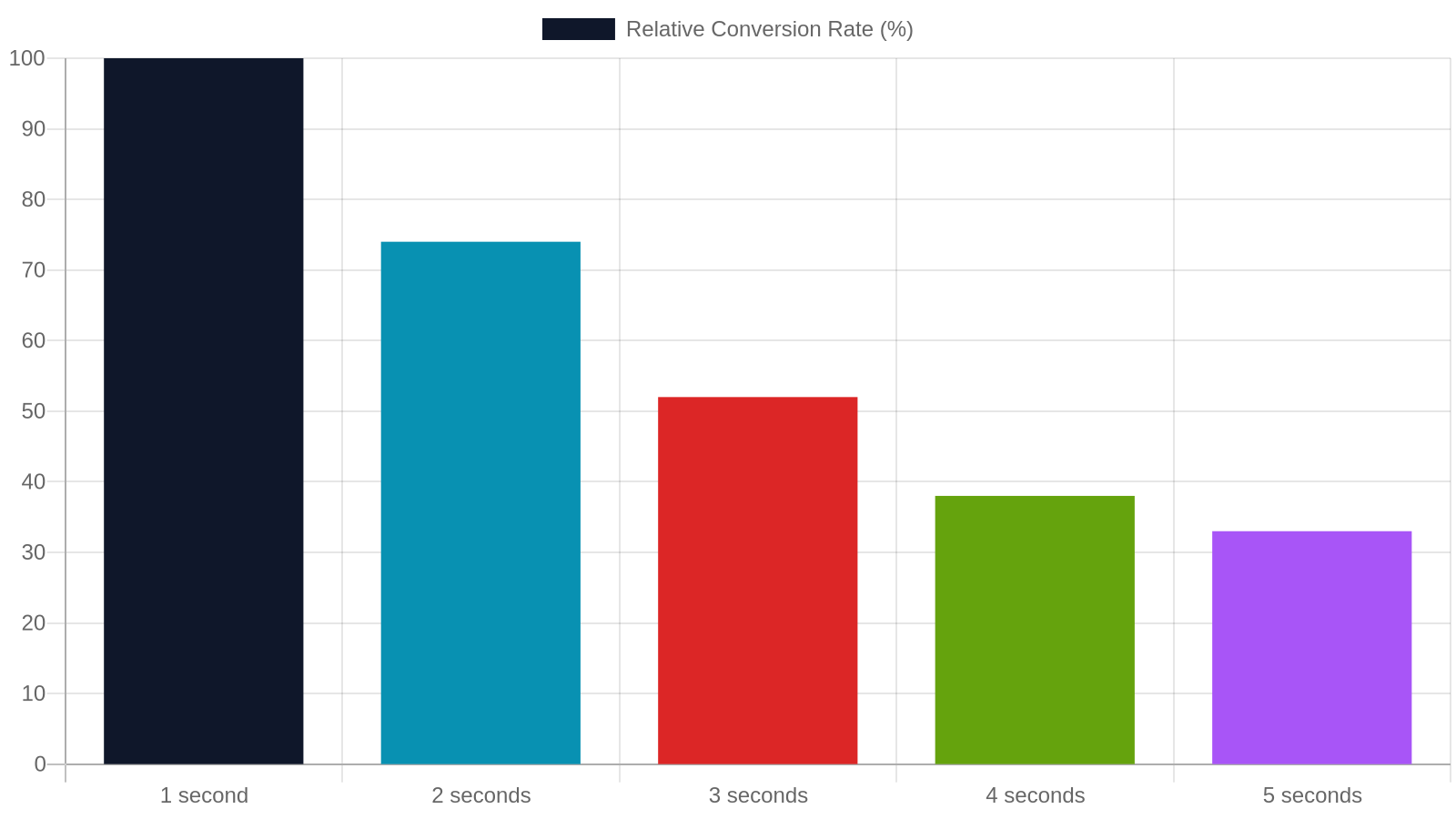
Page speed is not a nice-to-have — it is a direct Google ranking factor and a direct revenue factor. Research from Portent (2023) found that a site loading in 1 second converts 3× better than a site loading in 5 seconds. For e-commerce and service-based businesses in the Nashville metro, that gap translates to real lost revenue every single day. A health check should surface your exact speed scores across mobile and desktop, not just a ballpark estimate.
What Google's Core Web Vitals Actually Score
Google’s Core Web Vitals are three specific, measurable signals baked into its ranking algorithm since May 2021. They are:
- Largest Contentful Paint (LCP): how long until the main content loads. Target: under 2.5 seconds.
- Interaction to Next Paint (INP): how quickly the page responds to a click or tap. Target: under 200 milliseconds.
- Cumulative Layout Shift (CLS): how much the page visually jumps while loading. Target: under 0.1.
According to Google’s own data, pages that meet all three thresholds see up to 24% fewer session abandonments than pages that fail even one metric. For a Nashville restaurant, law firm, or contractor getting 500 visits a month, that’s potentially 120 extra engaged visitors — without spending a dime on ads.
Common Speed Killers on Nashville Small-Business Sites
The most frequent culprits we find during health checks for Tennessee businesses include uncompressed hero images (often 3–8 MB JPEG files), render-blocking JavaScript from outdated plugins, and shared hosting plans with Time to First Byte (TTFB) over 600ms. A properly configured WordPress site on managed hosting should achieve TTFB under 200ms and LCP under 2.0 seconds on mobile. If your site was built more than 3 years ago and has never had a performance pass, there’s a 90%+ chance it fails at least one Core Web Vital on mobile.
- Switch to WebP image format — average file size reduction of 30–50% vs. JPEG.
- Enable server-side caching and a CDN (Cloudflare’s free tier works for most SMBs).
- Defer non-critical JavaScript so the main content paints first.
3. Mobile Usability — Over 63% of Nashville Searches Happen on a Phone
Mobile usability is the lens through which most of your potential Nashville customers first experience your brand. StatCounter data for Tennessee in 2024 shows that 63.4% of all web sessions originate from a mobile device. Yet a surprising number of small-business websites — especially those built before 2020 — still serve a degraded or broken mobile experience. A health check catches these issues at the URL level, not just as a site-wide flag.
Google's Mobile-First Index and What It Means for You
Since 2023, Google has been fully mobile-first indexed — meaning it crawls and ranks your site based on the mobile version of your pages, not the desktop version. If your mobile experience is broken, your rankings suffer regardless of how polished your desktop site looks. Common mobile failures include text too small to read without zooming, buttons spaced fewer than 48px apart (causing mis-taps), and content wider than the viewport that forces horizontal scrolling.
Google Search Console’s Mobile Usability report flags these issues for free. A health check should pull this data and map every failing URL so you can prioritize fixes by traffic volume.
Local Intent Searches Are Almost Always Mobile
Searches like ‘plumber near me Nashville’, ‘best HVAC Franklin TN’, or ‘Jackson TN dentist open Saturday’ are overwhelmingly performed on smartphones — often while the searcher is already in the car. According to Google, 76% of people who conduct a local search on their phone visit a related business within 24 hours, and 28% of those searches result in a purchase. A mobile site that loads slowly or displays broken layouts is directly costing you walk-in and call-in customers.
- Test your site at search.google.com/test/mobile-friendly for a quick pass/fail.
- Check tap target sizes in Chrome DevTools under the Lighthouse accessibility audit.
- Ensure your phone number is a clickable
tel:link on every page.
4. On-Page SEO — Are Your Pages Actually Telling Google What You Do?
On-page SEO is the foundation every other optimization effort is built on. If your pages don’t clearly communicate their topic to Google through proper title tags, headers, meta descriptions, and body content, no amount of backlinks or technical fixes will fully compensate. A thorough health check maps every page’s on-page signals and identifies the gaps between what you intend to rank for and what Google actually sees.
Title Tags, Meta Descriptions, and Header Hierarchy
Every page on your site should have a unique, keyword-rich title tag (50–60 characters) and a meta description (140–160 characters) that acts as a mini-advertisement in the search results. A health check commonly reveals that small-business sites have duplicate title tags across 20–40% of their pages, or that WordPress has auto-generated generic titles like ‘Home — My Business’ that waste prime ranking real estate.
Header hierarchy (H1 → H2 → H3) tells both users and Google how your content is organized. Every page should have exactly one H1 that includes the primary keyword. Missing or duplicate H1s are among the top 5 on-page issues we find in Nashville site audits.
Keyword Cannibalization and Thin Content
Keyword cannibalization happens when two or more pages on your site compete for the same search term, splitting authority and confusing Google about which page to rank. It’s extremely common on service-business sites that have separate pages for each city (Nashville, Franklin, Brentwood, Murfreesboro) with near-identical content — a practice that used to work but now triggers Google’s duplicate-content filters.
Thin content — pages with fewer than 300 words of unique, useful text — is another frequent finding. Google’s Helpful Content system (updated September 2023) actively demotes sites where a significant portion of pages offer little original value. A health check flags every page under 300 words and every page with a content similarity score above 85% compared to another page on the same domain.
5. Schema Markup — the Hidden Code That Powers AI Answer Engines
Schema markup sits at the intersection of traditional SEO and the new world of AI-powered search. As ChatGPT, Perplexity, Google’s AI Overviews, and other generative engines increasingly answer queries by pulling from structured, citable sources, businesses without schema markup are effectively invisible to those systems. A health check should audit every page for schema presence, type accuracy, and validation errors — and most Nashville small-business sites we review have either no schema or broken schema that’s actively generating Google Search Console warnings.
What Schema Markup Is and Why It Matters More Than Ever
Schema markup (also called structured data) is a standardized vocabulary of code — drawn from Schema.org — that you add to your website’s HTML to explicitly tell search engines and AI systems what your content means, not just what it says. For a Nashville plumbing company, schema can communicate your business name, address, phone number, service area, hours, reviews, and pricing in a machine-readable format that Google, Bing, ChatGPT, and Perplexity can all parse directly.
Pages with correct LocalBusiness schema are 2–3× more likely to appear in Google’s rich results (star ratings, FAQ dropdowns, business info panels) than pages without it, according to Search Engine Land’s 2023 structured data study. With AI answer engines now pulling directly from schema-enriched pages to generate cited responses, this is no longer optional for competitive local businesses.
The Most Impactful Schema Types for Nashville SMBs
A health check should validate whether you have the right schema types implemented and whether they’re error-free (Google’s Rich Results Test is the authoritative validator). The highest-impact types for Nashville small businesses include:
- LocalBusiness / specific subtype (e.g., Plumber, Restaurant, LegalService) — establishes your entity identity.
- FAQPage — enables FAQ rich results and feeds AI answer engines directly.
- Service — describes individual services with descriptions and area served.
- Review / AggregateRating — displays star ratings in search results.
- BreadcrumbList — improves site structure signals and click-through rates.
Our schema implementation service covers all of these types with validation included.
6. Security and HTTPS — Your Site's Trust Signal

Security is both a user-trust issue and a direct Google ranking signal. Google has confirmed that HTTPS is a ranking factor, and Chrome’s ‘Not Secure’ warnings visibly erode visitor confidence before a single word of your content is read. A health check should verify your SSL certificate status, check for mixed-content errors (where some page assets still load over HTTP), and flag any known plugin vulnerabilities that could put your site — and your customers’ data — at risk.
Why Google Flags HTTP Sites as 'Not Secure'
Since 2018, Google Chrome has displayed a ‘Not Secure’ warning in the address bar for any page served over HTTP rather than HTTPS. This warning appears to every visitor before they even read a word of your content — and research from GlobalSign found that 84% of users would abandon a purchase if they saw that warning on a checkout or contact page. For service businesses collecting form submissions or phone call leads, an insecure site is a direct conversion killer.
An SSL certificate (the technology behind HTTPS) costs $0–$150 per year depending on your hosting provider — many hosts include it free via Let’s Encrypt. A health check verifies not just that your certificate exists, but that it’s valid, not expired, and correctly configured so no pages are accidentally served over HTTP.
Plugin Vulnerabilities and Outdated WordPress Cores
For the 43% of websites running WordPress (including the majority of Nashville small-business sites), security also means keeping the WordPress core, themes, and plugins updated. The Wordfence Threat Intelligence team reported in 2023 that 97% of WordPress vulnerabilities originated in plugins, not the core. A single outdated plugin — even one you installed and forgot about — can expose your entire site to malware injection, data theft, or a Google ‘Site may be hacked’ penalty that tanks your rankings overnight.
- Run a plugin audit: deactivate and delete anything unused.
- Enable automatic minor-version updates for WordPress core.
- Use a security scanner (Wordfence, Sucuri) and review its weekly reports.
7. Broken Links and Crawl Errors — the Silent Traffic Drains

Broken links and crawl errors are the digital equivalent of a storefront with a broken door — they frustrate visitors and signal to Google that your site is poorly maintained. A comprehensive health check crawls every internal and external link on your site, identifies 404 errors, redirect chains longer than two hops, and pages that are accidentally blocked from Google’s crawler by a misconfigured robots.txt or noindex tag.
How 404 Errors Hurt Your Rankings and User Experience
A 404 error occurs when a visitor or search engine crawler requests a URL that no longer exists. Every 404 is a dead end — it wastes Google’s crawl budget, destroys any link equity that was flowing to that URL, and sends visitors bouncing back to the search results (which Google interprets as a negative quality signal). A site with dozens of 404s is effectively leaking PageRank like a bucket with holes.
Health checks using tools like Screaming Frog or Ahrefs Site Audit can crawl every internal link on your site and surface all broken destinations in minutes. The fix is usually a simple 301 redirect from the broken URL to the most relevant live page — a 15-minute task that can recover months of lost link equity.
Orphan Pages and Crawl Budget Waste
Orphan pages are pages that exist on your site but have no internal links pointing to them. Google’s crawler may never find them, meaning they can’t rank — even if the content is excellent. This is especially common on WordPress sites where old blog posts, landing pages, or service pages were published and then forgotten after a site redesign.
Crawl budget matters most for sites with 500+ pages, but even small sites benefit from a clean internal link structure. A health check maps your internal link graph and flags any pages with zero internal links, allowing you to either add links to them or consolidate their content into stronger pages.
10-Point Website Health Check: What Each Factor Affects
Use this table to understand which health check factors most directly impact your rankings, user experience, and lead generation — and how quickly each can be fixed.
8. Google Business Profile Alignment — Your Local Rankings Depend on It

Your Google Business Profile (GBP) is often the first thing a Nashville-area searcher sees before they ever visit your website — and its data must be perfectly synchronized with your site. Mismatches between your GBP and your website confuse Google’s local algorithm, reducing your chances of appearing in the coveted Map Pack (the top 3 local results that appear above organic listings). A health check treats your GBP as an extension of your website and audits both together.
NAP Consistency: Name, Address, Phone Number
NAP consistency refers to having your business name, address, and phone number listed identically across your website, Google Business Profile, Yelp, Facebook, Apple Maps, and every other directory where your business appears. Even minor discrepancies — ‘Suite 200’ on your website vs. ‘Ste. 200’ on Yelp — can confuse Google’s local algorithm and suppress your Map Pack rankings.
A health check cross-references your website’s contact page, footer, and schema markup against your Google Business Profile data. For Nashville businesses serving multiple areas (Nashville, Franklin, Brentwood, Murfreesboro, Hendersonville, Mount Juliet), this check also verifies that your service-area settings in GBP match the geographic targeting on your website pages.
Review Signals and GBP Content Freshness
Google Business Profile is not a set-it-and-forget-it asset. Google’s local ranking algorithm weighs review quantity, recency, and response rate as significant signals. Businesses with a steady cadence of new reviews (at least 2–4 per month) consistently outrank businesses with older, static review profiles — even if the older profile has a higher total count. A health check should flag your current review velocity and response rate alongside your star average.
- Respond to every review — positive and negative — within 48 hours.
- Use GBP Posts weekly to signal content freshness to Google.
- Ensure your GBP primary category matches your most important service keyword.
9. AEO and GEO Readiness — Are You Visible to AI Answer Engines?

The search landscape in 2025 is no longer just Google’s ten blue links. An estimated 27% of U.S. internet users now use AI-powered tools (ChatGPT, Perplexity, Google AI Overviews) as their primary search interface at least weekly, according to Edison Research’s 2024 Infinite Dial report. If your Nashville business website isn’t structured for these systems, you’re invisible to a rapidly growing segment of your potential customer base. A modern health check must include an AEO and GEO readiness assessment — not just traditional SEO metrics.
What AEO and GEO Mean for Nashville Small Businesses
Answer Engine Optimization (AEO) is the practice of structuring your content so that AI-powered tools — Google’s AI Overviews, ChatGPT, Perplexity, Copilot — can extract, cite, and surface your business as an authoritative answer to user queries. Generative Engine Optimization (GEO) extends this to ensure your business appears correctly across multiple AI platforms, not just Google. Together, AEO and GEO represent the next frontier of local search visibility.
A health check should assess whether your site has the foundational elements AI engines require: clear entity definitions (who you are, what you do, where you serve), FAQ content with direct answers, schema markup, and authoritative inbound citations from reputable local sources. Our AEO services cover all of these dimensions for Tennessee businesses.
The Citation Gap: Why AI Engines May Not Know You Exist
AI language models are trained on web data, and they weight sources that are frequently cited, clearly structured, and authoritative. If your business has no mentions on local news sites, industry directories, or chamber-of-commerce pages, you may be completely absent from AI-generated answers — even for searches where you’d normally rank on page 1 of Google. This is the citation gap, and it’s widening rapidly as AI search adoption grows.
- Get listed in the Nashville Chamber of Commerce, Tennessee Small Business Development Center directories, and relevant industry associations.
- Pursue local press mentions — even a single Nashville Business Journal or Nashville Scene mention carries significant AI citation weight.
- Publish original data, statistics, or local research that other sites will naturally reference.
10. Local Citation Consistency — the Offline Signals That Affect Online Rankings
Citation consistency is the connective tissue of local SEO. Every time Google finds your business name, address, and phone number on a reputable third-party site, it gains more confidence that your business is real, established, and trustworthy — which translates directly into higher Map Pack and organic rankings. Inconsistent citations (wrong phone numbers, old addresses, misspelled business names) do the opposite: they introduce ambiguity that suppresses your local visibility.
Why Directories Still Matter in 2025
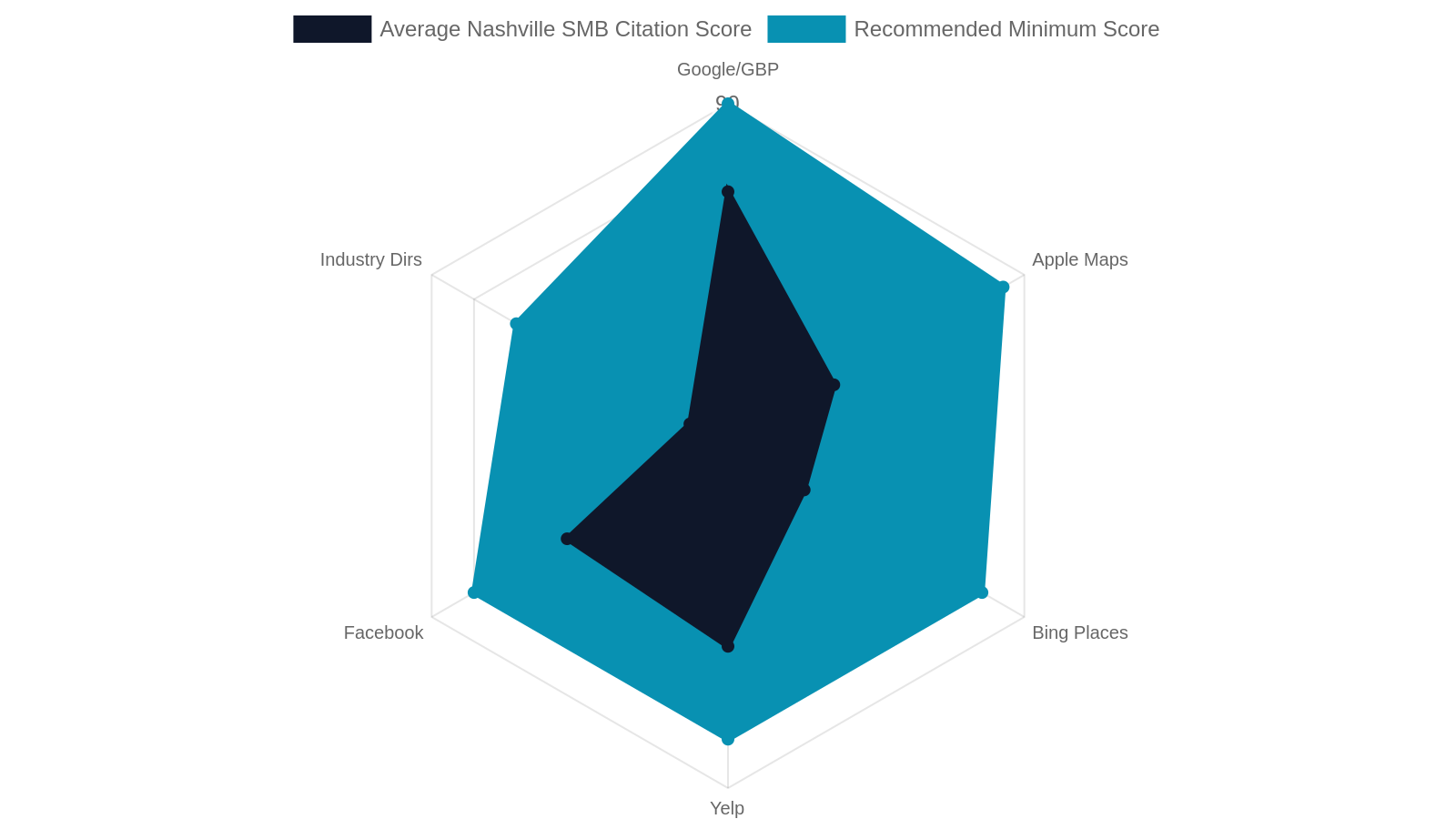
Local citations — mentions of your business name, address, and phone number on third-party directories — remain a significant local ranking factor. Moz’s 2023 Local Search Ranking Factors survey ranked citation signals in the top 8 factors for Map Pack visibility. For Nashville businesses, the most impactful directories include Google Business Profile, Yelp, Apple Maps, Bing Places, Facebook, the Better Business Bureau, and industry-specific directories (Houzz for contractors, Healthgrades for medical, Avvo for legal, etc.).
A health check should pull a citation audit showing how many directories you’re listed in, how consistent your NAP data is across them, and which high-authority directories you’re missing from entirely.
Fixing Inconsistent Citations Without Starting Over
Citation cleanup doesn’t require deleting and recreating every listing. Most major directories allow you to claim and edit existing listings. Tools like BrightLocal or Yext can push consistent NAP data to 50–100 directories simultaneously, though manual verification is still required for the highest-authority sites. For a typical Nashville small business, a full citation cleanup takes 2–4 weeks and costs $150–$500 depending on the number of inconsistencies found.
- Start with the ‘Big 4’: Google, Apple, Bing, and Facebook.
- Then address industry-specific directories relevant to your niche.
- Finally, clean up any duplicate listings — two GBP listings for the same location will split your review equity and confuse Google’s algorithm.
Ready to Get Your Free Website Health Check in Nashville?
You’ve now seen the 10 critical factors that determine whether your Nashville small-business website ranks, converts, and stays competitive in 2025. The good news: most of these issues are fixable within 30–90 days, and many cost little or nothing beyond time and expertise. The bad news: every day you wait, competitors who have addressed these issues are pulling further ahead in local search results and AI-generated answers.
Studio Blue Creative offers a completely free website health check for small and mid-sized businesses across Nashville, Jackson, and the Tennessee region. No credit card, no commitment — just a clear, prioritized picture of where your site stands and what to do about it.
What Happens After Your Health Check
A health check is only valuable if it leads to action. When Studio Blue Creative completes your free website health check, you receive a prioritized fix list organized by impact — not just a PDF of scores. We categorize every issue as Critical (fix within 7 days), High (fix within 30 days), or Moderate (fix within 90 days), so you know exactly where to focus first regardless of your budget or timeline.
From there, you can implement fixes yourself using our recommendations, or engage our team for full implementation. We serve businesses across the Nashville metro — Nashville, Franklin, Brentwood, Murfreesboro, Hendersonville, and Mount Juliet — as well as Jackson and the broader West Tennessee region. There’s no obligation after the health check, and no sales pressure.
Why Studio Blue Creative
Studio Blue Creative is a Tennessee-based digital agency with deep roots in both Nashville and Jackson. We specialize in the full stack of modern digital visibility: technical SEO, Generative Engine Optimization (GEO), AEO, custom WordPress development, Google Business Profile setup, and AI-powered chat and automation systems. We’re not a national agency that treats Tennessee as a zip code — we’re local, we know the competitive landscape, and we build long-term relationships with the businesses we serve.
Every engagement starts with honest diagnostics, not a sales pitch. Call us at 731-402-0402 for a free estimate, or start immediately by requesting your free website health check online — we’ll have your prioritized report ready within 48 business hours.
Frequently Asked Questions
Is a free website health check really free, or is there a catch?
A legitimate free website health check from a reputable agency costs you nothing upfront and comes with no obligation. The agency's goal is to demonstrate expertise and build trust — not to lock you into a contract. Studio Blue Creative's free health check for Nashville businesses includes a full prioritized report with no sales pressure attached.
How long does a website health check take?
A thorough health check typically takes 24–48 business hours to complete, depending on the size of your site. Larger sites with hundreds of pages may take 3–5 business days. You'll receive a written report, not just a verbal summary.
What's the difference between a website health check and an SEO audit?
A health check is a focused diagnostic covering 8–12 critical factors — it's designed to surface the highest-impact issues quickly. A full SEO audit is more comprehensive, covering keyword gap analysis, backlink profiles, competitor benchmarking, and content strategy, and typically costs $1,500–$5,000. A health check is the right starting point for most small businesses.
How often should a small business run a website health check?
At minimum, once per year. However, after any major site update (redesign, platform migration, new plugin installation) or after a noticeable traffic drop, you should run a health check immediately. Google updates its algorithm hundreds of times per year, so quarterly checks are ideal for competitive industries.
Does my Nashville business need AEO if I'm already ranking on Google?
Yes. Traditional Google rankings and AI engine visibility are increasingly separate channels. A business can rank on page 1 of Google and still be absent from ChatGPT, Perplexity, or Google's AI Overviews — which now appear above organic results for many local queries. AEO ensures you're visible in both ecosystems.
Can I do a website health check myself without hiring an agency?
You can run basic checks using free tools like Google Search Console, PageSpeed Insights, and Google's Mobile-Friendly Test. However, a professional health check goes deeper — crawling every URL, validating schema, auditing citation consistency, and assessing AEO readiness — tasks that require specialized tools and interpretation expertise to do correctly.
Find out if ChatGPT recommends your business.
Right now, your customers are asking AI for recommendations. The AI is naming somebody. Is that name yours? Run our free AEO Scorecard — we test 3 of your real queries against ChatGPT and Claude and email you a personalized report.
Ready for a real website?
Get a tailored 3-tier proposal in under a minute — including our Launch Deal ($699), a custom build, or our SEO Growth Package. No call required.