
Quick answer: To hire a web app developer near Jackson, TN, start by defining your project scope and budget (typical custom web apps run $5,000–$50,000+), then vet candidates by portfolio, local references, and technical stack. Prioritize developers who understand Tennessee's small-business landscape, offer transparent pricing, and can support your app post-launch. Local agencies like Studio Blue Creative combine West Tennessee market knowledge with full-stack capability — often delivering faster turnaround and clearer communication than remote-only freelancers.
1. Define Your Web App Scope Before You Hire Anyone
The single biggest mistake small businesses make when hiring a web app developer is starting the search before they know what they need. Developers — whether freelancers or agencies — price, schedule, and staff projects based on scope. A clear brief gets you accurate quotes; a vague one gets you wildly different numbers that are impossible to compare. Spend time up front defining what your app must do, who will use it, and what success looks like at the six-month mark.
Feature List vs. MVP: Know the Difference
A Minimum Viable Product (MVP) includes only the core features needed to test your idea with real users. A full feature list is everything you eventually want. Before you contact a single developer, separate these two lists. Developers price projects based on scope — a vague brief almost always leads to cost overruns of 20–40% above the original quote.
- MVP features: user login, core workflow, one payment method, basic reporting
- Phase 2 features: advanced analytics, third-party integrations, mobile app companion
Writing this down takes an afternoon and saves weeks of back-and-forth with every agency you evaluate.
Technical Requirements: Platform, Integrations, and Scale
Answer these questions before your first discovery call:
- Does the app need to work on mobile browsers, native iOS/Android, or both?
- Will it integrate with QuickBooks, Stripe, Salesforce, or another third-party tool?
- How many simultaneous users do you expect at launch — 50 or 5,000?
Developers in the Jackson, TN area and across West Tennessee work with a wide range of stacks — React, Vue, Laravel, WordPress with custom plugins — but your answers will immediately narrow the candidate pool to those with the right expertise.
2. Understand What Web App Development Actually Costs in Tennessee
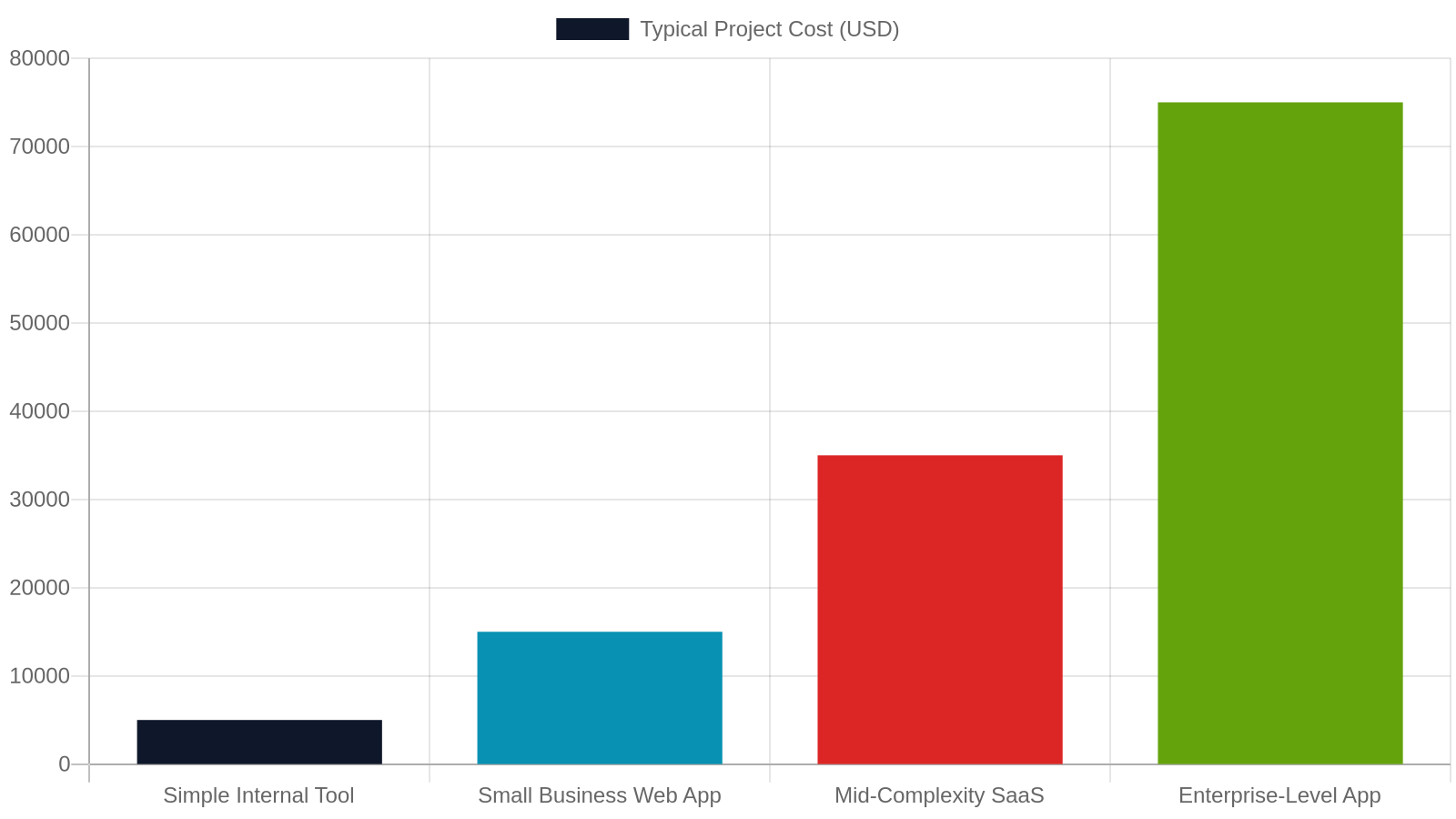
Cost is the question every business owner asks first — and the answer is genuinely wide-ranging. A simple internal tool might cost $5,000; a customer-facing SaaS platform with payment processing and user dashboards can run $50,000 or more. The chart below shows typical project cost ranges by app complexity so you can anchor your budget before requesting quotes.
Freelancer vs. Agency vs. Offshore: A Realistic Price Breakdown
Hourly rates and project minimums vary dramatically by model:
- Local freelancer (Nashville/Jackson area): $75–$150/hr; project minimum ~$3,000
- Regional agency (Tennessee-based): $100–$175/hr; project minimum ~$8,000
- National agency: $150–$250/hr; project minimum ~$25,000
- Offshore team (India, Eastern Europe): $25–$60/hr; coordination overhead often adds 15–30% to timeline
For most Jackson-area small businesses, a regional agency hits the sweet spot — local accountability, full-stack capability, and rates that don’t require a Series A funding round.
Hidden Costs to Budget For
The quoted build price is rarely the total cost. Plan for these line items:
- Hosting and infrastructure: $20–$300/month depending on traffic and database size
- SSL, domain, and CDN: $50–$200/year
- Post-launch maintenance retainer: typically 15–20% of build cost annually
- Third-party API fees: Stripe (2.9% + $0.30 per transaction), Twilio, Google Maps, etc.
- Content and copywriting: often overlooked; budget $500–$2,000 for initial content
Ask every candidate to provide a total cost of ownership estimate for year one, not just the build quote.
3. Know Which Technical Stack Your Project Needs

You don’t need to become a developer to hire one — but understanding the basic vocabulary of web app technology helps you ask better questions and evaluate candidates more accurately. The two main layers of any web app are the frontend (what users see) and the backend (where data lives and business logic runs). A full-stack developer handles both; specialized teams split the work.
Frontend Frameworks: React, Vue, and Beyond
The frontend is everything a user sees and touches. The most common frameworks in 2024 are:
- React.js — the industry standard; massive talent pool; ideal for complex, interactive UIs
- Vue.js — lighter learning curve; excellent for small-to-mid apps; popular with WordPress developers
- Next.js — React-based with server-side rendering; great for SEO-sensitive apps
For most Jackson-area small businesses, React or Vue paired with a solid backend is more than sufficient. Avoid over-engineering your stack — complexity adds cost and makes future maintenance harder.
Backend and Database Options
The backend handles your business logic, data storage, and API connections. Common choices:
- Node.js / Express — fast, JavaScript-based, great for real-time features like chat or live dashboards
- Laravel (PHP) — mature, well-documented, widely supported by Tennessee agencies
- WordPress + Custom Plugins — ideal if you already have a WP site and need moderate app functionality without a full rebuild
- PostgreSQL / MySQL — relational databases for structured business data
- Firebase / Supabase — managed backends that reduce infrastructure overhead for early-stage apps
Ask candidates which stack they specialize in and why they’d recommend it for your specific use case — not just what they prefer to build in.
4. Evaluate Portfolios Like a Pro — 6 Things to Look For

A portfolio is a developer’s most honest marketing material — it shows what they’ve actually shipped, not what they say they can do. When evaluating candidates for your Jackson, TN web app project, go beyond the screenshots. Click through live demos, read case studies, and ask pointed questions about the challenges they faced and how they solved them. Six specific signals separate strong portfolios from polished-but-shallow ones.
Relevance, Complexity, and Recency
A portfolio from 2019 tells you little about a developer’s 2024 capabilities. Look for:
- Recency: at least 2–3 projects completed within the last 18 months
- Relevance: have they built something similar to what you need? An e-commerce background is different from a booking-system or CRM background
- Complexity: do the projects show real business logic — user roles, payment flows, data exports — or are they mostly brochure-style sites dressed up as apps?
Live URLs, Case Studies, and Client References
Any serious developer or agency should be able to provide:
- Live URLs you can actually click through and test on mobile
- A brief case study explaining the client’s problem, the solution, and measurable results (e.g., “reduced manual data entry by 4 hours/week”)
- At least one client reference willing to take a 10-minute phone call
If a candidate hesitates on any of these, treat it as a yellow flag. Established agencies in the Nashville Metro and West Tennessee area will have no trouble providing all three. You can also review Studio Blue Creative’s project portfolio to see examples of real web and app work for Tennessee businesses.
5. Ask These 10 Interview Questions Before You Sign Anything

The interview stage is where most business owners underinvest their time. Thirty minutes of good questions before you sign a contract can prevent months of frustration. The ten questions below are split into two categories: process and communication (which predict your day-to-day experience) and ownership and support (which protect your business long-term).
Questions About Process and Communication
A technically brilliant developer who communicates poorly will cost you more in the long run than a slightly less skilled one who keeps you informed. Ask:
- “How do you handle scope changes mid-project?” — Listen for a clear change-order process, not vague reassurances.
- “How often will we have status meetings, and what tool do you use to track progress?” — Expect Basecamp, Jira, Notion, or similar.
- “Who is my primary point of contact — you, or a project manager?” — Know who picks up the phone when something breaks.
- “What does your QA process look like before launch?” — Manual testing? Automated tests? Both?
Questions About Ownership, IP, and Post-Launch Support
These questions protect your business legally and operationally:
- “Who owns the source code after I pay the final invoice?” — The answer must be: you do.
- “Will you give me access to all accounts — hosting, domain, GitHub repo?” — Full access is non-negotiable.
- “Do you offer a maintenance retainer, and what does it include?” — Security patches, uptime monitoring, and minor updates should be standard.
- “What happens if I need to bring another developer in later?” — A confident developer will hand off cleanly; a developer hiding something will hedge.
- “Can you provide a fixed-price quote or only time-and-materials?” — Both models are valid; just know which you’re agreeing to.
- “Have you worked with businesses in Jackson or the West Tennessee area before?” — Local context matters for understanding your customer base.
6. Local vs. Remote: Why Geography Still Matters for App Projects
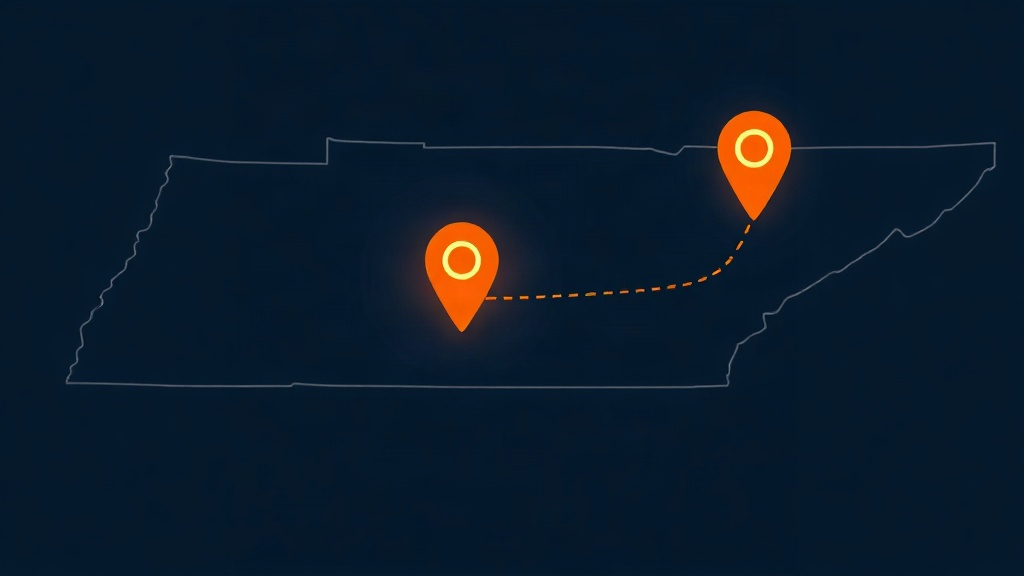
The rise of remote work has made it possible to hire a developer anywhere in the world — but “possible” and “optimal” are different things. For a Jackson, TN business owner building a web app that will serve local customers or internal staff, the developer’s location affects communication speed, cultural alignment, and long-term support quality. Here’s an honest look at both sides.
The Case for Hiring Local in Jackson and the Nashville Metro
Remote-first development is the norm in 2024 — but for small businesses in Jackson, TN and the broader West Tennessee market, local proximity still delivers real advantages:
- Same time zone, same business hours: No 9-hour lag waiting for a reply from an offshore team.
- In-person discovery sessions: A local developer can visit your office, watch your team’s workflow, and spot inefficiencies a video call would miss.
- Local accountability: An agency with a Tennessee address has reputational skin in the game. They want referrals from your network.
- Understanding of regional business culture: A developer who knows the Jackson market understands your customers, your competition, and the pace of business in West TN.
When Remote or Hybrid Makes Sense
Remote developers are a smart choice when:
- You need a highly specialized skill (e.g., machine learning integration, blockchain, or a niche API) that isn’t available locally
- Your project is well-documented enough that async communication works fine
- Budget constraints make a national agency out of reach and offshore rates are the only viable option
Even in these cases, consider a hybrid model: hire a local project manager or agency to oversee an offshore development team. This keeps communication tight and gives you a local point of accountability without paying full local rates for every development hour.
7. Red Flags That Should End a Conversation Immediately

Knowing who not to hire is just as valuable as knowing who to hire. The web development industry has a low barrier to entry — anyone can call themselves a developer and build a website. Protecting your Jackson, TN business means recognizing the warning signs before you’ve wired a deposit. These red flags fall into two categories: contract issues (which are legal risks) and communication issues (which predict a painful project experience).
Contract and Ownership Red Flags
Walk away if a developer or agency:
- Refuses to put deliverables, timelines, and payment milestones in writing
- Insists on retaining ownership of the source code after full payment
- Won’t give you admin access to your own hosting account or domain registrar
- Uses a contract with vague language like “reasonable effort” instead of specific deliverables
A legitimate Tennessee-based agency will have a clear Master Service Agreement (MSA) and a Statement of Work (SOW) for every project. If someone hands you a one-page email summary and calls it a contract, that’s a red flag.
Communication and Process Red Flags
Beyond the contract, watch for these behavioral warning signs during the sales process:
- No discovery call: Any developer who quotes a price without asking detailed questions about your business is guessing — and you’ll pay for the guess later.
- Overpromising timelines: A custom web app built correctly takes 8–20 weeks. Anyone promising 2 weeks for a complex app is cutting corners or planning to outsource without telling you.
- Vague technology answers: If they can’t explain their stack in plain English, they may not understand it well enough to support it post-launch.
- No references or live portfolio: Established developers always have something to show. “We keep all work confidential” is occasionally true but often a cover for a thin portfolio.
- Pressure to sign immediately: Legitimate agencies don’t run 48-hour closing windows. Take the time you need to compare at least three quotes.
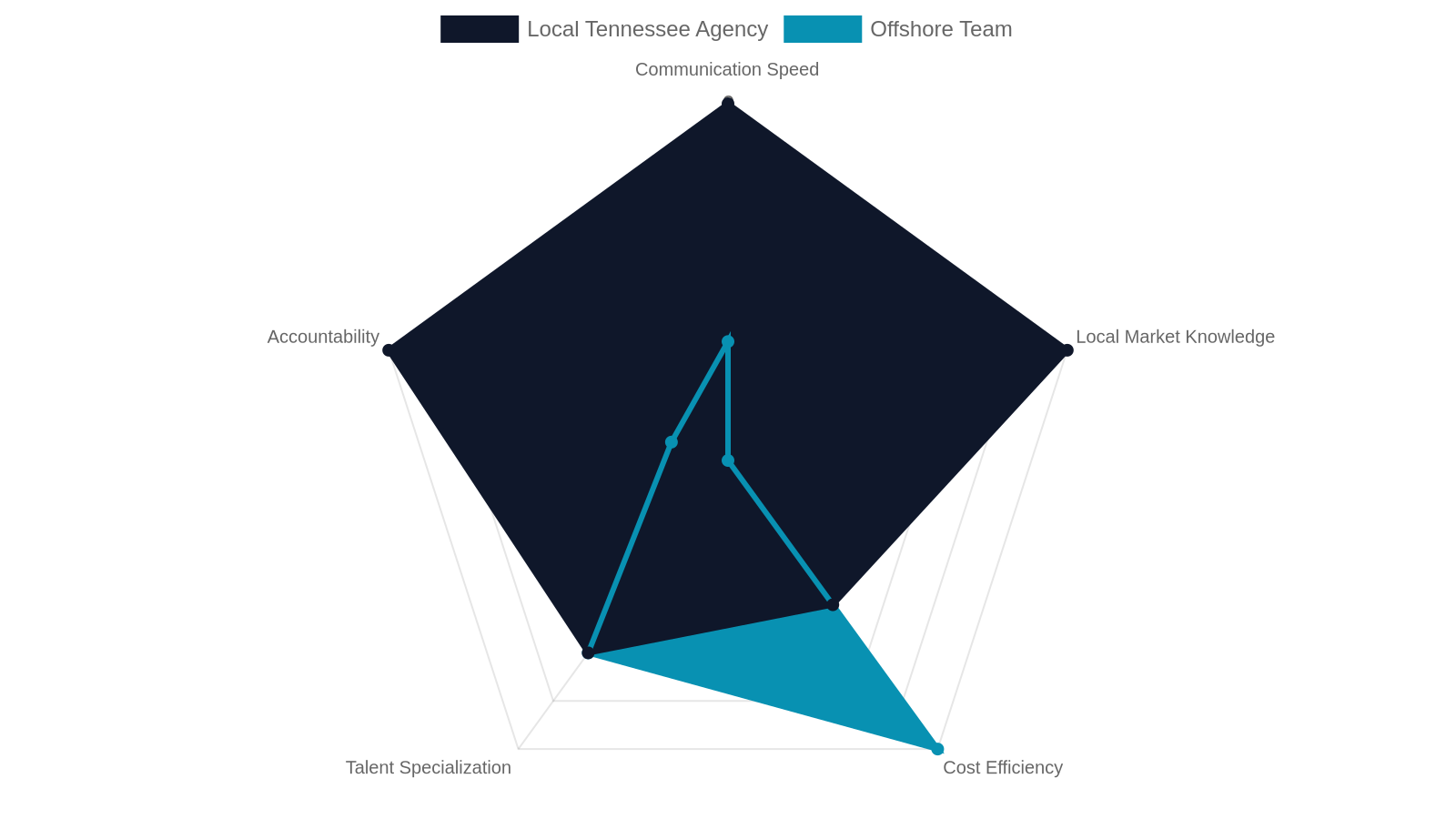
Hiring Options at a Glance: Local Agency vs. Freelancer vs. Offshore Team
Use this comparison to quickly assess which hiring model fits your Jackson, TN web app project based on budget, timeline, and risk tolerance.
8. The Hiring Process, Step by Step: A Timeline That Works

A structured hiring process keeps you in control and prevents the reactive decisions that lead to bad hires. The five-week framework below is realistic for a small business that needs to move efficiently without cutting corners. It accounts for proposal turnaround times, reference checks, and contract review — all of which are skipped far too often.
Weeks 1–2: Research, Brief, and Outreach
Use the first two weeks to build your project brief (scope, budget range, timeline, and success metrics) and identify 3–5 candidate agencies or freelancers. Sources for finding candidates in the Jackson and Nashville Metro area:
- Google Search: “web app developer Jackson TN” or “web development agency Nashville”
- LinkedIn: filter by location and skill
- Clutch.co: verified reviews with project cost data for Tennessee agencies
- Local Chamber of Commerce directories (Jackson Chamber, Nashville Chamber)
Send a brief outreach email with your project summary and ask for a 30-minute discovery call. Agencies that respond within 24–48 business hours are already demonstrating good communication habits.
Weeks 3–4: Discovery Calls, Proposals, and Reference Checks
Run discovery calls with your shortlist. After each call, ask for a formal proposal within 5–7 business days. A good proposal includes:
- Project scope and deliverables
- Technology stack recommendation with rationale
- Timeline broken into phases (design, development, QA, launch)
- Payment schedule (typically 30% upfront, 40% at milestone, 30% at launch)
- Post-launch support terms
While waiting for proposals, call references. Ask: “Did the project come in on time and on budget? Would you hire them again?” Two honest answers from past clients are worth more than any sales pitch.
Week 5: Decision, Contract Review, and Kickoff
Compare proposals side by side — not just on price, but on scope clarity, timeline realism, and the quality of the discovery conversation. Have a business attorney or trusted advisor review the contract before signing, especially the IP ownership and dispute resolution clauses. Once signed, schedule a kickoff meeting within the first week to align on communication cadence, tools, and the first milestone. A well-run kickoff prevents the most common early-project miscommunications.
9. SEO, AEO, and GEO: Why Your Web App Needs to Be Findable, Too

Building a web app is only half the battle — if your target customers can’t find it, the investment doesn’t pay off. Whether you’re building a customer portal, a booking system, or an internal business tool with a public-facing component, search visibility should be a requirement in your developer brief, not an afterthought. This is especially true for businesses serving the Jackson, TN and Nashville Metro markets, where local search competition is growing every year.
Technical SEO Built Into the App From Day One
Many web apps are built with zero consideration for search visibility — and that’s a costly mistake if customers need to find you through Google. Ensure your developer builds in:
- Server-side rendering (SSR) or static generation for pages that need to rank — client-side-only React apps are often invisible to crawlers
- Semantic HTML and proper heading structure (H1 → H2 → H3) on every page
- Structured data / schema markup for your business type, products, or services
- Core Web Vitals compliance — Google’s LCP, FID, and CLS metrics directly affect rankings
- Mobile-first responsive design — over 60% of web traffic in 2024 is mobile
AEO and GEO: Getting Found in AI-Powered Search
Answer Engine Optimization (AEO) and Generative Engine Optimization (GEO) are the emerging disciplines that help your business appear in AI-generated answers — ChatGPT, Google’s AI Overviews, Perplexity, and others. For a Jackson or Nashville Metro business, this means:
- Writing content that directly answers specific questions your customers type into AI tools
- Implementing LocalBusiness schema so AI engines can cite your location, hours, and services accurately
- Building citation authority so your business appears as a trusted source in AI-generated responses
Studio Blue Creative offers dedicated AEO services designed specifically for small businesses in Tennessee who want to be found in both traditional and AI-powered search.
10. Maintenance, Hosting, and Long-Term Support: Plan Before You Launch
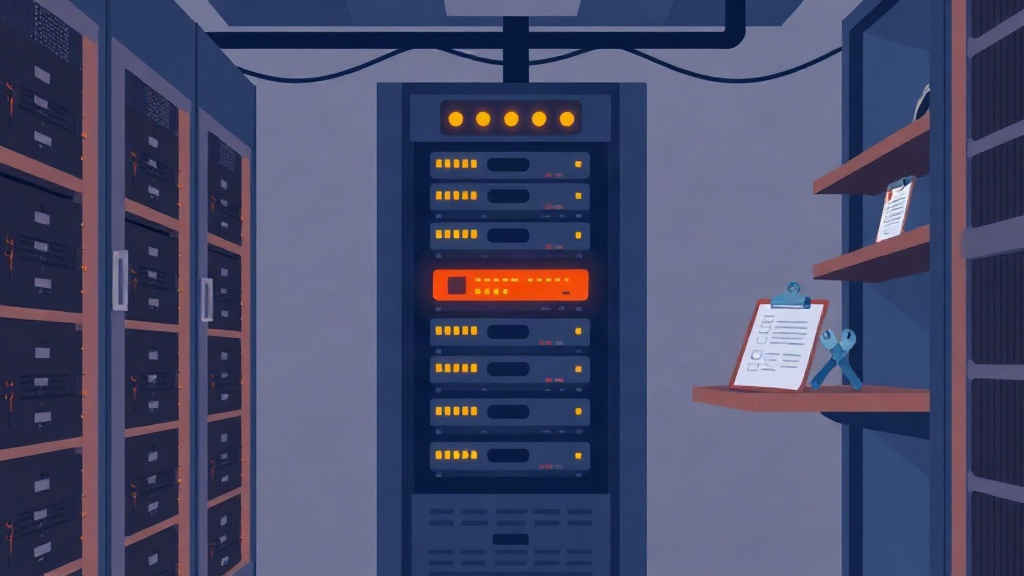
Launch day is not the finish line — it’s the starting gun. A web app requires ongoing maintenance to stay secure (WordPress alone sees 90,000+ attacks per minute globally), performant, and aligned with your evolving business needs. Before you sign a development contract, understand exactly what happens after the app goes live and who is responsible for keeping it running.
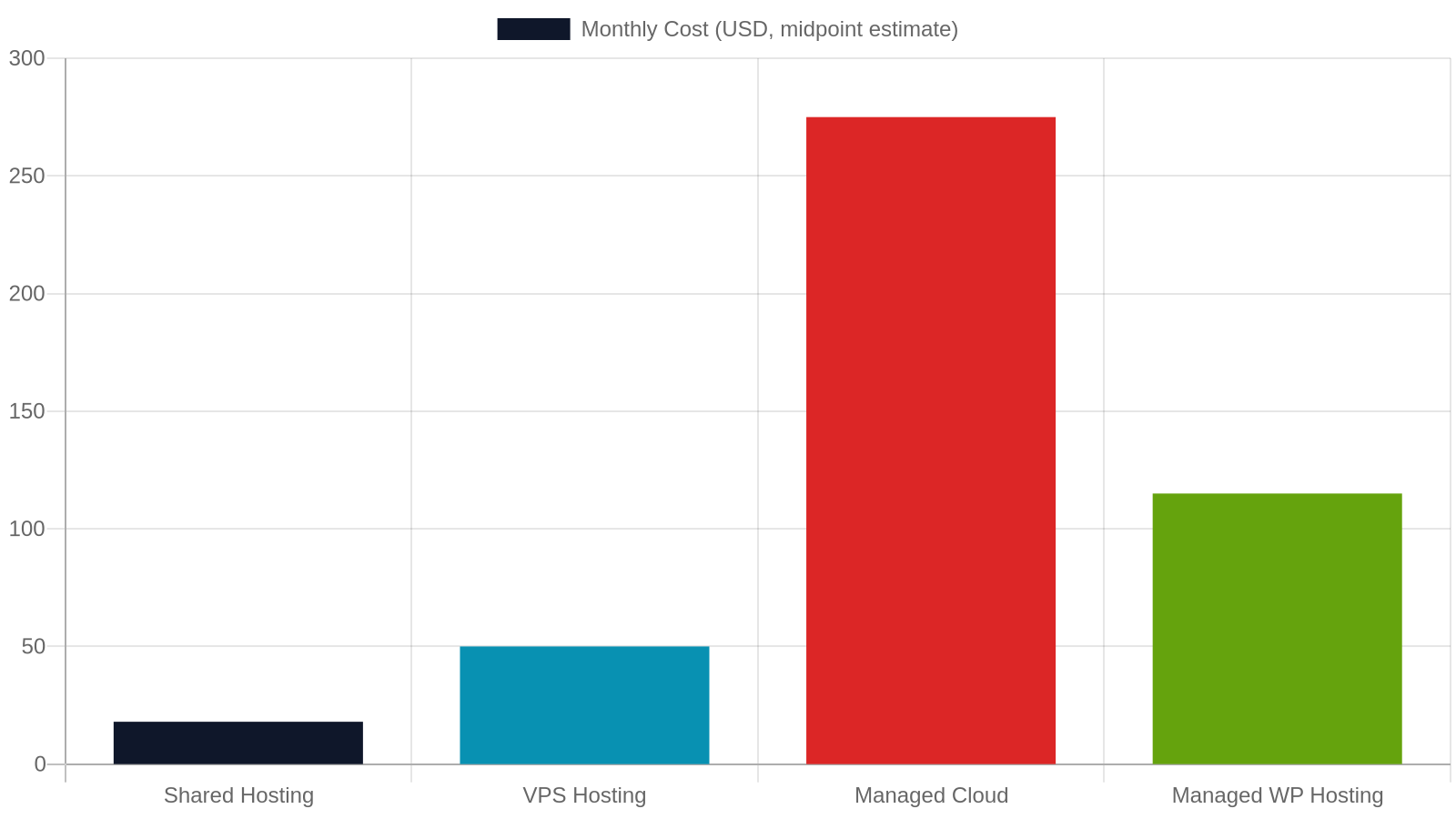
Hosting Options and What They Actually Cost
Where your app lives determines its speed, reliability, and security. Common options:
- Shared hosting (e.g., Bluehost, SiteGround): $5–$30/month — fine for simple sites, not for real web apps
- VPS hosting (e.g., DigitalOcean, Linode): $20–$80/month — good balance of cost and control for small apps
- Managed cloud (e.g., AWS, Google Cloud, Azure): $50–$500+/month — scales with traffic; requires DevOps knowledge to manage
- Managed WordPress hosting (e.g., WP Engine, Kinsta): $30–$200/month — ideal for WordPress-based apps with high-traffic needs
Ask your developer to recommend hosting that matches your current traffic and has a clear upgrade path for growth.
Maintenance Retainers: What's Included and What It Costs
A maintenance retainer keeps your app secure, fast, and functional after launch. Typical retainer tiers for Tennessee agencies:
- Basic ($150–$300/month): security patches, plugin/dependency updates, uptime monitoring
- Standard ($300–$600/month): everything above + monthly performance report, minor content updates, backup management
- Premium ($600–$1,200/month): everything above + priority bug fixes, quarterly feature additions, dedicated support contact
Skipping a retainer is a false economy — a single security breach or critical bug fix without a retainer in place can cost $500–$5,000 in emergency developer time. Build the retainer cost into your year-one budget from day one.
Ready to Hire a Web App Developer in Jackson, TN? Here's Your Next Move

You now have a complete framework for hiring a web app developer near Jackson, TN — from defining your scope and budgeting accurately, to evaluating portfolios, asking the right interview questions, and planning for long-term maintenance. The final step is simple: start the conversation with a developer who knows your market, communicates clearly, and has the portfolio to back up their pitch.
Why Studio Blue Creative Is Built for West Tennessee Businesses
Studio Blue Creative is a Tennessee-based digital agency serving both the Nashville Metro and Jackson / West Tennessee markets. Our team builds custom web apps, WordPress plugins, and full-stack digital solutions for small and mid-sized businesses — with transparent pricing, clear contracts, and post-launch support built into every engagement.
We’re not a national agency that treats Tennessee clients as an afterthought. We’re local, we’re accountable, and we understand what it takes to compete in the Jackson and Nashville markets in 2024 and beyond. Explore our web app development services for Jackson, TN businesses to see how we structure projects, what we build, and how we price our work.
Get a Free Estimate — No Commitment Required
Every project at Studio Blue Creative starts with a free discovery conversation. We’ll listen to your idea, ask the right questions, and give you an honest estimate — including timeline, technology recommendation, and total cost of ownership for year one. No pressure, no boilerplate proposals.
Call us today at 731-402-0402 or visit our full services page to learn more about everything we offer, from web app development to SEO, AEO, and AI-powered business tools. We serve businesses across Jackson, Nashville, Franklin, Brentwood, Murfreesboro, Hendersonville, Mount Juliet, and all of West Tennessee.
Frequently Asked Questions
How much does it cost to hire a web app developer in Jackson, TN?
Custom web app development in the Jackson, TN area typically ranges from $5,000 for a simple internal tool to $50,000 or more for a complex customer-facing platform. Local Tennessee agencies generally charge $100–$175 per hour, with project minimums around $8,000. Always ask for a total cost of ownership estimate that includes hosting, maintenance, and third-party API fees.
How long does it take to build a web app?
A properly built custom web app takes 8–20 weeks from kickoff to launch, depending on complexity. Simple tools with limited integrations can launch in 8–10 weeks; mid-complexity apps with payment processing, user roles, and dashboards typically take 14–20 weeks. Be skeptical of any developer promising a complex app in under 4 weeks.
Should I hire a local developer or a remote team for my Jackson, TN business?
For most small businesses in Jackson and West Tennessee, a local or regional agency offers the best combination of communication, accountability, and market knowledge. Remote or offshore teams can work well for clearly documented projects with tight budgets, but coordination overhead and time zone differences often add hidden costs. A local agency with a Tennessee address has reputational skin in the game.
Who owns the code after a web app is built?
You should. Any reputable agency or freelancer will transfer full intellectual property rights to you upon final payment. This must be explicitly stated in your contract — not implied. Ensure the contract also grants you access to all repositories, hosting accounts, and third-party service credentials.
What is the difference between a website and a web app?
A website primarily delivers information to visitors (think a brochure or blog). A web app is interactive — it processes user input, stores data, and performs business logic, like a booking system, customer portal, inventory manager, or SaaS platform. Web apps require more complex development and ongoing maintenance than standard websites.
Does Studio Blue Creative offer free estimates for web app projects?
Yes. Studio Blue Creative offers free discovery consultations and project estimates for businesses in Jackson, the Nashville Metro, and across Tennessee. Call 731-402-0402 or visit their web app development page to start the conversation with no commitment required.
Find out if ChatGPT recommends your business.
Right now, your customers are asking AI for recommendations. The AI is naming somebody. Is that name yours? Run our free AEO Scorecard — we test 3 of your real queries against ChatGPT and Claude and email you a personalized report.
Ready for a real website?
Get a tailored 3-tier proposal in under a minute — including our Launch Deal ($699), a custom build, or our SEO Growth Package. No call required.