
Choosing the right SEO agency is about finding a true partner, someone who understands your business goals, not just a vendor promising more website clicks. The path to a successful partnership begins when you first define what success actually looks like for your business—in real numbers, like more patient bookings or product sales—and then find an agency that can prove they know how to get you there.
First Things First: Define What Success Looks like
Before you even start looking for an agency, you need a clear destination in mind. It's easy to begin the search with a vague request like, "I just need more traffic." But that approach often leads to disappointment. Traffic is a tool, not the goal. True success is measured by outcomes that tangibly grow your business.
This journey starts with an honest look at your own organization. What would a successful SEO campaign genuinely accomplish for you? Getting this right—shifting your focus from abstract metrics to concrete business objectives—is the most crucial first step you can take.

From Vague Ideas to Concrete KPIs
Let's make this practical. Tying SEO efforts to measurable business results is how you move past generic goals. Consider these real-world examples:
- For a healthcare clinic in Tennessee: Success isn't just ranking #1 for "best doctor in Jackson." It's achieving a 20% increase in online appointment requests from new patients who live within a six-mile radius. The key performance indicator (KPI) that truly matters here is booked appointments.
- For a local e-commerce shop: A surge in traffic is nice, but a 15% lift in completed sales for your highest-margin products is what sustains the business. Your most important KPI is online sales revenue.
- For a nonprofit organization: Getting eyes on your mission statement is great, but success is really defined by a 30% jump in new donor sign-ups coming through the website. Here, the KPI is completed donation forms.
When you define your primary KPIs, your search for an agency transforms from a guessing game into a strategic investment. It provides a clear roadmap and ensures every conversation you have is laser-focused on measurable growth. To explore this further, our guide on how to increase website conversions explains exactly how these goals connect to your website's performance.
Setting a Realistic Budget and Resource Plan
Once you know your goals, it's time to be realistic about your budget. SEO is a long-term strategy, not a quick fix. Imagine hiring a new employee who works 24/7 to bring you qualified leads. What would you invest to achieve the KPIs you just outlined? Establishing a practical monthly budget from the start helps you filter out agencies that aren't a good financial fit.
Equally important is determining what you can bring to the partnership. Who on your team will be the primary point of contact? How much time can they realistically dedicate each week to reviewing reports, approving content, and providing feedback? An agency relationship is a two-way street. Knowing your internal capacity helps build a foundation for a partnership that truly thrives.
Key Takeaway: The best SEO partnerships are built on clarity. When you know the exact business outcome you're aiming for, you can evaluate agencies based on their ability to get you there—not just on their flashy promises of more clicks.
Part of this initial groundwork is also understanding your position in the market. As you define success, looking at metrics like What Is Share of Voice in Marketing can be crucial for setting competitive goals. Taking these steps means you’ll walk into agency meetings feeling prepared, confident, and focused.
Ready to turn those goals into a clear plan of action? A simple phone call can be the first step. Let's discuss how we can help you build a strategy that connects every SEO effort directly to your bottom line. Call us at 731-402-0402.
Vetting an Agency's Real-World Experience and Results
Any agency can create a sleek website and talk a good game. Your role is to look past the sales pitch and examine their actual track record. The real story isn't found in their promises, but in the tangible business growth they’ve already delivered for companies similar to yours.
This means you must look beyond "vanity metrics" like a simple increase in website traffic. Of course, more visitors are welcome, but it’s a hollow victory if none of them become customers. The objective is to find an agency that proves its value with results that directly impact your bottom line.
How to Analyze Case Studies for Real Growth
Think of case studies as an agency's portfolio—and it’s your job to review them with a critical eye. A truly valuable case study tells a clear story: it outlines the client's initial challenge, details the specific strategy the agency implemented, and then showcases the measurable outcomes.
Look for case studies that reflect the KPIs you’ve already set for your own business.
- For a healthcare provider: A case study showing a 40% increase in patient bookings from organic search is far more compelling than one that just brags about ranking for broad medical terms.
- For a local Jackson, TN business: Proven success in local SEO is essential. You need to see examples where they helped a similar local business dominate the Google Map Pack, resulting in a real-world increase in phone calls and foot traffic. To get a better idea of what this looks like, check out our guide on local SEO best practices.
Never hesitate to ask for more details. If a case study feels vague or the numbers seem unclear, press them for the before-and-after data. A confident agency with real results will be happy to provide more context.
Verifying Testimonials and Industry Expertise
Testimonials add a human element, but again, specificity is key. A quote that says, "They were great to work with!" is nice, but it tells you very little. What you're looking for is a testimonial that says something like, "Their strategy helped us increase online sales by $50,000 in six months." That provides concrete proof of their impact.
Industry relevance is another crucial factor. SEO is not a one-size-fits-all service. Different industries have their own unique challenges, compliance rules, and customer behaviors.
Real-World Scenario: A dental clinic here in Tennessee needs an agency that understands the nuances of HIPAA compliance for patient forms. They also need to be well-versed in Google's strict "Your Money or Your Life" (YMYL) guidelines for health content. An agency that mainly works with e-commerce brands could easily miss these critical details, putting the clinic at risk.
The same holds true for a nonprofit. They need a partner who knows how to craft content that inspires donations and volunteer sign-ups—a completely different skill set from generating leads for a B2B software company. Always ask an agency to show you direct examples of their work within your specific industry.
Why Proven Experience Matters More Than Ever
Choosing an agency with a proven track record is absolutely critical, especially when you consider that the #1 spot in Google's search results gets a massive 27.6% click-through rate. By contrast, results on the second page get less than 1% of all clicks. With Google constantly refining its algorithm, you need a partner who has navigated these updates and knows how to adapt and deliver.
For industries like healthcare or for nonprofits, where standards like HIPAA or YMYL are non-negotiable, this expertise isn't just a bonus—it's a requirement. We've seen firsthand how a data-driven strategy paired with deep industry knowledge can transform a client's online presence, turning their website from a simple brochure into a powerful lead-generation engine. For more eye-opening SEO statistics, you can read the full research about these findings here.
The right partner doesn't just know SEO; they know your business. They’ve walked this path before with clients just like you and have a portfolio of success stories to prove it. This experience is what separates an average agency from a true growth partner.
Digging Into Their SEO Philosophy and Technical Chops
Not all SEO is created equal. Flashy promises are one thing, but an agency's actual methodology is what drives real, long-term success. To truly know if you're selecting the right SEO partner, you have to look under the hood and understand their core philosophy.
This means asking direct questions about how they manage the three pillars of SEO: technical health, content, and link building. A great agency will have a clear, logical process for each. They should begin with a deep-dive site audit before proposing a strategy. They need to be able to walk you through exactly how they conduct keyword research and, more importantly, how that research is transformed into content that genuinely connects with your ideal customer.
White Hat vs. Black Hat: Know the Difference
The single most important concept to grasp is the line between sustainable, ethical strategies and risky shortcuts. In the SEO world, this is known as "white hat" vs. "black hat."
- White Hat SEO: This is the gold standard. It’s all about creating genuinely helpful content, earning backlinks from reputable sources, and optimizing your site’s technical performance to provide the best possible user experience. Think of it as a long-term investment that builds a durable, valuable asset for your business.
- Black Hat SEO: These are deceptive tactics used to fool search engines for a quick, temporary gain. This includes practices like buying links, stuffing pages with irrelevant keywords, and using hidden text. While it might provide a brief rankings boost, it almost always ends in a severe Google penalty that can make your online visibility disappear overnight.
A trustworthy agency will always be a champion for white hat SEO. They should be completely transparent about their methods, focusing on building sustainable growth that adheres to the rules, not trying to game the system.
Use this quick comparison to spot trustworthy SEO strategies versus risky, short-term tactics during your evaluation.
| Practice Area | Green Flag (Healthy Strategy) | Red Flag (Risky Tactic) |
|---|---|---|
| Link Building | Earning links through great content and outreach. | Buying links or using private blog networks (PBNs). |
| Content | Creating valuable, original content for users. | Keyword stuffing or using auto-generated/spun content. |
| Technical SEO | Improving site speed and user experience. | Hiding text or links with CSS to manipulate rankings. |
| Strategy Focus | Long-term, sustainable growth. | Guarantees of "#1 rankings" or "overnight results." |
When you're interviewing agencies, listen carefully to how they describe their work. Their language will reveal whether they're focused on building a solid foundation or just chasing quick, unsustainable wins.
Core Technical Skills You Can't Ignore
Beyond philosophy, an agency must have the technical expertise to execute effectively. Your website's technical foundation is the bedrock of any successful SEO campaign. A technically sound site is faster, easier for Google to crawl, and provides users a better experience—all significant ranking factors.
Before you sign any agreement, make sure they have real, proven experience with these essentials:
- Site Speed Optimization: Slow pages hurt conversions. A good agency knows how to identify and fix speed issues, from oversized images to inefficient code.
- Schema Markup: This is specialized code that helps search engines understand your content on a deeper level. It's what powers enhanced search results with star ratings, event details, or FAQs.
- Mobile-First Indexing: The majority of searches now happen on mobile devices, so Google ranks your site based on its mobile version. The agency must be an expert at creating a seamless mobile experience.
- Comprehensive Site Audits: They should have a clear process for finding and fixing technical issues that hold you back, like broken links, duplicate content, and crawl errors.
This visual pulls it all together, showing the key areas to investigate when you're vetting an agency—from their past work and client feedback to their specific industry know-how.
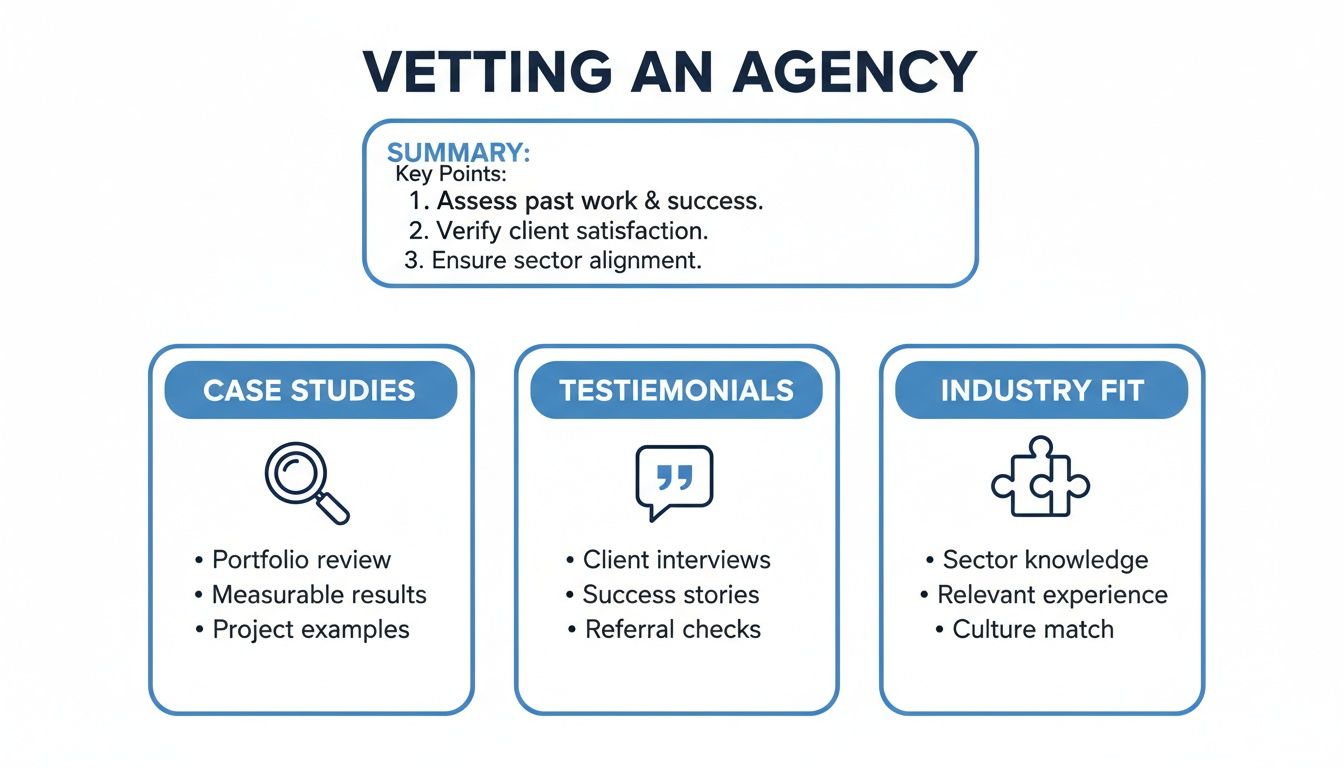
Looking at case studies, testimonials, and industry fit gives you a 360-degree view of an agency's capabilities and whether they're truly the right partner for you.
How They Approach Content and Link Building
Finally, don't be shy about asking pointed questions about their content and link-building process. For example, how do they ensure the content they create aligns with what your audience is searching for? A great agency will have a detailed process that goes beyond basic keyword research to truly understand searcher intent. You can learn more about this in our guide to building a content marketing strategy for small business.
When it comes to link building, be cautious of any agency that promises a specific number of links per month. Quality is infinitely more important than quantity. Ask them to describe their process for earning high-quality, relevant backlinks from reputable sites in your industry. Their answer will tell you everything you need to know about whether they're focused on building lasting authority or just using risky, short-term tactics.
Feeling confident about an agency’s technical skills and ethical approach is a huge step forward. If you're looking for a partner who can clearly explain their process and focuses on sustainable growth, let's talk. A simple conversation can provide the clarity you need. Call us at 731-402-0402.
Decoding Contracts, Pricing, and Communication Styles
The sales pitch is over. Now comes the real test: the proposal and the contract. This is where all those promises and conversations are put into writing, forming a binding agreement. You need to review the fine print carefully, because understanding an agency's pricing, contract terms, and communication style is what sets the foundation for your entire partnership.
A great relationship isn't just about results. It’s built on transparency, clear expectations, and knowing you have a true partner in your corner, not just another vendor. This is where you find out if their way of doing business aligns with yours.

Making Sense of SEO Pricing Models
SEO pricing is never one-size-fits-all, and the structure an agency uses says a lot about their approach. Before you consider signing, get familiar with the common marketing agency pricing models to determine what makes sense for your budget and your goals.
You'll almost always encounter one of these three:
- Monthly Retainer: This is the industry standard for ongoing SEO. You pay a fixed fee each month for a specific set of services. For example, a local Tennessee business might pay a retainer for continuous local SEO, content creation, and monthly reporting. It's the best model for long-term, sustained growth.
- Project-Based Fee: This is a one-time fee for a specific task with a clear start and end date. A nonprofit, for instance, might hire an agency to conduct a deep technical SEO audit and implement all the recommended fixes. It’s perfect for well-defined, short-term needs.
- Hourly Rate: Some agencies or consultants charge by the hour. This can work for small, one-off tasks or strategic advice, but be cautious—costs can escalate if the scope isn't clearly defined. Always ask for an estimated number of hours upfront to avoid surprises.
The best pricing model is the one that aligns with what you're trying to achieve. If you're committed to long-term growth, a retainer usually delivers the most value. If you just need a specific problem solved, a project-based fee is often the way to go.
Non-Negotiable Contract Elements
Your contract is your safety net. It needs to be perfectly clear, leaving no room for misinterpretation. If an agreement seems vague or one-sided, it's a red flag.
A solid SEO contract will always include these key elements:
- A Detailed Scope of Work (SOW): This isn't a suggestion; it's a checklist. The SOW should list every single deliverable. If they promised four blog posts a month, Google Business Profile optimization, and building five backlinks, it needs to state that explicitly.
- Contract Length: Most SEO retainers are for 6 or 12 months. This is a fair timeframe, as it genuinely takes time to see meaningful results. Be wary of agencies pushing for extremely long contracts without a stellar track record to back it up.
- Cancellation Clause: What happens if things don't work out? A fair contract will have a clear out-clause, usually requiring 30-day written notice. This protects both parties and ensures you aren't locked into an unproductive relationship.
- Ownership of Work: This is crucial. You must retain ownership of all content, designs, and technical fixes made to your site, even if you part ways. It's your website, and you paid for the work.
Gauging Their Communication Style
Finally, don't forget the human element. How an agency communicates can make or break the entire experience. You're looking for a partner who is proactive, transparent, and responsive—not one you have to chase for updates.
As you finalize your decision, ask these questions:
- Who will be my day-to-day contact? You need to know if you’ll be talking to a senior strategist or a junior account manager who is simply relaying information.
- What does your typical communication cadence look like? Will you have weekly check-ins? Monthly reports? Get these expectations set in stone from the beginning.
- Can you tell me about a time a strategy wasn't working and how you handled it with the client? This question is invaluable. It reveals how they deal with adversity. A great partner won't hide bad news; they'll be honest and come to you with a plan to get back on track.
A transparent agency will welcome these questions. Their answers will give you a real sense of what it’s actually like to work with them day in and day out.
Walking into a sales call fully prepared can completely shift the dynamic. It stops being a sales pitch you have to sit through and becomes an interview you conduct. Having a sharp, strategic list of questions ready lets you cut through the fluff and get to the heart of how an agency truly operates.
These aren't just surface-level queries. They're designed to dig into an agency’s process, their approach to reporting, how they manage client relationships, and—most importantly—how they handle things when they don't go according to plan. Think of this as your toolkit for making a confident final decision.
Before you get down to the nitty-gritty of contracts and pricing, you need to be absolutely sure you're talking to the right people. The best way to do that? Ask pointed questions that reveal how they think, work, and communicate.
To make this easier, here is a checklist of essential questions. This isn't just a list to run through; it's a framework for a real conversation. Use these to get a feel for their expertise and to see if they're the kind of partner you can trust with your business's growth.
Your Agency Interview Checklist
| Category | Sample Question to Ask |
|---|---|
| Strategy & Process | "Can you walk me through your exact process for the first 90 days with a new client like us?" |
| Strategy & Process | "How do you make sure your SEO efforts support our other marketing, like social media or email?" |
| Technical SEO | "What's your approach to a technical SEO audit, and what are the top 3 things you'd look for on our site?" |
| Reporting & KPIs | "Beyond traffic, which specific business KPIs will you use to measure success for us?" |
| Reporting & KPIs | "Could you share a sanitized example of a monthly report so we can see how you communicate progress?" |
| Reporting & KPIs | "How do you calculate the actual ROI of your SEO campaigns?" |
| Communication | "Who will be our day-to-day point of contact, and what's their direct experience level?" |
| Problem-Solving | "Tell me about a time a campaign wasn't hitting its goals. What did you do to turn it around?" |
| Problem-Solving | "What's your process for communicating bad news, like an unexpected drop in rankings?" |
Let's break down why these specific areas are so critical.
Strategy and Process
You absolutely have to understand an agency's methodology. Their answers here will show whether they have a structured, goal-oriented process or if they’re just winging it from month to month. A solid strategy is the bedrock of any successful SEO campaign.
Get started with these probing questions:
- "What does your discovery and onboarding process look like for a new client like us?" A great agency won’t just jump in. They’ll have a detailed process that includes a technical audit, deep competitor analysis, and a real conversation about your business goals before any work begins.
- "Can you walk me through how you would develop the initial 90-day SEO strategy for our business?" This question forces them to apply their knowledge directly to your situation, not just give you a canned answer. Listen for mentions of your specific KPIs and goals.
- "How do you integrate SEO with a client's other marketing channels, like social media or email marketing?" Their answer reveals if they see the big picture. SEO doesn't live on an island; it should be part of your entire business growth engine.
Unpacking Their Reporting and Success Metrics
Reporting is where accountability lives. A good report does more than show traffic graphs; it tells a story about how SEO is translating into real business results—leads, sales, and phone calls. Vague or confusing reports are a huge red flag.
Make sure you get crystal clear on how they measure and communicate success.
- "Beyond traffic and rankings, which specific KPIs will you report on to show us we're achieving our business goals?" Their response should tie directly back to the goals you discussed earlier. If you’re a local business in Tennessee, that might mean foot traffic or appointment bookings.
- "Could you show us a sanitized example of a monthly report you send to clients?" Don't just take their word for it. Seeing a real report tells you everything about their commitment to transparency and data-driven storytelling.
- "How do you measure the ROI of your SEO efforts?" A top-tier agency will have a clear way to connect their work to your bottom line. If they fumble this question, they might be more focused on vanity metrics than on actual business value.
A truly confident agency will welcome these questions. They'll see it as an opportunity to showcase their expertise and their commitment to a transparent, results-driven partnership.
Gauging Client Relationships and Problem-Solving
Let's be real: every SEO campaign hits roadblocks. Google rolls out an unexpected algorithm update, or a competitor launches an aggressive new strategy. How an agency responds to these challenges is often what separates the great partners from the mere vendors.
These questions help you understand the human side of the partnership:
- "Can you describe a time when a client's strategy wasn't delivering the expected results, and how you pivoted?" This is a powerful one. It tests their honesty, their problem-solving skills, and their ability to communicate proactively when things get tough.
- "Who will be our main point of contact, and what is their level of experience?" You need to know if you'll be working with a seasoned strategist or handed off to a junior account manager right after you sign.
- "What is your process for communicating bad news or unexpected drops in performance?" A strong partner is proactive. They'll come to you with an explanation and a plan, not wait for you to notice something is wrong in a report.
Choosing an SEO agency is a big decision. Armed with these questions, you can move past the sales pitch and find a true partner who is ready to help you grow.
Feeling prepared to have this conversation? Let’s put our process to the test. We would be happy to answer every one of these questions and more. Give us a call at 731-402-0402.
A Few Final Questions You're Probably Asking
Even after you've done all your homework, a few questions usually pop up. That's completely normal. Picking an SEO partner is a big decision, and you should feel 100% confident before you sign anything.
Let’s tackle the most common questions we hear from business owners trying to make that final call.
How Long Does It Really Take to See SEO Results?
This is always the first question, and the honest-to-goodness answer is: it depends. While you might see some small wins from technical fixes in a few weeks, the kind of results that actually move the needle—like a real, steady stream of leads or sales—typically take 4 to 12 months to build up.
Think of it like getting in shape. You don't see results after one trip to the gym. The timeline hinges on a few things:
- Your Starting Point: A brand-new website is like starting from scratch. An established site with some history has a head start.
- Your Competition: If you're in a crowded market, it's going to take more time and muscle to climb the ranks.
- The Game Plan: A more aggressive, comprehensive strategy will get you there faster than a timid one.
A good agency will be upfront about this from day one. They'll focus on building sustainable, long-term growth instead of promising you the moon overnight. In those first 1-3 months, you should be looking for early signs of life: better rankings for your most important keywords, a noticeable uptick in organic traffic, and cleaner technical health scores for your site.
What’s the Difference Between Local SEO and National SEO?
Getting this right is absolutely critical because it dictates the entire strategy.
Local SEO is all about getting your business seen by customers in a specific geographic area, like right here in Jackson, TN. This means optimizing your Google Business Profile, making sure your business is listed correctly across local directories, and targeting keywords people actually use, like "best plumber near me." If you have a physical location or serve a specific area, this is non-negotiable.
National SEO, on the other hand, is for businesses that can serve customers anywhere. Think e-commerce stores, SaaS companies, or national consultants. The focus is on broader keywords and reaching a country-wide audience. The tactics are completely different, and a local business needs a partner who has proven experience in the local search arena.
Here's a real-world look: A Jackson-based dental clinic needs to show up in the Google Map Pack when someone searches "emergency dentist in Madison County." An online boutique that ships handmade leather goods across the country needs to rank for "buy unique leather wallets." The goals—and the work required to achieve them—are worlds apart.
Should I Go with a Big Agency or a Smaller One?
There’s no single right answer here—it all comes down to what you need and how you like to work.
Large agencies often have a huge list of services and plenty of resources. The trade-off? You might get passed off to a junior-level account manager and feel like a small fish in a very big pond.
Smaller, boutique agencies, like us, are built for a more hands-on, dedicated partnership. You’re often working directly with the senior experts who are in the trenches, doing the actual work. It allows us to be more nimble, build a real relationship, and be directly accountable for the results. If you value a close, collaborative partnership and want direct access to the A-team, a smaller agency is usually the way to go.
Feeling more confident about the road ahead? The last step is to take action.
At Studio Blue Creative, we believe in building transparent partnerships that deliver real, measurable results. As a veteran-owned agency right here in Tennessee, we're ready to answer any other questions you've got.
Let's start turning your goals into a reality. A simple conversation is the best place to begin. Call us at 731-402-0402 or head over to our website at studiobluecreative.com to get started.
Find out if ChatGPT recommends your business.
Right now, your customers are asking AI for recommendations. The AI is naming somebody. Is that name yours? Run our free AEO Scorecard — we test 3 of your real queries against ChatGPT and Claude and email you a personalized report.