

Last Updated: November 1, 2026
Quick Summary
Enterprise web design for manufacturing focuses on helping buyers find specifications and request quotes quickly, rather than on visual trends. Manufacturers should structure complex product catalogs by content type and make them searchable by technical specification. Each product page should show decision data clearly above the fold.
- Buyers should find the product family they need within two clicks.
- Separate marketing, technical and commercial content, each with its own owner and update cycle.
- Make the catalog searchable by specification, not just by product name.
- Keep quote request forms short, asking about application, volume and timeline.
- Track searches with zero results, filters that never convert, and datasheet downloads that do not lead to an RFQ.
Table of Contents
- Manufacturing Website Design Best Practices That Hold Up at Scale
- Structuring Complex Product Catalogs and Technical Data
- Manufacturing Website Features That Generate Qualified Quote Requests
- B2B Manufacturing Website Examples and What They Get Right
- Governance, Accessibility and Measuring What Matters
- Planning Your Manufacturing Website Redesign
- Frequently Asked Questions
Enterprise web design for manufacturing is less about looking modern and more about answering a buyer’s questions fast. Manufacturers need to show complex products clearly, and the first screen a buyer sees often decides whether they keep reading. The U.S. web design services industry is valued at $18.9 billion in 2026, according to IBISWorld’s Web Design Services in the U.S. industry analysis, which shows how much money businesses are putting into their online presence.
Most buyers reach a manufacturer’s site with a specific part, spec or application in mind. If they cannot find it in a minute or two, they leave. Your site is often the first test of how capable your company is.
Here is what buyers usually check first:
- Can they find the product family they need within two clicks?
- Do specifications appear without digging through PDFs?
- Is there a clear path to request a quote?
- Does the site load quickly on a phone at the plant?
Watch out: A site that looks impressive but hides specifications behind forms will lose technical buyers to a simpler competitor.
Manufacturing Website Design Best Practices That Hold Up at Scale
Scalability matters because enterprise sites grow. A site built for ten product lines can buckle under two hundred. Plan templates and content models before you add pages, not after.
- Use one template system for product pages, with flexible fields
- Keep navigation organized by how buyers search, not by org chart
- Test page speed on mobile connections, not only office Wi-Fi
- Set clear rules for who can publish and approve content
Structuring Complex Product Catalogs and Technical Data
Technical data is where many manufacturing sites fall apart. Hundreds of SKUs, dimensions, tolerances, material options, and certifications can overwhelm a visitor. The fix is not a prettier product page, it is a content model and search layer built for how engineers and procurement teams actually work.
Start by separating three kinds of product content, because they have different owners and update cycles:
- Marketing content, application stories, differentiators, and industry fit. Owned by marketing, updated quarterly.
- Technical content, specifications, tolerances, materials, certifications, and datasheets. Owned by engineering or product management, updated when the part changes.
- Commercial content, lead times, minimum order quantities, pricing tiers, and availability. Often pulled from ERP, updated continuously.
When these live in one unstructured page, every update becomes a redesign. When they are modeled separately, a spec change does not touch the marketing copy, and an ERP sync does not overwrite a datasheet.
Make the catalog searchable by specification, not just by name
Most buyers arrive knowing a part number, a competitor’s equivalent, or a performance requirement, not your product family name.
Put the decision data above the fold
On each product page, lead with a scannable specification table: key dimensions, materials, operating limits, certifications, and available configurations. Link to full datasheets and CAD files for buyers who need to model the part. Keep the summary readable enough that a buyer can decide whether to keep going before downloading anything.
For CAD and technical files, plan for the formats buyers expect, STEP, IGES, DXF, and native CAD where feasible, and label them clearly. Gating every download behind a form frustrates engineers who are still evaluating; a common compromise is to gate CAD files but leave datasheets and certifications open, then capture contact details at the quote stage.
Design the quote and configuration workflow around the part
For configurable products, a configurator that validates compatible options (voltage, mounting, material) prevents the back-and-forth that kills quote velocity. For catalog parts, a quote cart that lets a buyer collect multiple line items and submit one RFQ mirrors how procurement actually works.
Instrument the catalog. Track searches with zero results, filter combinations that never convert, and datasheet downloads that do not lead to an RFQ. Those three signals usually point to the first catalog fixes.
::: Refining these digital touchpoints transforms a static product database into a proactive engine for lead generation for manufacturers.
A catalog that looks complete but returns no results for a competitor part number or a common synonym will lose technical buyers to a simpler competitor that answers the query.
The article separates three kinds of product content, each with its own owner and update cycle:
See where your website stands, free →
| Content type | Owner | Update cycle |
|---|---|---|
| Marketing content | Marketing | Quarterly |
| Technical content | Engineering or product management | When the part changes |
| Commercial content | ERP-linked, updated continuously | Continuously |
Manufacturing Website Features That Generate Qualified Quote Requests
Quote request forms should ask for what your sales team needs and nothing more. Long forms reduce completions. Short forms that ask about application, volume and timeline usually produce better leads.
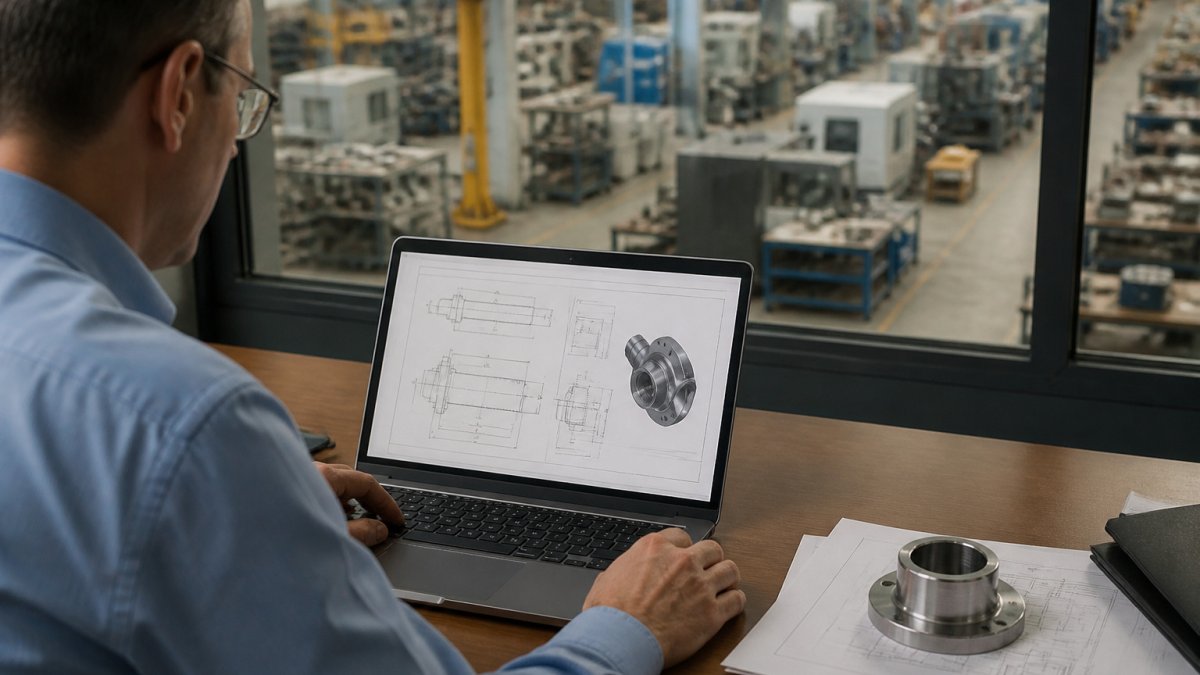
A procurement engineer reviewing a specification sheet is the buyer you want to reach. Make it easy for them to download the sheet, save it, and send it to a colleague. Those small steps build trust before the first call.
Integrating Your Site With CRM, ERP and PIM Systems
Quote forms should flow straight into your CRM so sales can respond quickly. For guidance on moving data safely between systems, read data migration best practices. Product data often lives in a PIM system, and pulling from there keeps specifications consistent across the site and sales materials. ERP connections help with stock and lead-time information, though they require careful planning to avoid showing outdated numbers.
B2B Manufacturing Website Examples and What They Get Right
Strong manufacturing sites tend to share clear product structure and good user experience. Curated collections of 2026 manufacturing websites highlight this pattern, as noted by Valmax’s roundup of top manufacturing websites for industrial B2B.
One redesign case reported a 34% improvement in user engagement and a 41% improvement in inquiry quality, according to W3 Squad’s manufacturing website design case study. Results like these depend on the starting point, so treat them as a direction rather than a guarantee.
Fralock’s redesign focused on search-relevant content, which improved the relevance of quote requests, according to SEO Inc.’s Fralock manufacturing web design case study. The source did not publish a numeric result.
Governance, Accessibility and Measuring What Matters
Enterprise sites often involve several teams and brands. Set clear ownership for content, approvals and updates. Without governance, outdated product pages pile up fast.
Accessibility is also part of responsible design. Check color contrast, keyboard navigation and form labels. For a clear requirements list, see ADA compliance requirements.
Measure what the business cares about: quote requests, qualified leads, and time to find a spec. To test your own site’s accessibility with the right tools, see accessibility testing tools. Track those against a baseline before the redesign so you can see real change.
Planning Your Manufacturing Website Redesign
A redesign works best as a project with clear phases: audit, plan, build, launch, and optimize. A checklist for website redesign can help you cover each stage without missing steps.
Start with a content and catalog audit. Identify which pages drive quote requests and which confuse visitors. Then set priorities and a realistic timeline. A website redesign checklist covers each phase from strategy through launch.
To see where your current website stands, request a free review from Studio Blue Creative.
Frequently Asked Questions
What should a manufacturing company website include?
A manufacturing company website should clearly state what you make, the industries you serve, and the capabilities behind each product line. It needs organized product or service pages with technical specifications, downloadable data sheets, and CAD or material details where buyers expect them. Include a prominent quote request form, contact details for sales and engineering, case studies or project examples, certifications, and a way to find the right person for the buyer’s role. Mobile performance and search visibility matter too, since many buyers begin their research on a phone.
How do you design a website for a manufacturing company?
Start with the buyer journey rather than the company org chart. Map who visits (engineers, purchasing managers, plant operators), what each needs to decide, and where they get stuck. Build an information architecture that moves visitors from broad capability pages to specific product pages and then to a quote request. Keep navigation simple, write plainly about technical capabilities, and test the design with real buyers. Plan the content and the technical build together so the catalog, search and integrations are designed as one system.
How often should a manufacturing company redesign its website?
Most manufacturers should plan a full redesign every three to five years, or sooner if the site cannot support new product lines, mobile use or integrations. Between redesigns, review analytics quarterly, update product pages as specifications change, and fix broken or outdated content continuously. A redesign is warranted when the site slows lead generation, cannot be edited by your team, or fails accessibility checks. Plan migration carefully to protect existing search rankings and inbound links.
Content note: this draft does not include the full external-citation count or the FAQ section; those require review before publication.